Written by Koay Yih Zi
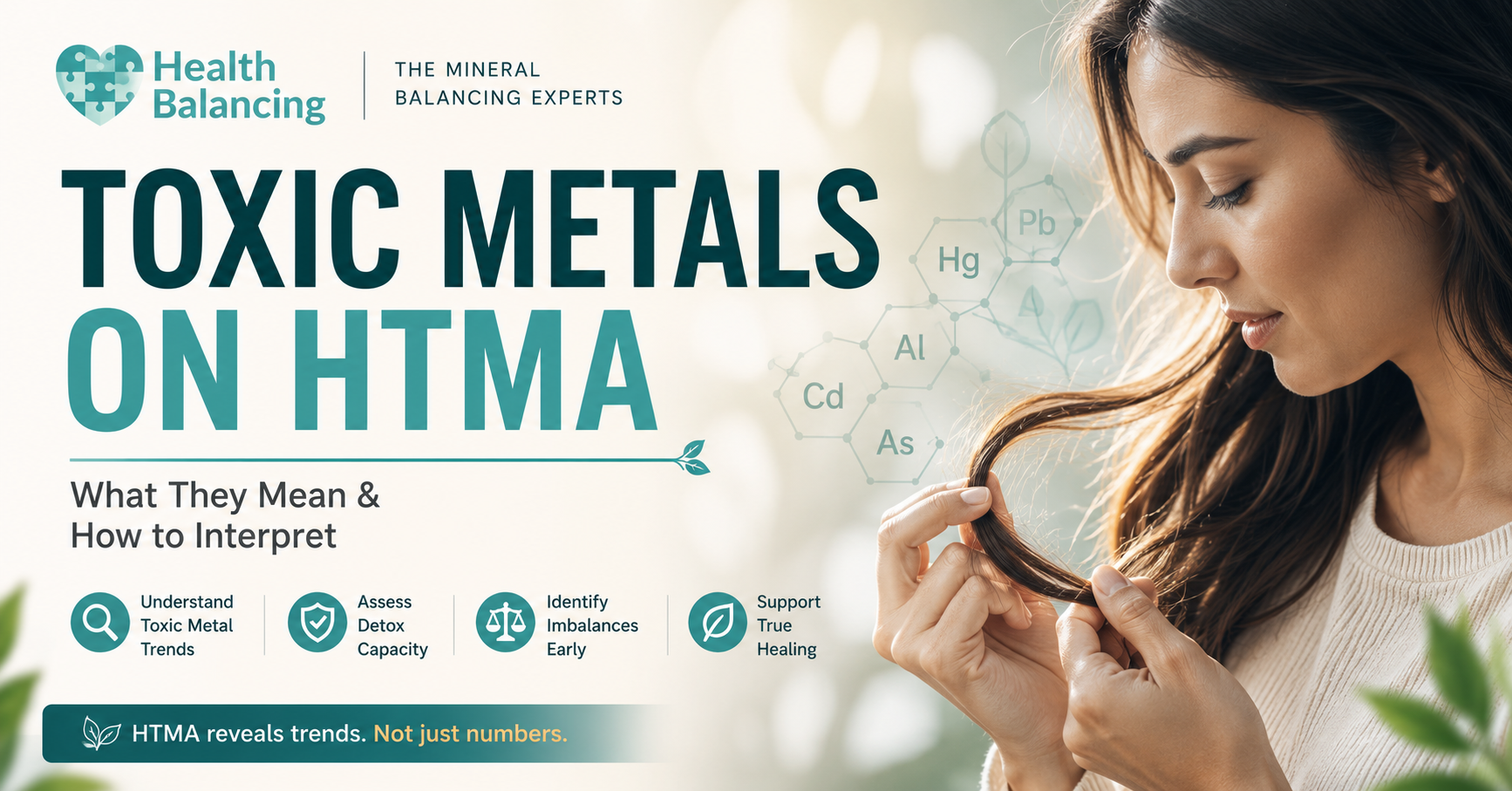
A tissue-level view of exposure, retention, elimination capacity — and stored experience
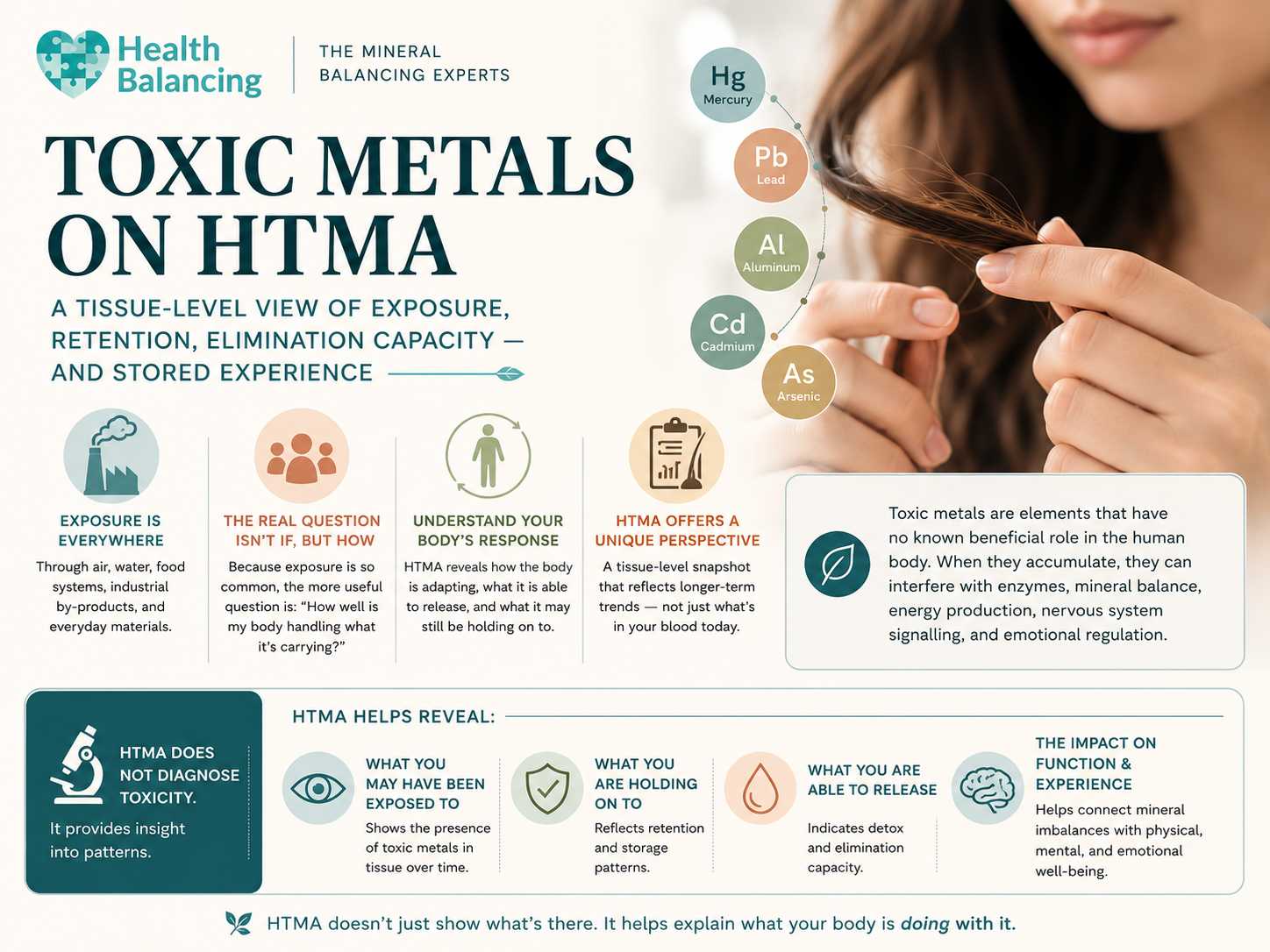
Toxic metals are elements that have no known beneficial role in the human body. When they accumulate, they can interfere with enzymes, mineral balance, energy production, nervous system signalling, and emotional regulation.
In today’s environment, exposure is widespread — through air, water, food systems, industrial by-products, and everyday materials.
Because exposure is now so common, the more useful question is rarely “Have I been exposed?”
It is almost always: “How well is my body handling what it’s carrying?”
This is where Hair Tissue Mineral Analysis (HTMA) offers a distinct and valuable perspective.
HTMA does not attempt to diagnose toxicity.
It helps reveal how the body is adapting, what it is able to release, and what it may still be holding on to.
Article Contents
- Why Toxic Metals Are Difficult to Assess
- What HTMA Actually Measures
- Why Metals Can Appear Low Even When Burden Is High
- The Role of Mineral Status and Stress
- Toxic Metals, Minerals, and Stored Experience
- Poor Elimination as “Holding On”
- Armoring: when elimination temporarily shuts down
- Toxic Metals vs. Toxic Forms of Nutrient Minerals
- Why Metals May Rise on a Retest
- Short Term Exposure vs Long Term Burden
- Common Toxic Metals People Ask About
- If Detox Has Felt Emotionally Intense Before
- Gentle Takeaway
- Frequently Asked Questions
Why toxic metals are difficult to assess
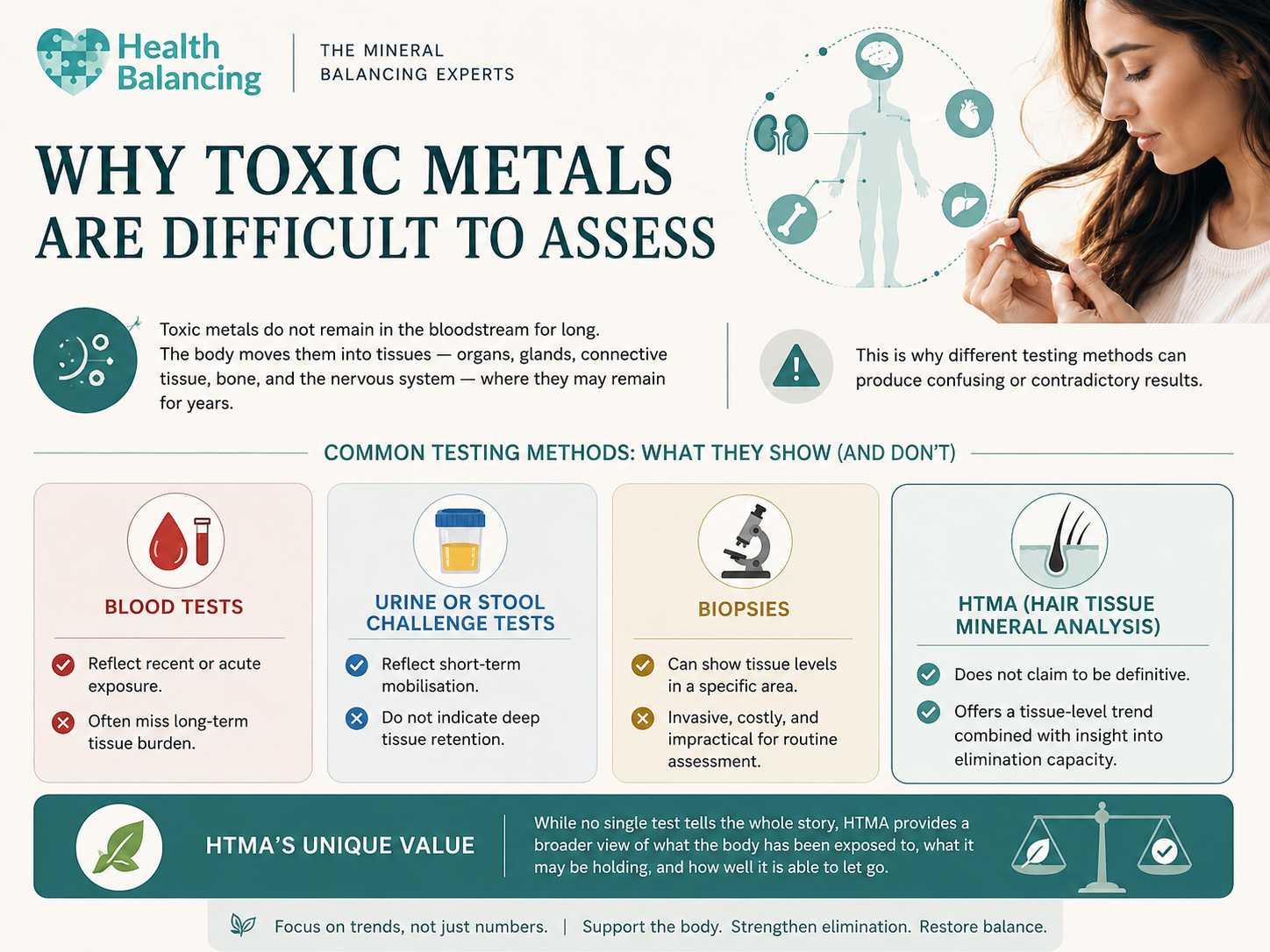
Toxic metals do not remain in the bloodstream for long. The body moves them into tissues — organs, glands, connective tissue, bone, and the nervous system — where they may remain for years.
This is why different testing methods can produce confusing or contradictory results.
Blood tests can reflect recent or acute exposure, but often miss long-term tissue burden.
Urine or stool challenge tests reflect short-term mobilisation, not deep retention.
Biopsies are invasive and impractical for routine assessment.
HTMA does not claim to be definitive. What it offers instead is something many tests do not:
a tissue-level trend combined with insight into elimination capacity.
What HTMA actually measures
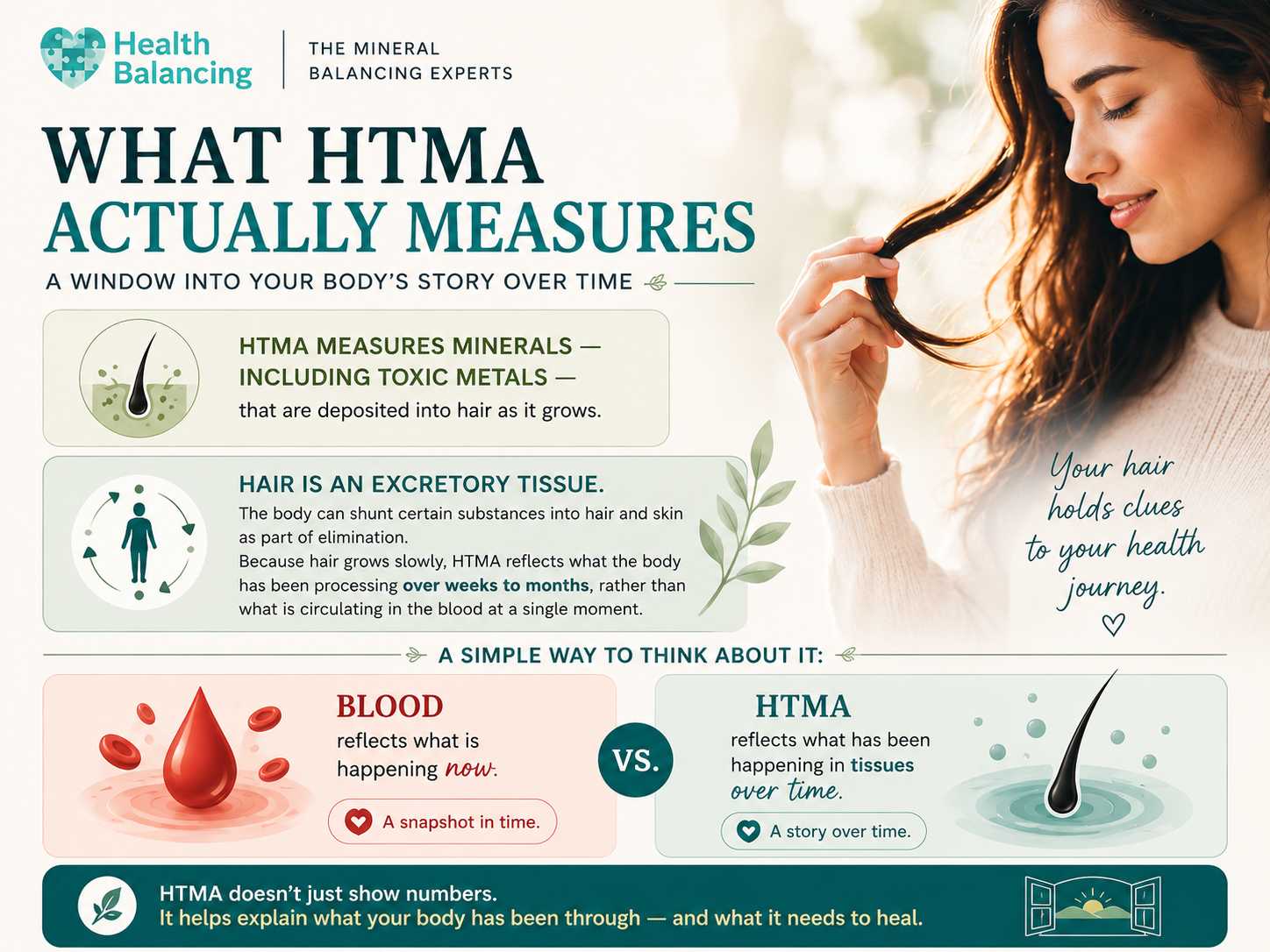
HTMA measures minerals — including toxic metals — that are deposited into hair as it grows.
Hair is an excretory tissue. The body can shunt certain substances into hair and skin as part of elimination. Because hair grows slowly, HTMA reflects what the body has been processing over weeks to months, rather than what is circulating in the blood at a single moment.
A simple way to think about it:
Blood reflects what is happening now.
HTMA reflects what has been happening in tissues over time.
Why metals can appear low even when burden is high
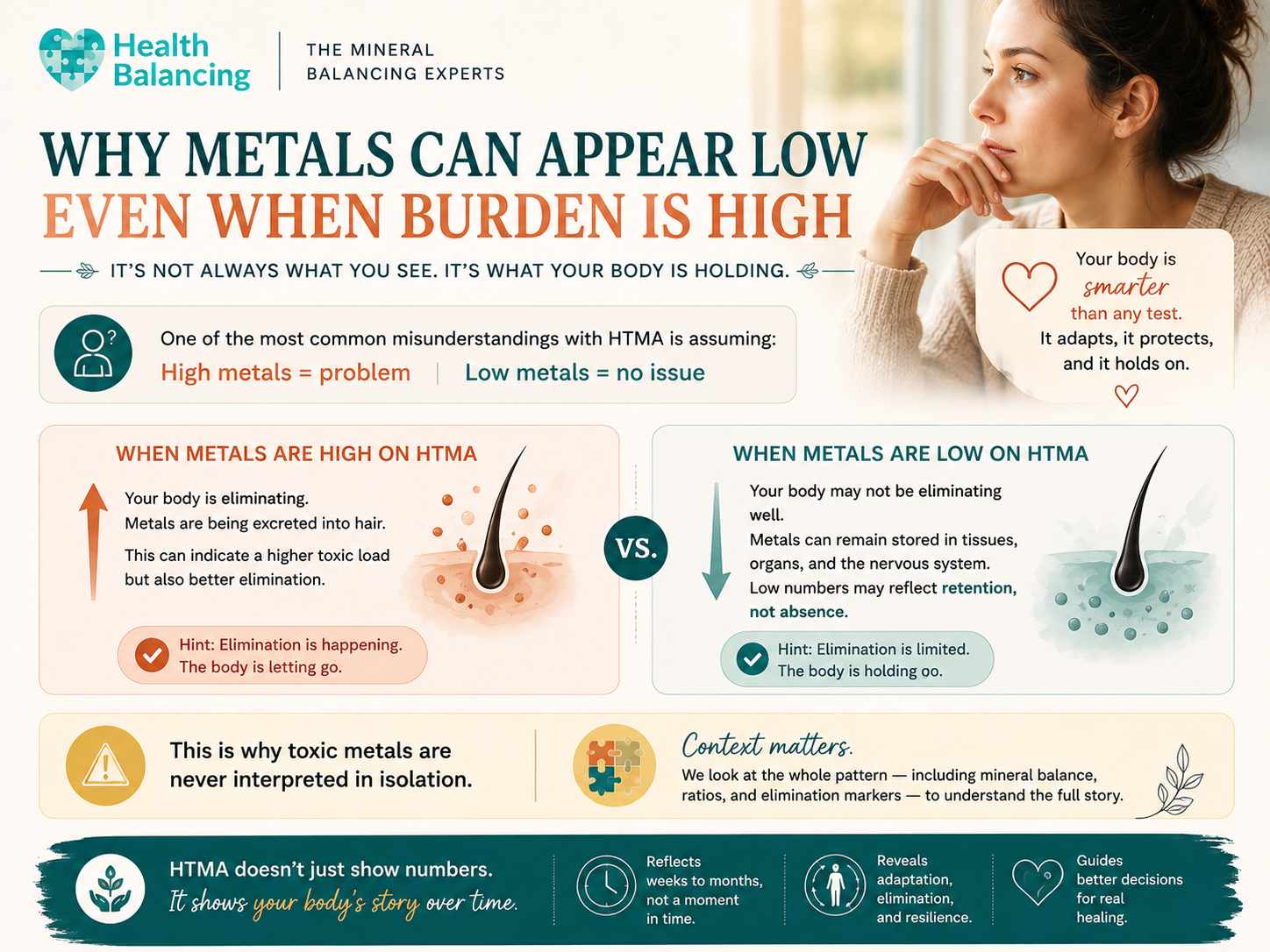
One of the most common misunderstandings with HTMA is assuming:
High metals = problem
Low metals = no issue
In reality, many people are poor eliminators — meaning their bodies do not efficiently excrete toxic metals into hair. In these cases, a report showing few visible metals may reflect retention, not absence.
This is why toxic metals are never interpreted in isolation.
Context matters.
The role of mineral status and stress
Minerals are not just nutrients. They are the foundation of all biological activity.
Hormones, enzymes, neurotransmitters, and even vitamins depend on minerals to function. When essential minerals such as zinc, magnesium, selenium, and others are depleted, the body may temporarily rely on less-preferred substitutes — including toxic metals — to keep vital processes running.
Chronic stress accelerates this process by depleting mineral reserves and suppressing elimination pathways.
For this reason, detox is not simply about removal.
It is about restoring the conditions that allow replacement and release.
Toxic metals, minerals, and stored experience
An often overlooked aspect of toxic metals is that minerals influence more than physical processes. They also affect neurological, emotional, and psychological functioning.
Dr. Paul Eck observed that minerals — both nutrient and toxic — carry specific qualities that influence how the nervous system operates.
Historical and clinical observations support this:
Iron has been associated with anger and reactivity.
Mercury exposure has long been linked to neurological and emotional disturbance.
Copper can stimulate neurotransmitters associated with fear, anxiety, and emotional intensity.
Because of this close relationship between minerals and the nervous system, deep elimination of toxic metals may at times coincide with the release of old emotions, memories, or trauma.
This does not mean memories are “stored in metals” in a literal sense. Rather, minerals influence the tissues, enzymes, and signalling pathways through which emotional patterns are expressed and held.
Just as importantly, the reverse can also be true:
releasing long-held emotional stress can improve the body’s ability to eliminate toxic metals.
Poor elimination as “holding on”
One common HTMA pattern is known as the poor eliminator pattern.
This pattern typically shows:
- very low levels of toxic metals
- alongside very low levels of nutrient minerals
From a functional perspective, this pattern reflects conservation and holding. The body is not readily releasing substances — whether nutrients or toxins.
Importantly, a very low reading does not mean the mineral is absent. It usually means the mineral is sequestered and cannot be easily eliminated. In all cases, the mineral is present in toxic or disruptive amounts.
In this context, poor elimination can be understood not only physiologically, but symbolically:
a system that is not yet ready to let go.
This is not a failure. It is information — and it explains why forcing detox in these states often backfires.
Armoring: when elimination temporarily shuts down
Another pattern sometimes seen on a retest is known as armoring.
Armoring occurs when, on a retest (with unwashed hair), one or more minerals decline into poor or very poor eliminator ranges while the person is actively following a supportive program.
Functionally, this reflects a temporary reduction or redirection of elimination. The body may hold more tightly to substances during periods of stress, metabolic change, or when retracing old imbalances or trauma.
In simple terms, the system “puts on armor” to stabilise before continuing deeper release.
Armoring is not a setback. It is often part of a longer healing sequence.
Toxic metals vs. toxic forms of nutrient minerals
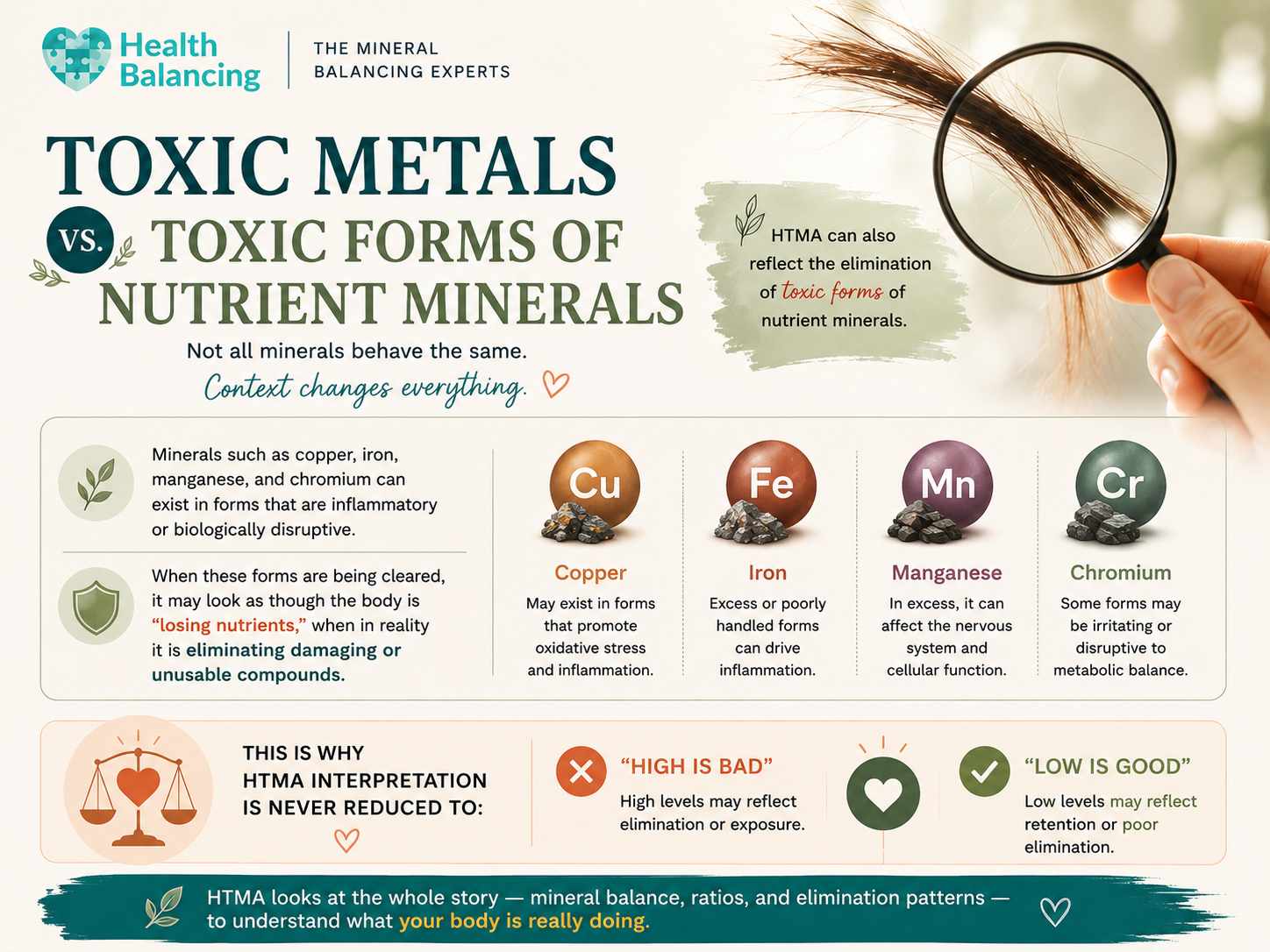
HTMA can also reflect the elimination of toxic forms of nutrient minerals.
Minerals such as copper, iron, manganese, and chromium can exist in forms that are inflammatory or biologically disruptive. When these forms are being cleared, it may look as though the body is “losing nutrients,” when in reality it is eliminating damaging or unusable compounds.
This is one reason HTMA interpretation is never reduced to “high is bad” or “low is good.”
Why metals may rise on a retest
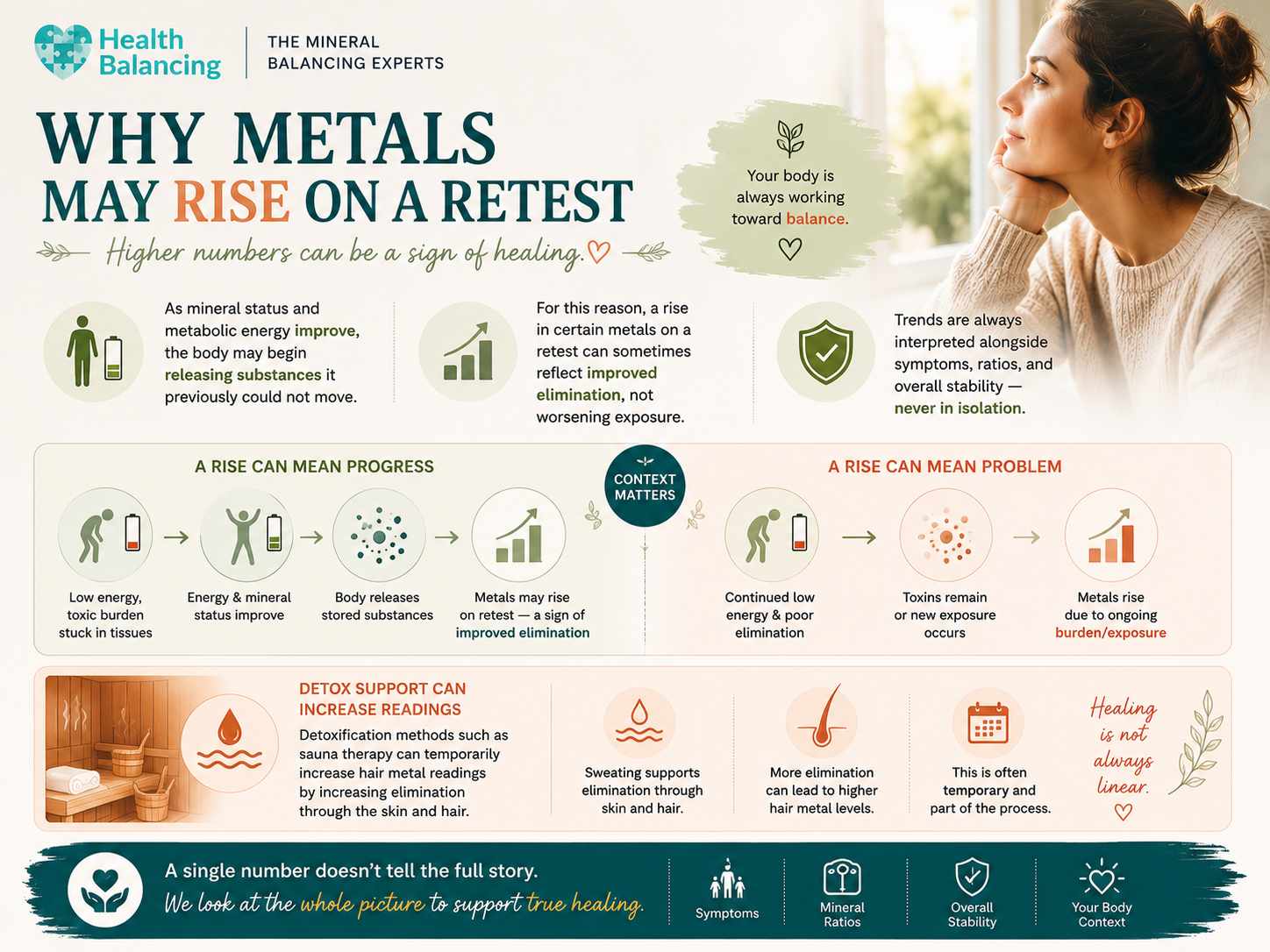
As mineral status and metabolic energy improve, the body may begin releasing substances it previously could not move.
For this reason, a rise in certain metals on a retest can sometimes reflect improved elimination, not worsening exposure.
Detoxification methods such as sauna therapy can also temporarily increase hair metal readings by increasing elimination through the skin and hair.
Trends are always interpreted alongside symptoms, ratios, and overall stability — never in isolation.
Short-term exposure vs. long-term burden
HTMA reflects tissue trends over time, but it can also capture recent exposure patterns.
For example:
- eating larger fish more frequently may show up as higher mercury
- increased rice consumption may show higher arsenic
This is why diet, environment, and timing always matter when interpreting results.
Common toxic metals people ask about
On HTMA reports, people most commonly ask about:
When retained over time, these metals can interfere with energy production, enzyme function, mineral balance, nervous system signalling, and emotional regulation. Their presence does not automatically indicate danger — interpretation always depends on mineral reserves, stress patterns, and elimination capacity.
If detox has felt emotionally intense before
For some people, detox is not only physically challenging — it can feel emotionally stirring.
This is not a sign something is wrong. It often means the system finally has enough safety and support to release what it has been holding.
This is why pacing, nourishment, and nervous system support matter far more than aggressive removal.
Gentle takeaway
HTMA does not diagnose toxicity.
It helps reveal how the body is adapting — physically, neurologically, and emotionally.
Detox is not a battle.
It is a process of rebuilding enough safety, energy, and mineral support to let go — in the right order, and at the right pace.
Frequently Asked Questions