Written by Koay Yih Zi
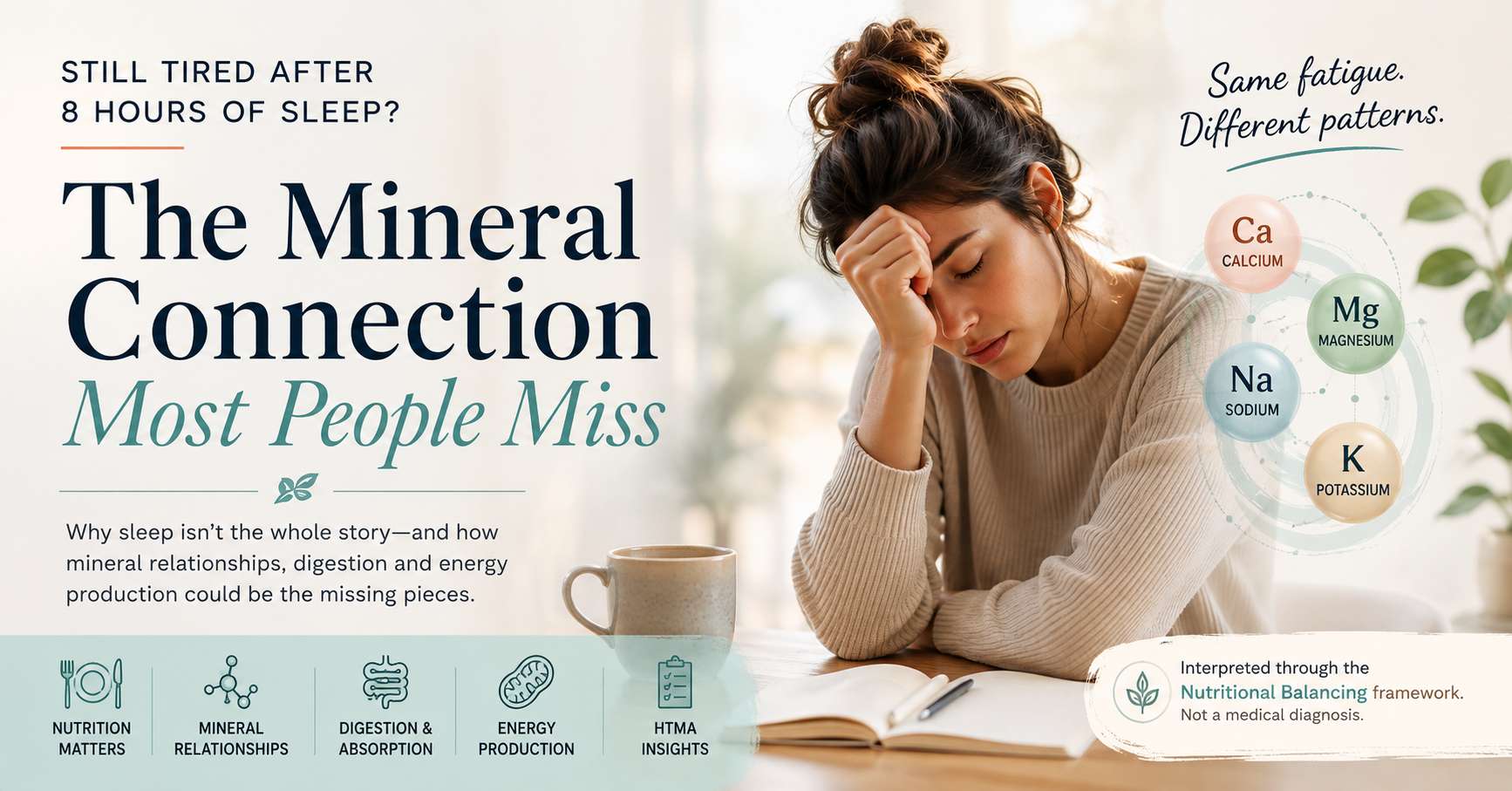
Why Am I Still Tired After 8 Hours of Sleep? The Mineral Connection Most People Miss
If eight hours of sleep consistently leaves you exhausted, sleep may not be the whole problem.
Fatigue despite adequate sleep can have many causes, including poor sleep quality, sleep apnea, anemia, thyroid problems, inadequate nutrition, medications and other health conditions.
But there’s another part of the picture that gets less attention: sleeping enough doesn’t necessarily mean your body has everything it needs to produce and sustain energy.
Energy production depends on a chain of events—from digesting and absorbing nutrients to using them to produce ATP. Minerals such as magnesium, calcium, sodium and potassium are involved throughout this process, and they don’t work independently.
You may have already tried magnesium, iron, B vitamins, electrolytes or supplements marketed for energy—yet you’re still tired.
So perhaps the question isn’t simply:
“What am I deficient in?”
But:
“How are the nutrients and minerals involved in energy production working together?”
Two people can experience similar fatigue while having very different nutritional patterns underneath it. One may feel heavy, sluggish, cold and depleted. Another may be exhausted but anxious, restless and unable to switch off—the familiar “wired but tired” experience.
Same complaint. Potentially very different nutritional picture.
Contents
- Why Am I Still Tired After 8 Hours of Sleep?
- How Does Your Body Actually Make Energy?
- Can Mineral Imbalances Contribute to Fatigue?
- Why Doesn’t Taking More of One Mineral Always Help?
- Which Mineral Relationships Do I Look At?
- Can Two People Have the Same Fatigue but Different Mineral Patterns?
- Why Do I Feel Tired Even Though I Eat Healthy?
- Why Aren’t My Energy Supplements Working?
- Where Does HTMA Fit?
- What Should You Do If You’re Still Exhausted?
- Frequently Asked Questions
Why Am I Still Tired After 8 Hours of Sleep?
Sleeping for eight hours doesn’t necessarily mean you’re getting restorative sleep—or that sleep is the only factor affecting your energy.
Fatigue can have many causes, including poor sleep quality, sleep apnea, inadequate nutrition, anemia, thyroid disorders, medications, mood disorders and other health conditions. Fatigue and sleepiness aren’t quite the same thing either: fatigue can persist despite rest, whereas sleepiness refers more specifically to the tendency to fall asleep. (AAFP)
Common contributors to persistent fatigue include:
- Poor-quality sleep — including sleep apnea or disrupted sleep
- Medical causes — such as anemia, thyroid disorders, medications and other health conditions
- Inadequate nutrition — including insufficient calories, protein or essential nutrients
- Digestion and absorption issues — which can affect how well nutrients are utilized
- Stress and nutritional imbalances — which can affect sleep, digestion, appetite and nutritional needs
If you regularly wake unrefreshed—particularly if you snore, gasp during sleep, wake with headaches or experience significant daytime sleepiness—it’s worth discussing sleep quality with your healthcare provider. Persistent or worsening fatigue also deserves appropriate medical assessment.
Here, we’ll focus on one part of the picture that often receives less attention: nutrition, mineral relationships and energy production.
How Does Your Body Actually Make Energy?
Energy production is a process, not a single switch.
A simplified version looks like this:
Eat → Digest → Absorb → Process → Deliver nutrients to cells → Produce ATP
ATP (adenosine triphosphate) is the usable form of energy that powers cellular processes throughout your body.
Your mitochondria play a central role in producing ATP. But mitochondria aren’t operating in isolation.
Before nutrients can contribute to cellular energy production, you first need to consume them, digest them, absorb them and make them available to your cells.
That means eating a nutritious diet is important—but it doesn’t tell us everything about your nutritional status.
And this is where minerals enter the picture.
Can Mineral Imbalances Contribute to Fatigue?
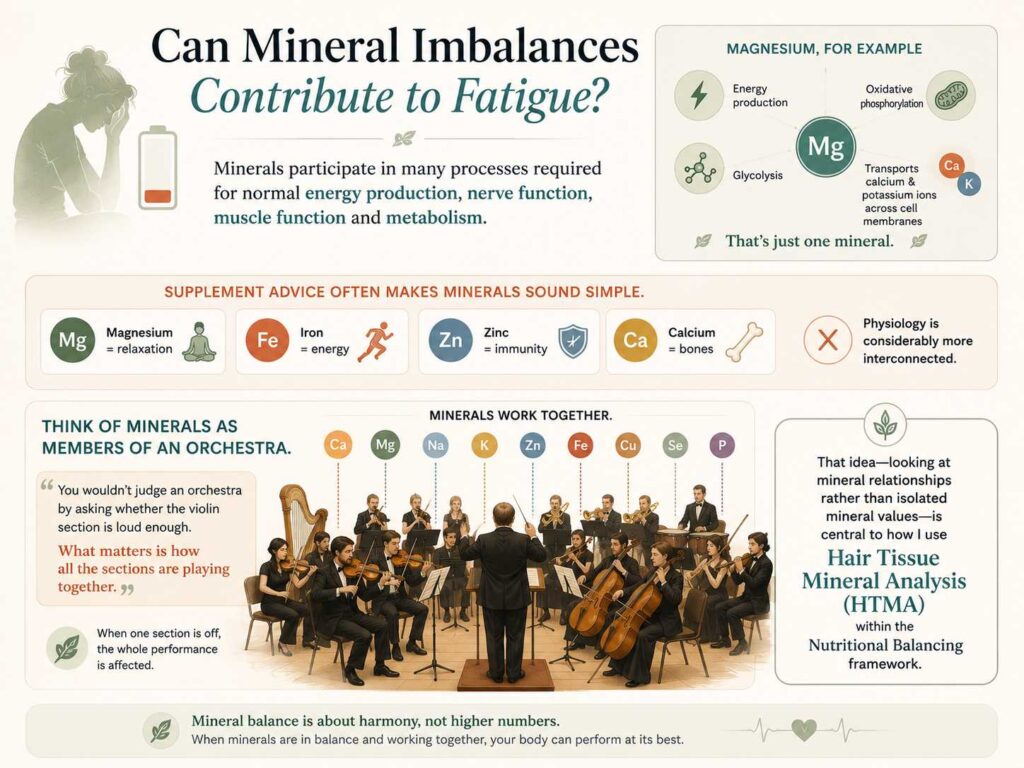
Minerals participate in many processes required for normal energy production, nerve function, muscle function and metabolism.
Magnesium, for example, is required for energy production, oxidative phosphorylation and glycolysis. It also plays a role in transporting calcium and potassium ions across cell membranes. (Office of Dietary Supplements)
That’s just one mineral.
The important point is that nutrients don’t perform their jobs independently.
Yet supplement advice often makes them sound as though they do:
Magnesium = relaxation
Iron = energy
Zinc = immunity
Calcium = bones
Physiology is considerably more interconnected.
I prefer to think of minerals as members of an orchestra.
You wouldn’t judge an orchestra by asking whether the violin section is loud enough. What matters is how all the sections are playing together.
That idea—looking at mineral relationships rather than isolated mineral values—is central to how I use Hair Tissue Mineral Analysis (HTMA) within the Nutritional Balancing framework.
Why Doesn’t Taking More of One Mineral Always Help?
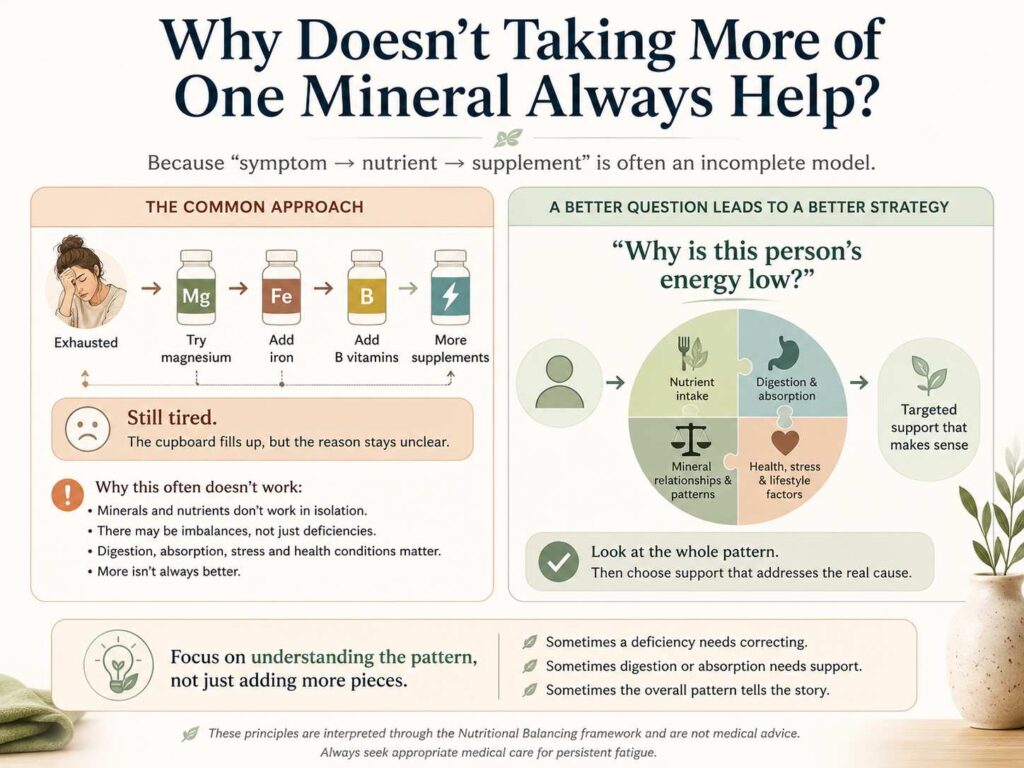
Because “symptom → nutrient → supplement” is often an incomplete model.
Suppose you’re exhausted.
You read that magnesium is involved in energy production, so you take magnesium.
Still tired.
You discover iron deficiency can cause fatigue, so perhaps you add iron.
Then B vitamins.
Then electrolytes.
Then a mitochondrial formula.
Before long, your supplement cupboard resembles a small pharmacy—and you still don’t really know why you’re tired.
Sometimes there is a genuine nutritional deficiency that needs correcting.
Sometimes intake is inadequate.
Sometimes digestion or absorption deserves attention.
Sometimes a medication or medical condition is contributing.
And sometimes looking at the overall nutritional pattern is more useful than continually adding isolated nutrients.
That’s why I prefer asking:
“Why is this person’s energy low?”
rather than:
“Which supplement gives people more energy?”
Those questions sound similar.
They can lead to very different strategies.
Which Mineral Relationships Do I Look At?
Within the Nutritional Balancing framework developed by Dr. Paul Eck, four major minerals receive particular attention:
Calcium (Ca) · Magnesium (Mg) · Sodium (Na) · Potassium (K)
These are not obscure trace elements. They participate in fundamental physiological functions involving nerves, muscles, fluid balance and metabolism.
Within Eck’s framework, however, the interest isn’t simply whether each hair mineral is individually “high” or “low.”
It’s also in their relationships to one another.
The pattern formed by calcium, magnesium, sodium and potassium is used within Nutritional Balancing to classify what Eck called a person’s oxidation rate.
An easy way to understand the concept is to imagine the body’s metabolism as an engine.
An engine can run too slowly.
It can rev too hard.
Or it can run somewhere closer to its appropriate operating range.
This is an interpretive model within Nutritional Balancing—not a diagnosis of thyroid or adrenal disease and not a direct measurement of metabolic rate.
But the model illustrates an important principle:
Not everyone who feels exhausted has the same underlying nutritional pattern.
Can Two People Have the Same Fatigue but Different Mineral Patterns?
Yes—and this is one reason I don’t believe fatigue should automatically lead to the same diet or supplement program for everyone.
Consider two hypothetical people.
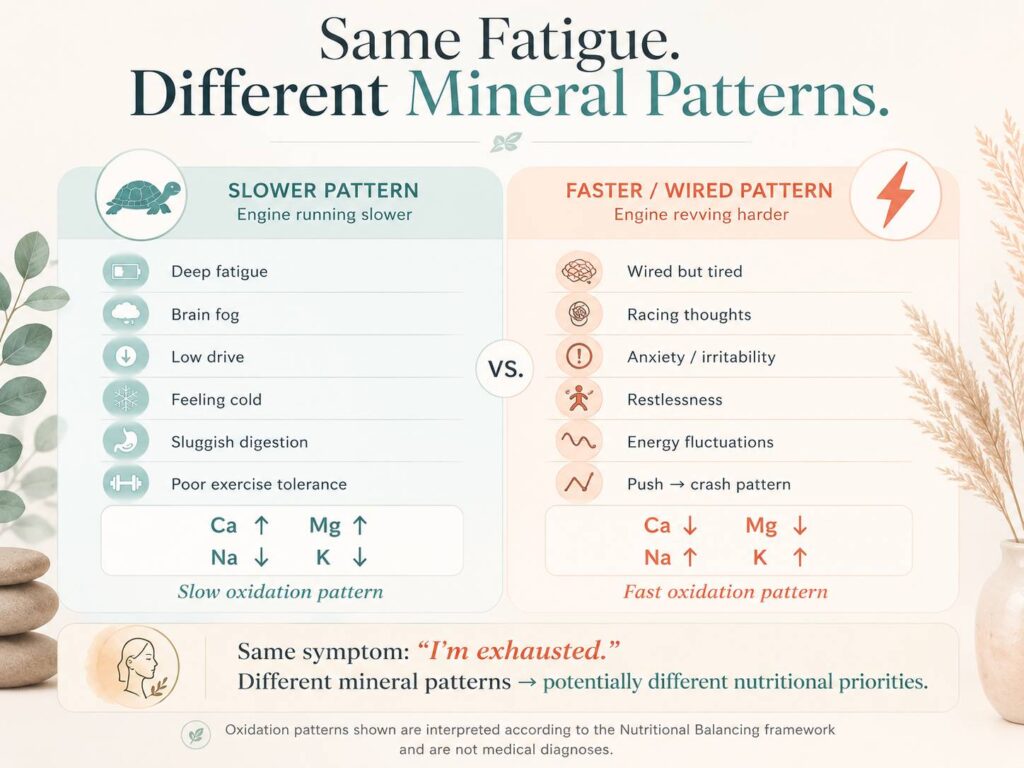
Person A: “My engine feels like it has slowed down.”
This person might describe:
- deep fatigue despite sleeping
- brain fog
- low drive
- feeling cold
- sluggish digestion
- constipation
- difficulty getting going in the morning
- poor exercise tolerance
Within the Nutritional Balancing framework, one pattern that may be considered is slow oxidation.
On HTMA, this is characterized by a particular relationship among calcium, magnesium, sodium and potassium.
Think of the analogy as an engine running too slowly.
Adding more fuel doesn’t necessarily address the reason the engine isn’t generating power efficiently.
Now consider someone who experiences fatigue very differently.
Person B: “I’m exhausted, but I can’t switch off.”
This person may describe:
- feeling wired but tired
- anxiety or irritability
- racing thoughts
- restless sleep
- energy fluctuations
- temporary bursts of nervous energy
- crashing after periods of activity
- relying on caffeine or stimulation to keep going
They may not even look tired.
They can be busy, productive and constantly moving.
But underneath that activity, they feel depleted.
Within the Nutritional Balancing model, faster oxidation patterns have traditionally been described more like an engine revving too hard—burning through available resources rather than producing steady, sustainable energy.
Both people say:
“I’m exhausted.”
But their experience of fatigue is almost opposite.
And that’s the payoff:
The same symptom doesn’t necessarily mean the same nutritional pattern.
Why This Matters for Your Diet
If two people can experience fatigue differently, giving everyone the same “energy diet” doesn’t make much sense.
One person may benefit from adjusting protein intake.
Another may need changes to meal composition or timing.
One may tolerate large amounts of raw vegetables and fibre beautifully.
Someone experiencing bloating, constipation or poor digestion may struggle with exactly the same diet.
This doesn’t mean there is a special diet that can be determined from fatigue symptoms alone.
It means context matters.
And “healthy” isn’t always synonymous with appropriate for this person right now.
Why Do I Feel Tired Even Though I Eat Healthy?
Because eating nutritious food is only the first step.
You still have to digest it, absorb the nutrients and make them available for your body to use.
This becomes particularly relevant when fatigue appears alongside:
- bloating
- constipation
- poor appetite
- digestive discomfort
- restrictive eating
- multiple food sensitivities or intolerances
If you have a beautifully planned diet but struggle to digest or tolerate it, simply adding more “superfoods” may not solve the problem.
And continually eliminating foods can create another problem: the supposedly healthy diet becomes increasingly restrictive.
Clinical guidance on fatigue similarly recommends considering nutritional status and warns against excessively restrictive eating patterns when evaluating physiological causes of fatigue. (AAFP)
Sometimes the next nutritional intervention isn’t removing another food.
It’s understanding what your body actually needs—and what it can currently handle.
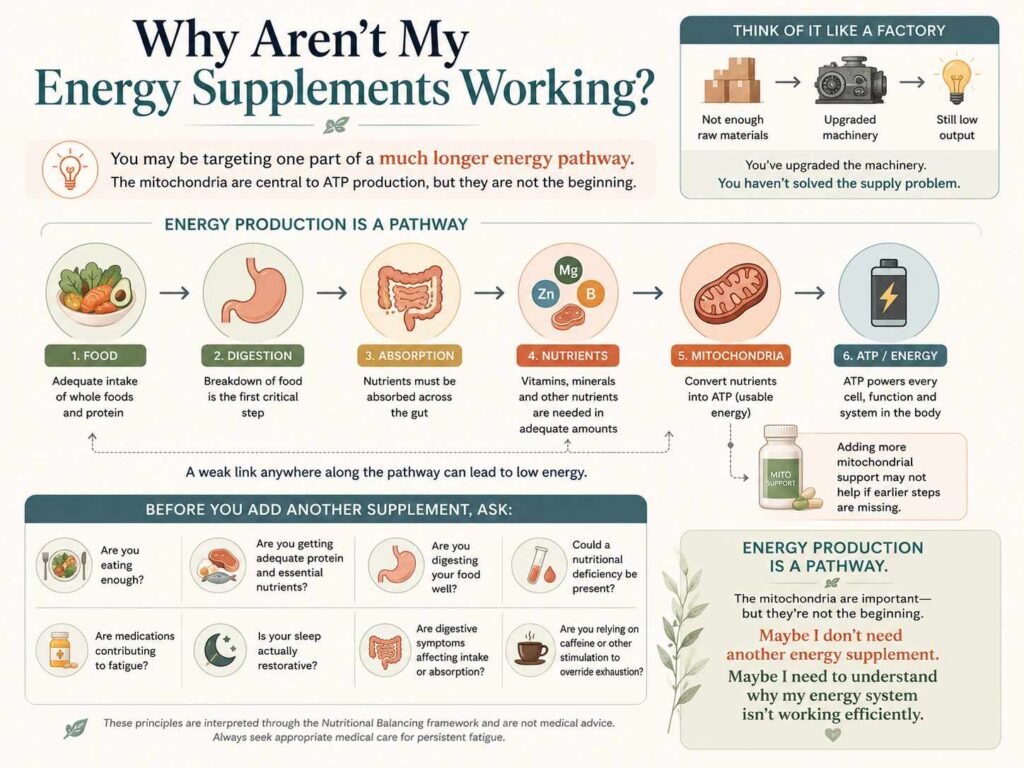
Why Aren’t My Energy Supplements Working?
One possibility is that you’re targeting one part of a much longer energy pathway.
Mitochondria are central to ATP production. But imagine installing a more efficient engine in a factory that isn’t receiving enough raw materials.
You’ve upgraded the machinery. You haven’t solved the supply problem.
Before adding more “mitochondrial support,” it makes sense to ask:
- Are you eating enough?
- Are you getting adequate protein and essential nutrients?
- Are you digesting your food well?
- Could a nutritional deficiency be present?
- Could medications be contributing?
- Is your sleep actually restorative?
- Are digestive symptoms affecting food intake or absorption?
- Are you relying on caffeine or stimulation to override exhaustion?
Energy production is a pathway. Supporting one part of it doesn’t necessarily address what may be limiting it elsewhere.
Where Does HTMA Fit?
Hair Tissue Mineral Analysis (HTMA) measures the concentrations of selected elements in a hair sample.
I use HTMA as one additional layer of information within a broader nutritional assessment.
It does not diagnose why someone is tired.
It does not diagnose thyroid disease, adrenal disease, anemia, sleep apnea, depression, ME/CFS or other medical causes of fatigue.
And it doesn’t replace appropriate blood testing or medical evaluation.
Within the Nutritional Balancing framework, I use HTMA to examine patterns and relationships between minerals alongside:
Symptoms + Diet + Digestion + Lifestyle + Stress + Medical History + Laboratory Investigations + HTMA
Rather than seeing one low mineral and automatically trying to replace it, I’m interested in questions such as:
What are the major mineral relationships?
What broader pattern do they form?
Does that pattern make sense alongside the person’s symptoms, diet and lifestyle?
What nutritional priorities emerge when all of those findings are considered together?
That’s a very different approach from using HTMA as a stand-alone diagnostic test.
What Should You Do If You’re Still Exhausted?
Start by taking persistent fatigue seriously.
Fatigue has a wide range of possible causes, and evaluation should be guided by your symptoms, medical history, medications, sleep, nutritional status and other relevant findings rather than indiscriminately ordering every possible test. (AAFP)
But if you’ve already spent months trying to solve the problem by sleeping longer, eating “healthier” and adding more supplements, consider changing the question.
Instead of:
“What else can I take for energy?”
ask:
“What might be preventing my body from producing and sustaining energy effectively?”
That opens the door to looking at sleep quality, medical contributors, nutritional adequacy, digestion and absorption, stress—and the relationships between nutrients rather than simply chasing individual deficiencies.
Because:
Energy isn’t created by one mineral.
Fatigue isn’t always caused by one deficiency.
And two exhausted people don’t necessarily need the same nutritional strategy.
That’s the central idea behind the way I approach mineral balancing.
If your exhaustion has become persistent and is affecting your day-to-day functioning, read more about chronic fatigue and the factors that may contribute to it.
Frequently Asked Questions
Want to Explore the Mineral Side of Fatigue?
Want to Explore Your Own Mineral Patterns?
If you’ve ruled out obvious causes of fatigue but still don’t understand why your energy hasn’t returned, Hair Tissue Mineral Analysis can provide another layer of information.
Rather than looking at one nutrient in isolation, HTMA allows us to examine your mineral levels, mineral relationships and broader patterns alongside your symptoms, diet, digestion and lifestyle.
This article is for educational purposes only and is not intended to diagnose, treat or cure any medical condition. Persistent, severe, worsening or unexplained fatigue should be evaluated by an appropriate healthcare professional.