Your simple guide to the test that reveals what’s really going on inside your body.
Is HTMA scientifically valid?
Hair Tissue Mineral Analysis has been used for decades to assess mineral patterns and toxic metal exposure. It is commonly used as a wellness assessment tool to evaluate long-term mineral balance and stress patterns.
What can HTMA detect?
HTMA may reveal mineral imbalances, oxidation rate patterns, stress-related mineral depletion, and toxic metal accumulation such as mercury, lead, and aluminum.
How far back does HTMA show?
Hair testing generally reflects mineral patterns over the previous 3–4 months, depending on hair length and growth rate.
Can HTMA detect heavy metals?
Yes. HTMA may detect toxic metals including mercury, lead, aluminum, cadmium, and arsenic. Learn more about hair testing for heavy metals.
How is HTMA different from blood tests?
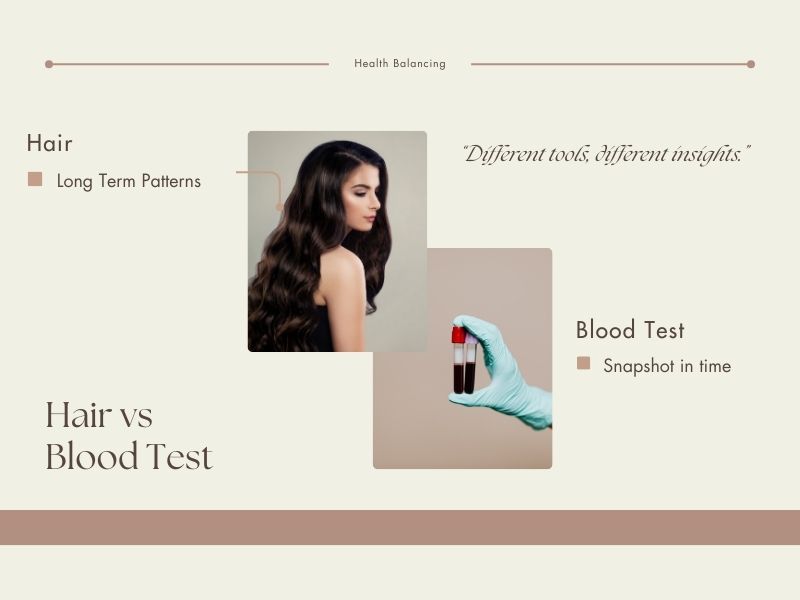
Blood tests provide a short-term snapshot of what is circulating in the bloodstream, while HTMA reflects longer-term mineral patterns stored in tissues. Read more about HTMA vs blood tests.
How often should HTMA be repeated?
Many people repeat HTMA every 3–6 months to track progress and changes in mineral balance over time.
Does dyed, treated, or chemically processed hair affect HTMA results?
Chemically treated hair can interfere with HTMA accuracy, which is why practitioners typically ask for hair as close to its natural state as possible, ideally from the scalp area where regrowth reflects the most recent few months of mineral activity. Hair acts as a recording medium, growing slowly and capturing the minerals your cells have been using or losing over time — so anything altering the hair’s chemical structure, such as bleach or strong dye treatments, can distort that record. If hair has been recently treated, it’s best to flag this when submitting a sample so the lab and practitioner can account for it when interpreting calcium, magnesium, sodium, and potassium levels, along with any toxic metal readings.
Why does HTMA focus on mineral ratios instead of just individual mineral levels?
HTMA focuses on ratios because minerals don’t function in isolation — they interact in chains that determine how efficiently the body produces and uses energy. Too much calcium can slow metabolism down, while low sodium combined with low potassium may reflect a stressed or depleted state rather than either mineral being a standalone problem. A single mineral reading in isolation, such as calcium, doesn’t reveal much on its own, but its relationship to magnesium, sodium, or potassium can provide additional context when assessing oxidation rate, stress response, and nervous system function. This is why Dr. Eck, the pioneer behind modern HTMA, emphasised relationships between minerals as an important part of interpreting the overall pattern rather than focusing on individual numbers alone.
What is "oxidation type" and why does it matter for interpreting HTMA results?
Oxidation type refers to how quickly or slowly your body is burning fuel for energy, and it’s one of the core patterns HTMA reveals. A faster oxidation rate means the metabolic engine runs hot, while a slower rate means the body is conserving energy by applying the brakes — both patterns show up through specific mineral ratios on the hair report. Knowing someone’s oxidation type allows a Nutritional Balancing practitioner to recommend foods, supplements, and lifestyle adjustments matched to how that person’s body is actually functioning, rather than using a one-size-fits-all approach. This is part of why HTMA is described as a chemistry-based roadmap rather than a simple pass-or-fail test.
Is HTMA useful for people whose blood tests come back "normal" but who still feel unwell?
Yes, this is one of the main reasons people turn to HTMA, since it’s designed to identify mineral patterns that may not be apparent from standard blood tests. Blood tests provide a snapshot of what is circulating in the blood at a particular point in time, while HTMA reflects minerals incorporated into hair during its growth — providing a longer-term view of mineral patterns. Mineral depletion or changes in mineral status may develop over time without producing an obvious abnormality in a single blood test. For example, magnesium can appear normal in blood while hair shows a different mineral pattern that may warrant further investigation alongside symptoms, diet, history, and other relevant tests. This can make HTMA relevant for people experiencing fatigue, brain fog, anxiety, or burnout even when standard laboratory results appear within normal ranges.
Can HTMA results explain emotional symptoms like anxiety or low motivation, not just physical fatigue?
Yes, HTMA’s mineral patterns may provide context for both physical energy and aspects of emotional wellbeing. Dr. Eck’s approach views energy as fundamentally chemical, with mineral relationships influencing how the body produces and uses energy. From this perspective, imbalances in mineral relationships may be associated with changes in motivation, mood, and stress tolerance. For instance, high copper combined with low zinc is considered within Nutritional Balancing to be relevant to patterns involving anxiety, inflammation, or hormonal function, while imbalances in sodium and potassium may be associated with feeling “wired but tired” or having reduced stress tolerance. This is why HTMA is often used as more than a nutrient checklist — it provides a framework for considering mineral relationships alongside physical symptoms, emotional wellbeing, diet, and other relevant factors.
What happens after receiving HTMA results — is it just a report, or does it come with guidance?
HTMA results can be accompanied by a personalised plan, not just raw data. After the lab analyses the hair sample and produces a report showing mineral levels, ratios, and patterns, the findings can be translated into practical recommendations covering diet, supplementation, and lifestyle changes based on the person’s mineral patterns and overall nutritional needs. This may include nutrient-dense meals, targeted supplements such as Endo-Met formulations, and lifestyle adjustments that support rest, recovery, and healthy detoxification processes. The aim is to turn mineral pattern information into practical next steps rather than leaving someone to interpret the numbers alone.
Is there an ideal length or amount of hair needed for an accurate HTMA test?
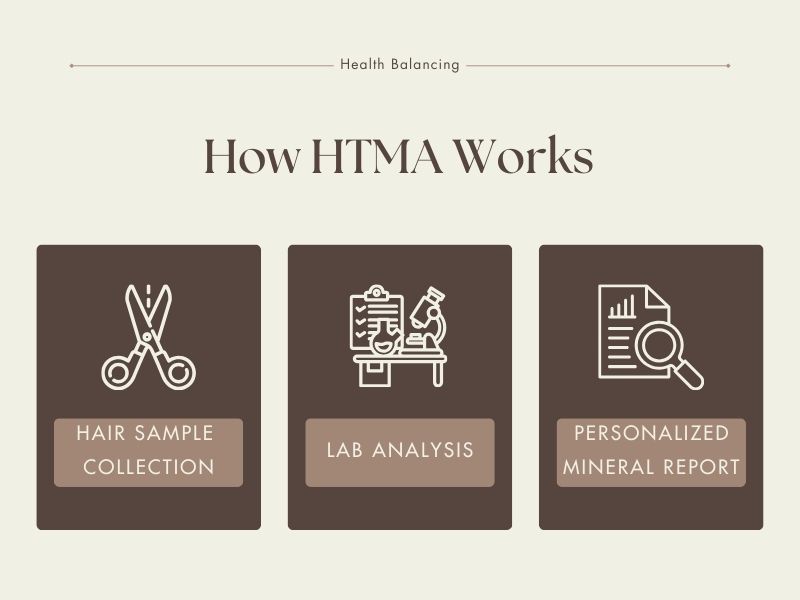
A small hair sample, roughly equivalent to a tablespoon when collected, is generally sufficient for HTMA testing. The process is simple and non-invasive: collecting the sample, sending it to a certified lab such as Analytical Research Labs for digestion and analysis, and then receiving a detailed report on mineral levels and ratios. Because hair grows gradually, sampling close to the scalp is intended to reflect the more recent period of hair growth. Specific collection instructions are usually provided by the practitioner to ensure the sample is taken correctly for lab analysis.
Are there people for whom HTMA is not particularly useful or appropriate?
HTMA is described as a wellness assessment tool rather than a diagnostic test, so it isn’t intended to replace medical evaluation for diagnosing disease. People with acute medical concerns should still seek appropriate clinical care alongside or instead of HTMA. HTMA may be relevant when someone is experiencing patterns such as chronic fatigue, burnout, brain fog, anxiety, poor stress tolerance, sleep issues, or signs of nutritional depletion associated with prolonged stress. Because HTMA reflects mineral patterns rather than providing a diagnosis, it’s most useful as one piece of a broader picture of someone’s stress, metabolic, and nutritional status, ideally interpreted alongside professional guidance.