

Frequently Asked Questions
Is detoxification something the body switches on and off, or is it always happening?
Detoxification is a constant biological process that never fully switches off — the body is continuously working to identify, neutralize, and eliminate toxins as part of normal metabolic function. What changes isn’t whether detox is occurring, but how smoothly and safely it proceeds, which depends heavily on energy availability, mineral reserves, and nervous system state. This distinction matters because it reframes common detox approaches: rather than trying to “trigger” or “kickstart” detox with an intense protocol, the more useful question becomes whether the body currently has what it needs to eliminate comfortably. HTMA is used specifically to assess this underlying capacity, rather than to determine whether detox itself is happening.
What mineral patterns are commonly linked to poor detox tolerance?
Several specific HTMA patterns are commonly associated with poor detox tolerance, stronger reactions, or stalled elimination: a Three or Four Lows pattern, low sodium and potassium levels, an unbalanced sodium-to-potassium ratio, a very slow oxidation rate, and general impaired elimination patterns. These patterns don’t indicate that something is fundamentally wrong — they typically reflect what the body is prioritising first, such as stability, energy conservation, and nervous system regulation, ahead of active elimination. Recognising one or more of these patterns on a hair test helps explain why detox has felt harder than expected for some people, and signals that rebuilding capacity may need to come before elimination is pushed forward.
Why does detox timing matter more than which detox method I choose?
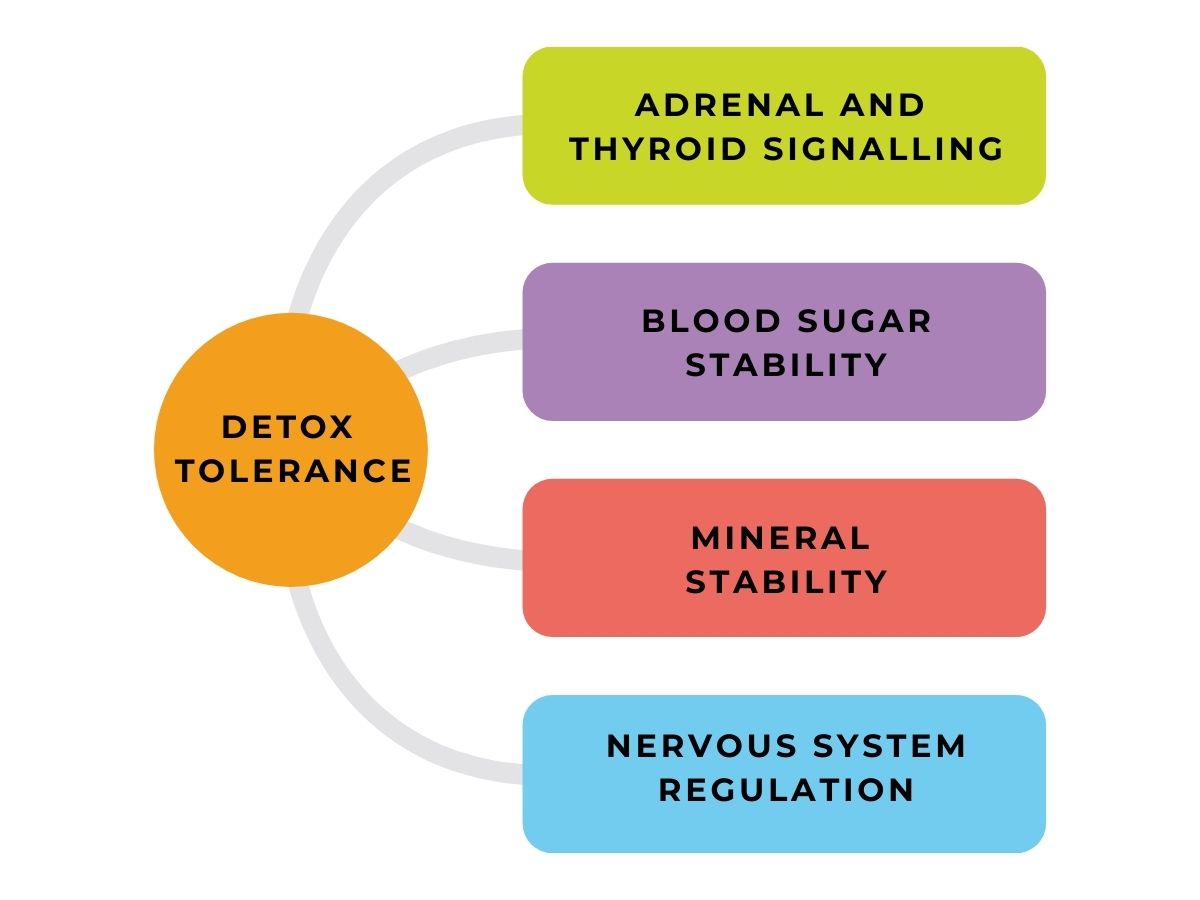
Timing matters more than method because detox tolerance is shaped by underlying factors — adrenal and thyroid signalling, blood sugar stability, mineral availability, and nervous system regulation — that determine whether any given approach will be well tolerated, regardless of how gentle or “natural” it claims to be. This is why some people feel noticeably better with gentle detox support, while others experience the same protocol as overwhelming or worsening. Choosing the right method matters less than choosing the right moment, which is why nutritional balancing prioritises restoring energy, regulation, and mineral reserves first, using timing as the primary safety mechanism rather than relying on any particular detox technique to be inherently safe.
Can HTMA tell me if my toxic metal levels are dangerous or how "toxic" I am?
No — Hair Tissue Mineral Analysis does not diagnose toxicity or measure how dangerous your toxic metal levels are. Instead, it provides insight into tissue-level mineral status, stress patterns, and elimination capacity, which is a fundamentally different kind of information than a toxicity diagnosis. This distinction matters because detection on an HTMA doesn’t equal danger — toxic elements often become visible on a hair test specifically when the body has enough capacity to start moving them, not necessarily at the moment exposure occurred. Understanding this difference helps prevent the common, fear-driven misreading of hair test results as an urgent toxicity alarm rather than as useful context about readiness and timing.
What does it mean if my body seems to be "prioritising stability" instead of actively detoxing?
It means the body has assessed that it doesn’t yet have sufficient energy, regulation, or mineral reserves to eliminate toxins comfortably, and is instead focusing resources on maintaining basic stability first. This isn’t a sign of dysfunction — patterns like Three or Four Lows, low sodium and potassium, or very slow oxidation reflect a functional, protective response to depletion, not a body that has “failed” at detoxing. In practice, this often shows up as detox attempts triggering stronger reactions, fatigue, or feeling worse rather than better. Recognising this pattern is useful because it shifts the goal from pushing elimination harder toward rebuilding the underlying capacity the body needs before elimination can happen smoothly.
How does nutritional balancing decide when someone is ready for detox?
Nutritional balancing determines detox readiness by evaluating the same factors that influence detox tolerance — adrenal and thyroid signalling, blood sugar stability, mineral reserves, and nervous system regulation — rather than assuming everyone is ready for the same protocol at the same time. This structured, mineral-based approach prioritises restoring energy, regulation, and reserves before actively encouraging elimination, since attempting detox before these foundations are in place is a common reason people feel worse rather than better. In practice, this often means addressing patterns like low sodium and potassium or slow oxidation first, allowing detox to occur naturally and gradually once the body has genuinely regained the capacity to handle it.
What's the difference between a genuine detox reaction and my body simply not being ready for detox?
A genuine detox reaction typically reflects the body actively releasing and processing stored toxins, while a “not ready” reaction usually reflects insufficient reserves or regulation to handle that release comfortably — the two can look similar on the surface but stem from different underlying states. This is part of why HTMA patterns like low sodium and potassium, a Three or Four Lows pattern, or very slow oxidation matter: they indicate a body that’s more likely to react strongly or feel worse when elimination is pushed, rather than one that’s simply processing normally. Distinguishing between these states typically requires looking at the broader mineral and stress pattern rather than symptoms alone, which is why professional HTMA interpretation is often used to guide this decision.
Is heavy metal detox safe to attempt without professional guidance?
Attempting aggressive heavy metal detox without guidance carries real risk, particularly for people whose bodies aren’t currently equipped to eliminate comfortably — pushing elimination before adequate energy, minerals, and nervous system regulation are in place is a common reason detox backfires rather than helps. This is different from detox happening naturally in the background, which the body does continuously as part of normal function. Rather than forcing a protocol based on generic advice, an appropriately paced approach — informed by tools like HTMA that assess mineral reserves and stress patterns — helps identify whether someone’s body is currently positioned to handle active detox support, or whether rebuilding capacity should come first.