
Frequently Asked Questions
What's the difference between a mineral pattern and a mineral ratio on HTMA?
A mineral ratio compares two individual minerals to reveal how the body is responding right now to stress, energy demands, and recovery, while a mineral pattern looks at the broader picture — how much overall reserve and capacity the body has to work with. Ratios are the moment-to-moment signal; patterns are the wider adaptive state built up over months or years of stress, depletion, or compensation. A single ratio like sodium-to-potassium might flag reduced stress tolerance, but a pattern such as Four Lows shows that this reduced tolerance is happening alongside broader depletion across multiple minerals. On a Hair Tissue Mineral Analysis, both are read together — ratios inform the details, while patterns provide the context needed to choose an appropriately paced approach.
Can someone have more than one mineral pattern at the same time?
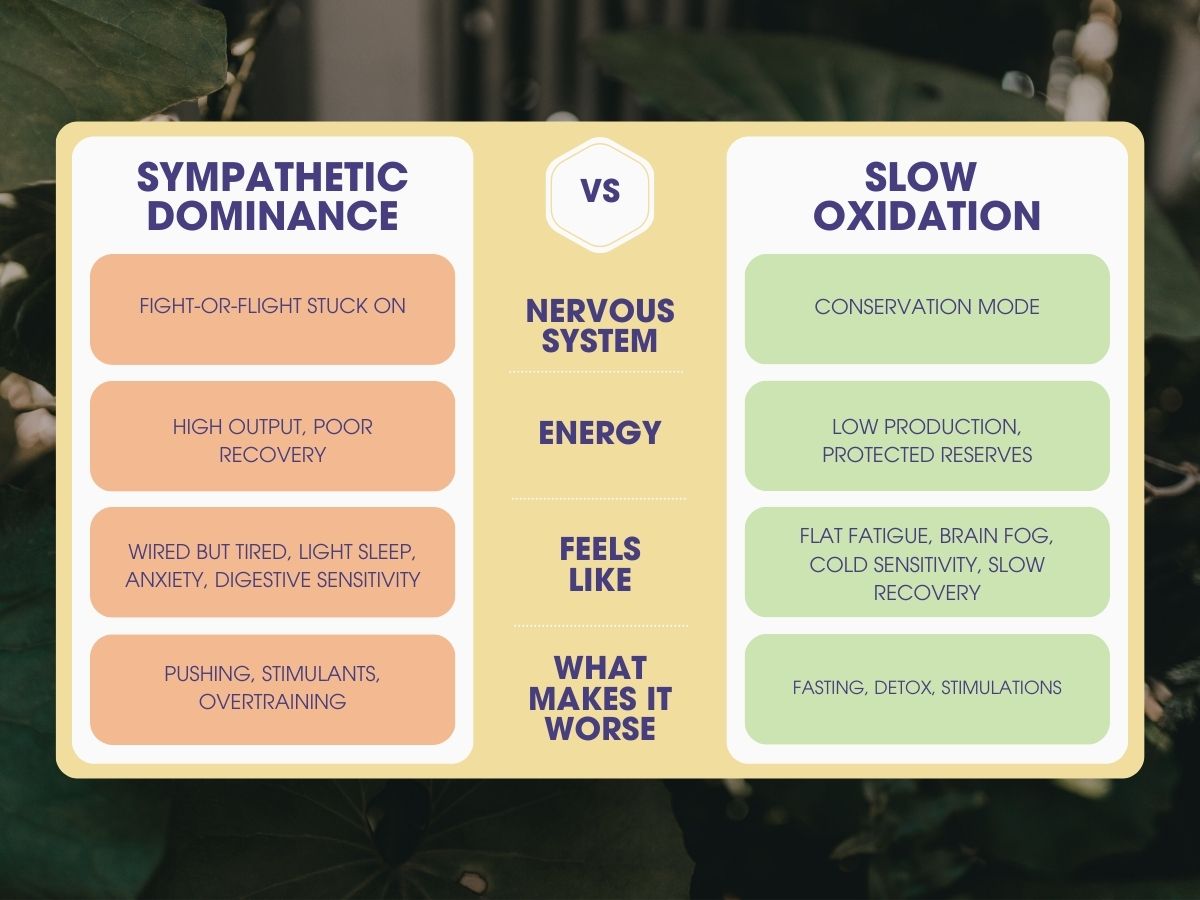
Yes — patterns often overlap rather than existing in isolation, since they all describe different aspects of how the body has adapted to sustained stress. For example, someone experiencing Sympathetic Dominance (a nervous system stuck in fight-or-flight) can also show Slow Oxidation (a slowed metabolic pace) or an Impaired Detox pattern at the same time, because all three can stem from the same underlying depletion. Rather than needing to isolate a single “correct” label, an HTMA is read holistically, looking at how multiple patterns interact to explain the fuller picture of symptoms. This is part of why two people with similar complaints, like fatigue or anxiety, may need very different approaches — their overlapping patterns aren’t identical even when their symptoms sound the same.
Why does detoxing sometimes make people feel worse instead of better?
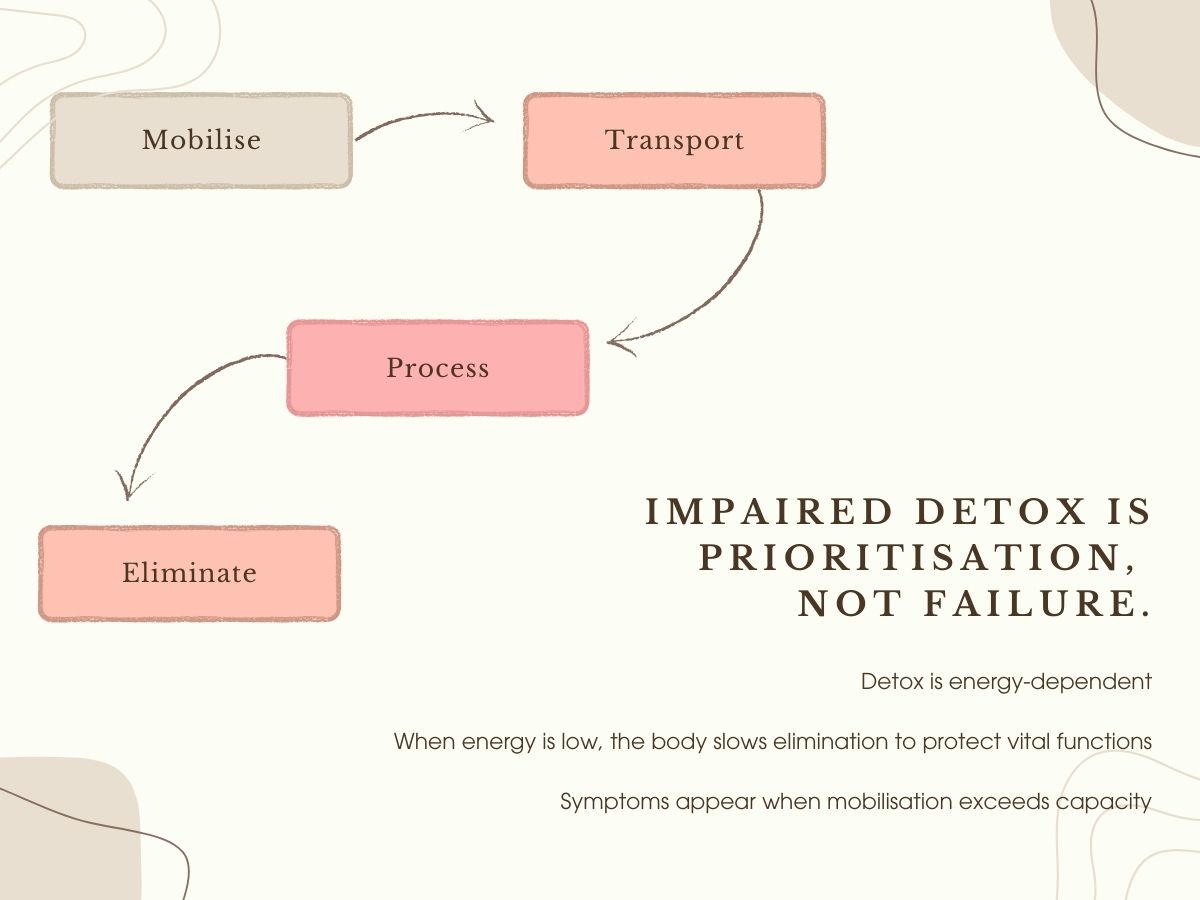
Detoxification can sometimes worsen symptoms because it is an energy-dependent process, and when nutritional reserves are low or the body is under significant stress, more aggressive approaches may be poorly tolerated. Within the Nutritional Balancing framework, this may be described as an Impaired Detox pattern, in which detoxification is considered less efficient when the body’s resources are limited. Pushing a cleanse or aggressive protocol too quickly can therefore trigger stronger reactions rather than relief. This does not necessarily mean that detoxification has “failed” or that something is wrong; it may indicate that the approach is not well tolerated at that point. Recognising this pattern through HTMA may help inform whether additional detox-focused support is appropriate or whether nutritional foundations should be prioritised first.
Why does the Four Lows pattern look concerning, but not necessarily mean something is seriously wrong?
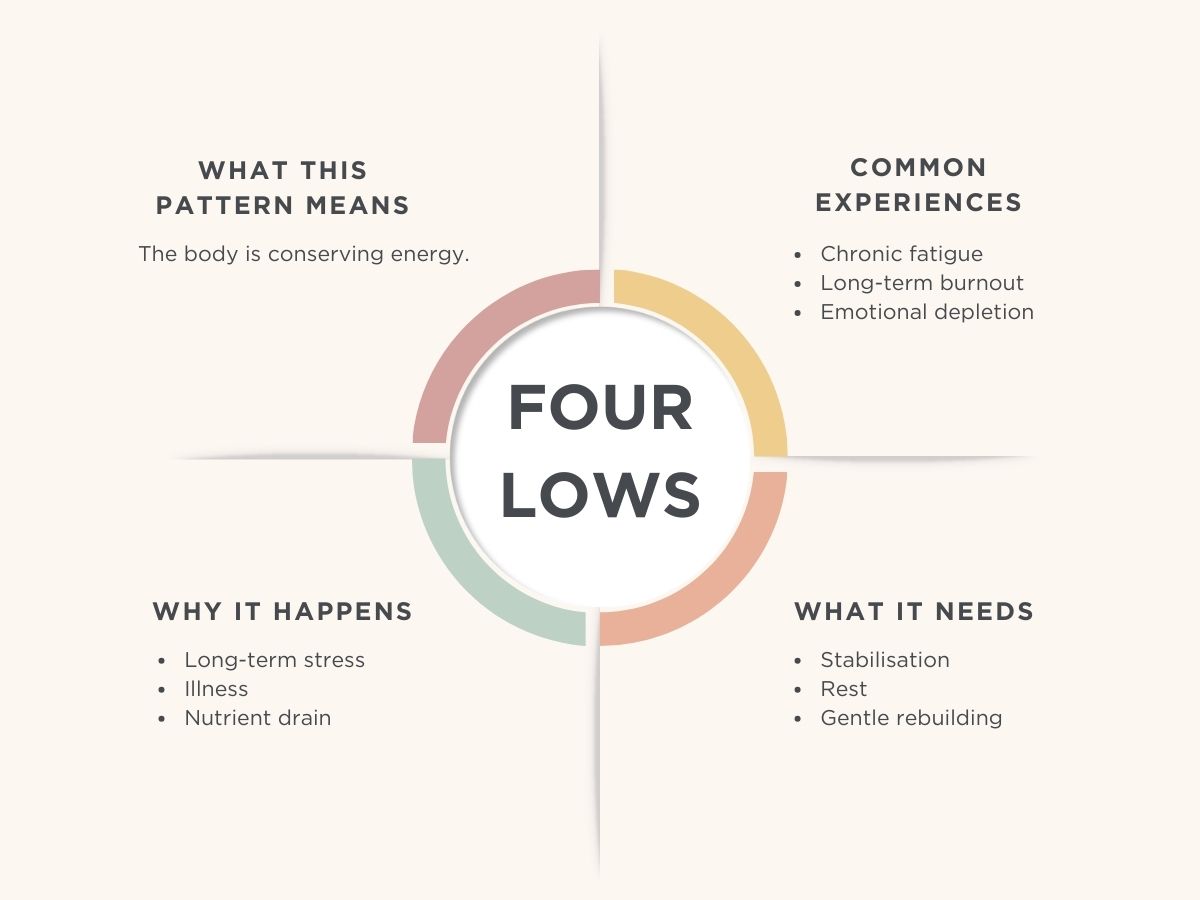
The Four Lows pattern looks concerning because it shows calcium, magnesium, sodium, and potassium all below ideal ranges at once, which can appear alarming on paper. However, this pattern typically reflects a system that has been quietly compensating and surviving under long-term physical or emotional depletion, rather than one that is acutely failing. It’s commonly seen in chronic fatigue and long-term burnout, where the body has been stretched thin for an extended period without adequate rebuilding. Because it represents deep, cumulative depletion rather than a sudden crisis, recovery from this pattern typically isn’t approached with intensity — it calls for stabilisation, rest, and gentle, gradual rebuilding of mineral reserves rather than aggressive correction.
How is the Burnout pattern different from the Low Sodium & Potassium pattern?
Burnout reflects a depleted stress response where the adrenal and metabolic systems no longer rebound efficiently, often showing up as exhaustion that doesn’t resolve with rest and strong reactions to caffeine or supplements. The Low Sodium & Potassium pattern is more specifically tied to reduced adrenal signaling and stress tolerance, commonly presenting as blood sugar instability or difficulty tolerating change or pressure. In practice, they frequently occur together, since low sodium and potassium are often part of what produces the burnout picture — but Burnout describes the broader functional state, while Low Sodium & Potassium points to a more specific mineral-level driver behind it. Both are read as reduced capacity rather than personal failure, and both typically call for pacing and rebuilding rather than pushing through.
Do mineral patterns change over time, and can they be tracked with retesting?
Yes — mineral patterns are adaptive states, not fixed or permanent labels, which means they can shift as stress load decreases and mineral reserves are rebuilt. Since Hair Tissue Mineral Analysis reflects roughly three months of tissue-level mineral activity, retesting at intervals allows a pattern to be tracked over time, showing whether reserves are recovering or whether the body is still compensating in the same way. This is one of the more encouraging aspects of pattern-based interpretation: a Four Lows or Burnout pattern identified today isn’t expected to stay static, but is instead used as a starting point for a nutritional balancing program aimed at gradually restoring capacity, with progress checked through follow-up testing rather than assumed.
Is a mineral pattern on HTMA the same as a medical diagnosis?
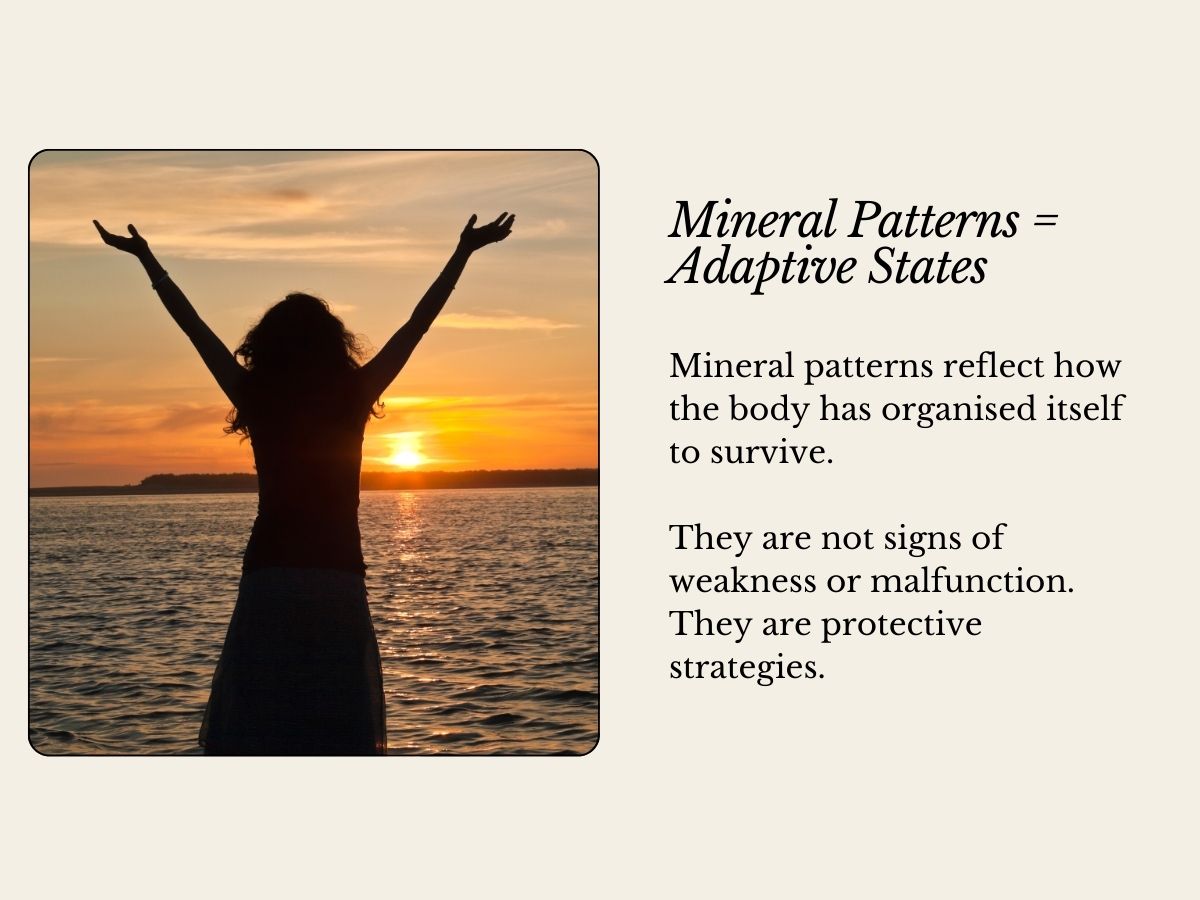
No — mineral patterns are explicitly not diagnoses; they’re a way of describing adaptive states the body has developed in response to prolonged stress, illness, or depletion. A pattern like Sympathetic Dominance or Slow Oxidation doesn’t identify a disease, but instead provides context for why certain symptoms are showing up and what kind of support the body can currently tolerate. This distinction matters practically: because nutritional balancing is not a means of diagnosis, treatment, or cure for any condition, patterns are used to guide gentle, appropriately paced rebalancing of body chemistry — with the understanding that as balance improves, many associated symptoms tend to resolve on their own rather than being treated directly.
Why doesn't "doing everything right" — diet, exercise, supplements — always improve symptoms?
This happens because when the body is in a depleted mineral pattern, standard health advice can be mistimed rather than incorrect, and doesn’t account for what the body can realistically handle right now. Timing and appropriateness often matter more than intensity or effort — stimulation, intense exercise, or aggressive supplementation can help one pattern while actively destabilising another. For example, someone in a Slow Oxidation or Burnout pattern may find that pushing harder deepens exhaustion rather than resolving it, even while following generally sound health practices. Recognising the underlying pattern through HTMA reframes the goal from applying more effort to matching support to actual capacity, which is why identical routines can produce very different results for different people.