Written by Koay Yih Zi
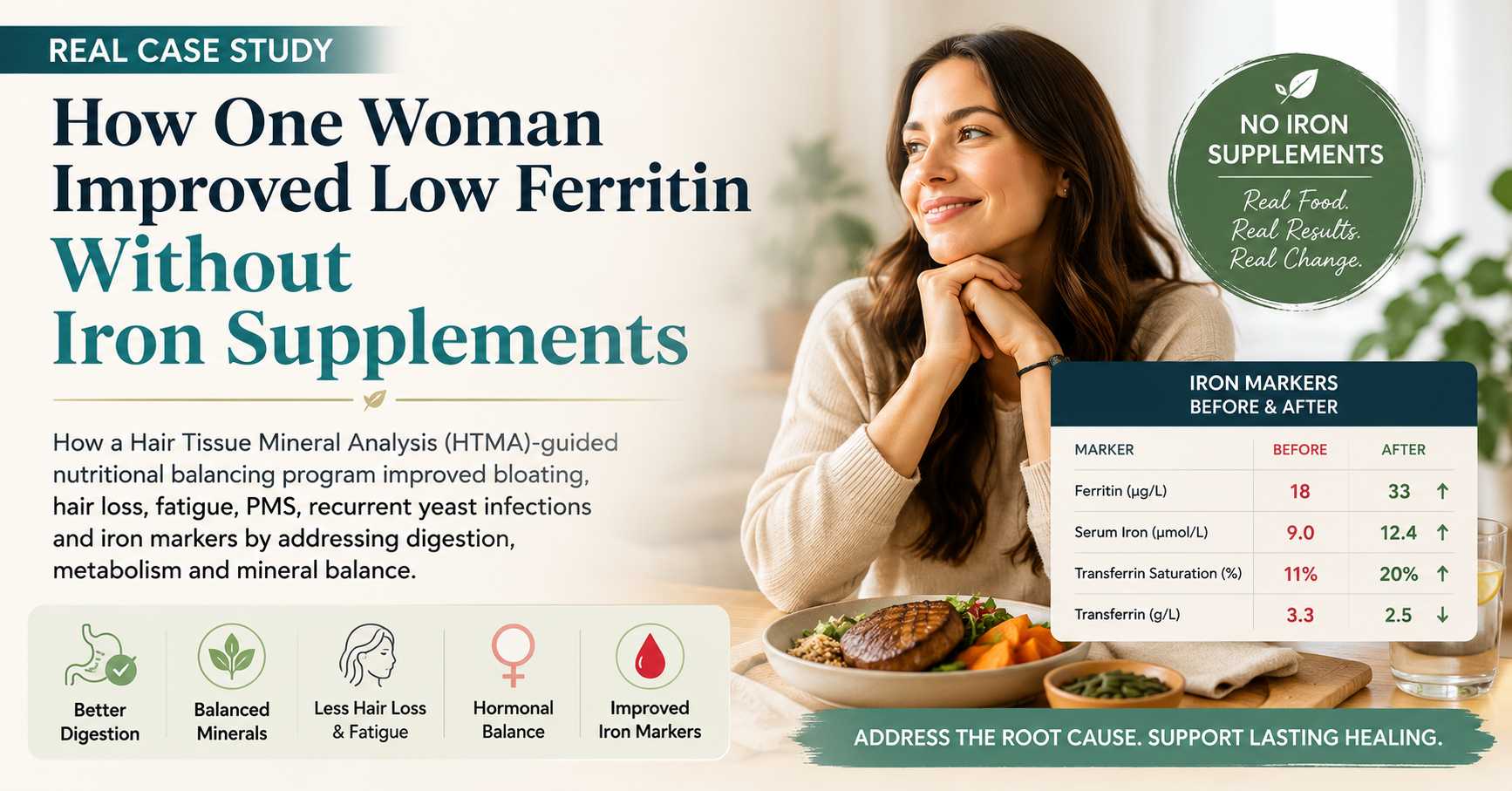
How a Hair Tissue Mineral Analysis (HTMA)-guided nutritional balancing program improved bloating, hair loss, fatigue, PMS, recurrent yeast infections and iron markers by addressing digestion, metabolism and mineral balance.
This case study is shared for educational purposes. The client’s name and identifying details have been anonymised to protect their privacy.
Contents
- Key Results at a Glance
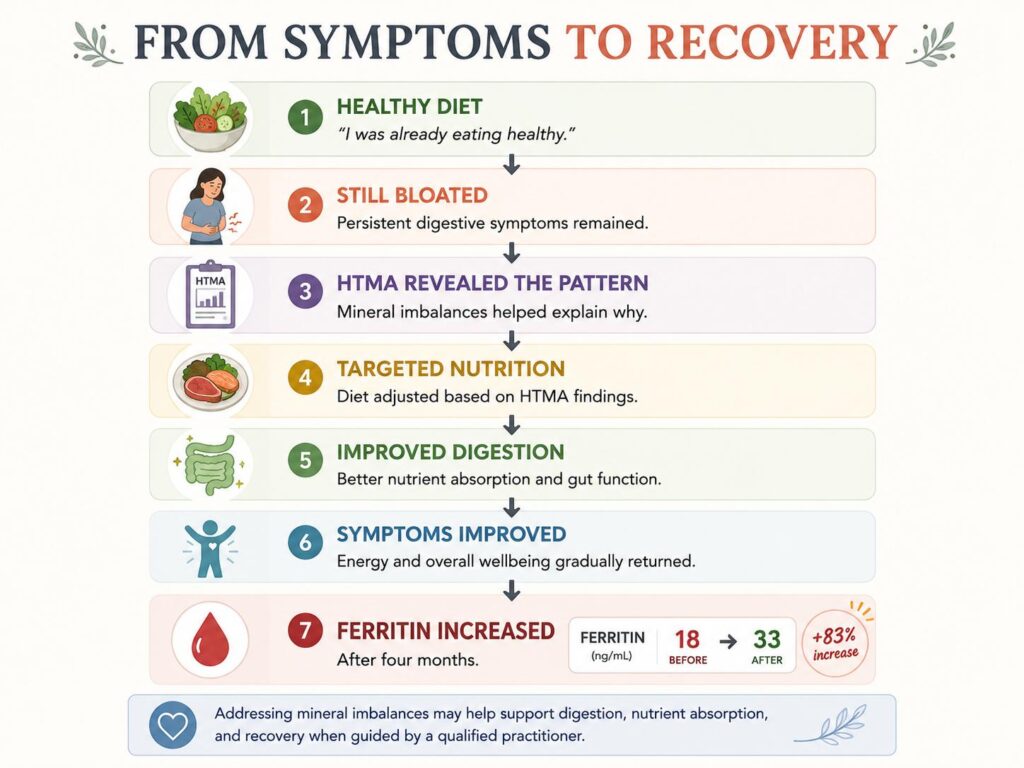
- Introduction: “I Was Already Eating Healthy”
- Meet Sarah
- Why Her Healthy Diet Wasn’t Working
- What Her Hair Tissue Mineral Analysis Revealed
- Why We Didn’t Focus on Iron Supplements
- Supporting Metabolism with Animal Protein
- Why We Reduced Many “Healthy Foods”
- Why We Simplified the Diet
- The Importance of Digestive Support
- Four Months Later
- What This Case Teaches
- Frequently Asked Questions
Key Results at a Glance
After approximately four months on a personalized nutritional balancing program:
Laboratory improvements
| Marker | Before | After |
|---|---|---|
| Ferritin (µg/L) | 18 | 33 |
| Serum Iron (µmol/L) | 9.0 | 12.4 |
| Transferrin Saturation (%) | 11 | 20 |
| Transferrin (g/L) | 3.3 | 2.5 |
Symptom improvements
✔ Significant improvement in bloating
✔ PMS completely resolved
✔ Menstrual cramps much more manageable
✔ Hair loss decreased
✔ Fatigue resolved
✔ No recurrent vaginal yeast infections
Most notably, these improvements occurred without taking an iron supplement.
Introduction: “I Was Already Eating Healthy”
If you’ve ever thought:
“I’m already eating healthy… why am I still bloated, exhausted and losing my hair?”
this story may sound familiar.
Sarah wasn’t living on processed food.
She avoided gluten.
She avoided refined sugar.
She exercised regularly.
She cooked most of her own meals.
She ate oats, berries, seeds, chicken and vegetables.
Yet she still struggled with:
- persistent bloating
- two failed rounds of antibiotics for SIBO
- low ferritin
- hair loss
- fatigue
- recurrent vaginal yeast infections
- PMS
- menstrual cramps
Many people in this situation simply assume they need another supplement.
Instead, we asked a different question.
What if the problem wasn’t simply what she was eating—but how well her body was able to digest, absorb and utilize those nutrients?
Meet Sarah
Sarah, a 29-year-old office worker came to us after struggling with digestive symptoms for more than two years.
Her main concerns included:
Digestive
- Persistent bloating
- Positive SIBO breath test
- Suspected SIFO
Hormonal
- Premenstrual syndrome
- Menstrual cramps
- Recurrent vaginal yeast infections
Energy & appearance
- Hair loss
- Fatigue
- Brain fog
- Mood swings
Blood testing also showed:
- Ferritin: 18 μg/L
- Serum iron: 9.0 μmol/L
- Transferrin saturation: 11%
She had already completed two courses of antibiotics for SIBO without lasting improvement.
Why Her Healthy Diet Wasn’t Working
This is where the story becomes interesting.
Sarah wasn’t eating fast food.
She wasn’t drinking soft drinks every day.
She wasn’t living on sweets.
In fact, many nutrition professionals would probably describe her diet as excellent.
Breakfast
- Oat pancakes
- Bananas
- Berries
- Chia seeds
Lunch
- Chicken breast
- Rice or potatoes
- Broccoli
- Carrots
- Zucchini
Snacks
- Whole nuts
- Kiwi
- Apples
- Oranges
Dinner
- Homemade millet bread
- Pumpkin seeds
- Tomatoes
- Cucumber
- Chicken
- Eggs
She also drank coffee with coconut milk.
Looking at this diet alone, most people would expect excellent health.
Yet her symptoms continued.
This highlights an important principle:
A food can be healthy, but still not be the right food for your current physiology.
Rather than asking whether these foods were healthy, we asked whether they matched her current metabolic state and digestive capacity.
What Her Hair Tissue Mineral Analysis Revealed
Blood tests tell us what is happening.
Hair Tissue Mineral Analysis (HTMA) helps us understand why the body may be struggling to recover.
Rather than measuring one nutrient in isolation, HTMA evaluates mineral relationships to identify nutritional patterns affecting metabolism, stress adaptation, digestion and nutrient utilization.
Five findings stood out.
1. Her Metabolism Had Slowed
Sarah showed mild slow oxidation, together with a very high calcium-to-potassium ratio.
In HTMA this suggests reduced thyroid and adrenal activity and a slower metabolic rate.
When metabolism slows, the body often produces less cellular energy.
That can influence:
- digestion
- tissue repair
- hormone production
- immune resilience
- nutrient utilization
Instead of trying to stimulate metabolism with caffeine or sugar, the goal became gradually rebuilding metabolic activity.
2. Her Mineral Reserves Were Depleted
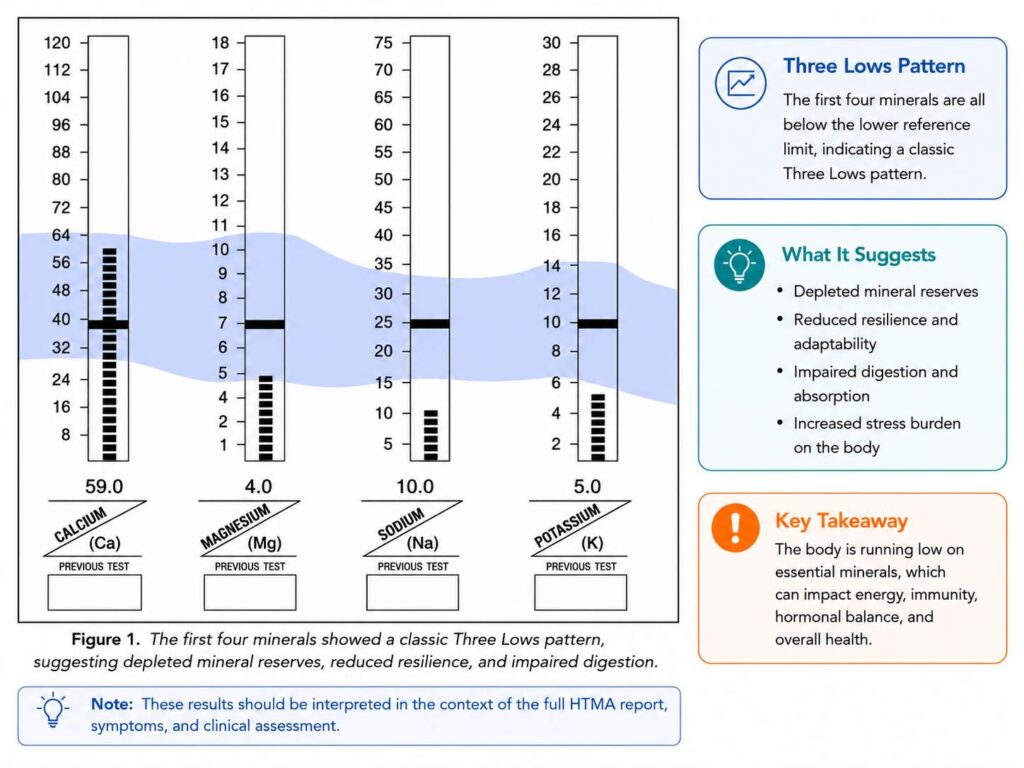
She also showed a Three Lows pattern, together with low sodium and low potassium.
This pattern suggests depleted mineral reserves and reduced adaptive capacity.
Think of it as trying to renovate a house with very few building materials.
The body may struggle to:
- repair tissues
- tolerate stress
- maintain stable energy
- recover efficiently
Rather than pushing harder, the body first needed rebuilding.
3. Her Body Wasn’t Handling Carbohydrates Well
One of the most important findings was a high calcium-to-magnesium ratio (14.75).
Within HTMA, this suggests impaired carbohydrate tolerance.
Notice this doesn’t necessarily mean she was eating processed junk food.
Most of her carbohydrates came from foods generally considered healthy:
- oats
- millet bread
- rice
- bananas
- apples
- oranges
- berries
However, even healthy carbohydrates still require the body to process and metabolize them.
Combined with her positive SIBO breath test, these foods may also have contributed to intestinal fermentation.
Instead of eliminating carbohydrates completely, we reduced the overall carbohydrate load while increasing protein and cooked vegetables.
4. Digestion Was Probably a Bigger Problem Than Iron
Her HTMA suggested:
- impaired digestion
- impaired protein synthesis
- low zinc
- low phosphorus
- low sodium-to-potassium ratio
Together, these findings suggested something very important.
The problem wasn’t simply what she was eating.
It was how well she was digesting and assimilating those nutrients.
Someone can eat an excellent diet and still experience nutrient deficiencies if digestion is compromised.
5. Copper Regulation Appeared Disrupted
Another interesting finding was a Copper Imbalance Pattern identified through Hair Tissue Mineral Analysis (HTMA).
In HTMA, copper status is interpreted using the overall mineral pattern—including oxidation rate, mineral ratios, and related minerals—rather than the hair copper level alone.
This means low hair copper does not automatically indicate copper deficiency. Depending on the broader HTMA pattern, it may instead suggest that copper regulation or utilization is out of balance.
This became particularly relevant when reviewing her diet, as many foods commonly promoted as “superfoods” are naturally high in copper. When an HTMA pattern suggests copper imbalance, dietary recommendations should be individualized.
Why We Didn’t Focus on Iron Supplements
Rather than asking:
“How do we increase iron?”
we asked:
“Why isn’t her body utilizing nutrients efficiently?”
Instead of chasing one blood marker, we focused on improving:
- metabolism
- digestion
- mineral balance
- protein synthesis
- nutrient assimilation
Correcting those underlying patterns became the priority.
Supporting Metabolism with Animal Protein
One of the primary goals of Nutritional Balancing is gradually increasing the oxidation rate toward normal.
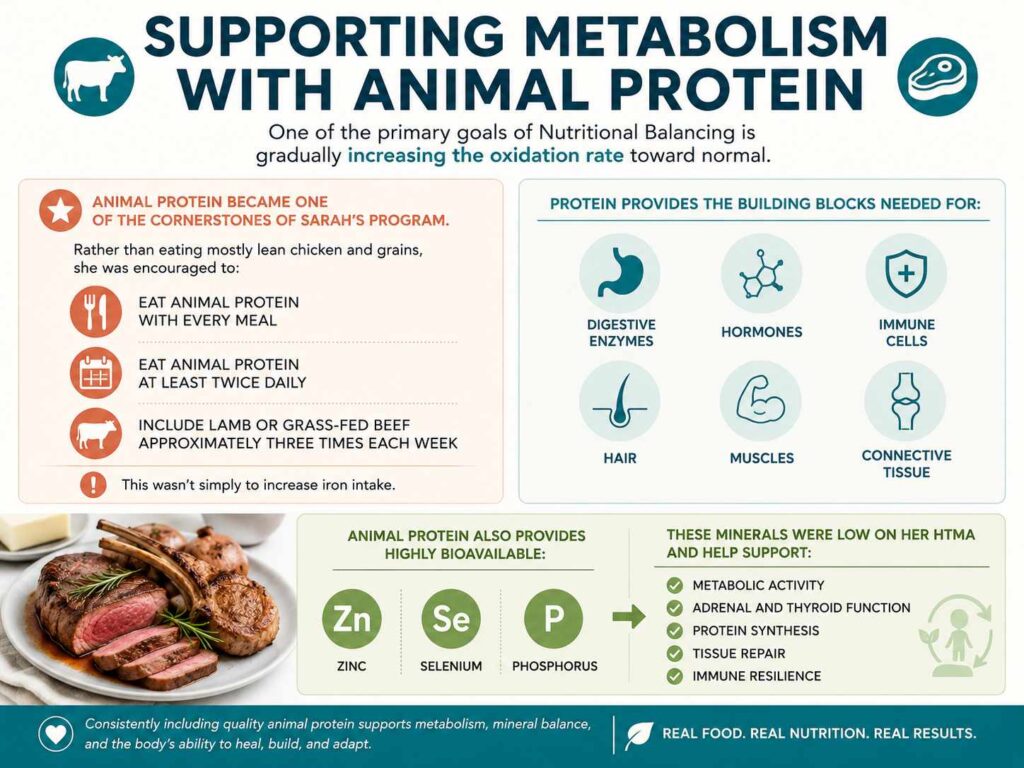
Animal protein became one of the cornerstones of Sarah’s program.
Rather than eating mostly lean chicken and grains, she was encouraged to:
- eat animal protein with every meal
- eat animal protein at least twice daily
- include lamb or grass-fed beef approximately three times each week
This wasn’t simply to increase iron intake.
Protein provides the building blocks needed for:
- digestive enzymes
- hormones
- immune cells
- hair
- muscles
- connective tissue
Animal protein also provides highly bioavailable:
- zinc
- selenium
- phosphorus
These minerals were low on her HTMA and help support:
- metabolic activity
- adrenal and thyroid function
- protein synthesis
- tissue repair
- immune resilience
Why We Reduced Many “Healthy Foods”
Perhaps the most surprising aspect of her program was that we temporarily reduced several foods commonly promoted as healthy.
Not because they are unhealthy.
But because they didn’t appear to match her current physiology.
If you’re wondering why we recommended temporarily reducing foods that are generally considered healthy, I’ve explained the reasoning in more detail in my article, Why Healthy Foods Sometimes Cause Bloating.
Fruit
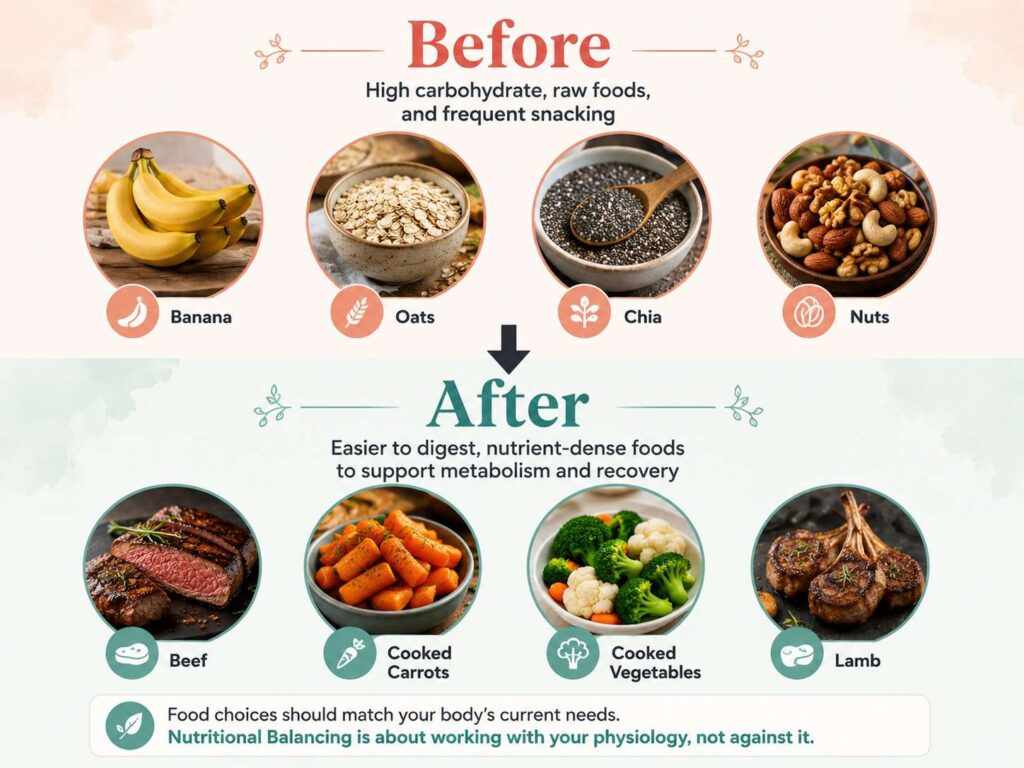
Sarah regularly ate bananas, apples, oranges and berries throughout the day.
Although nutritious, fruit contributes natural sugars and, depending on the fruit, varying amounts of FODMAP carbohydrates.
For someone with persistent bloating, a positive SIBO breath test and impaired carbohydrate tolerance, reducing the overall FODMAP load may help reduce intestinal fermentation and gas production.
This wasn’t about avoiding fruit forever.
It was about giving her digestive system an opportunity to recover.
Whole grains
Her diet included:
- oats
- millet bread
- rice
Rather than encouraging more whole grains, we reduced them because:
- her HTMA suggested impaired carbohydrate tolerance
- grains may contribute to intestinal fermentation in susceptible individuals
- simplifying digestion became more important than maximizing fibre intake
Seeds and Nuts
This was perhaps the most unconventional recommendation.
Her breakfasts regularly included:
- chia seeds
- flaxseed
- pumpkin seeds
- whole nuts
Most nutrition advice would encourage eating more of these foods.
We did the opposite.
There were two reasons.
First, these foods can be difficult to digest in someone with impaired digestive function.
Second, many are naturally high in copper.
Because her HTMA suggested a Copper Imbalance Pattern, we temporarily reduced foods such as:
- chia seeds
- flaxseed
- pumpkin seeds
- sunflower seeds
- sesame seeds
- whole nuts
- cocoa and dark chocolate
- avocados
Instead, we emphasized zinc-rich foods such as lamb and grass-fed beef.
The goal wasn’t to avoid these foods forever.
It was to temporarily reduce potential contributors to copper dysregulation while supporting better mineral balance.
Raw vegetables
Raw vegetables are often promoted as healthier than cooked vegetables.
For Sarah, we recommended the opposite.
Soft, well-cooked vegetables require less digestive effort and may improve mineral availability while reducing irritation in an already stressed digestive system. I discuss the reasoning behind this in more detail in my article, Why Healthy Foods Sometimes Cause Bloating.
Coconut milk
Plant-based milks were also reduced temporarily because they may contribute to digestive irritation or gut imbalance in susceptible individuals.
Tomatoes and Potatoes
These nightshade vegetables were temporarily reduced because they may aggravate inflammation or digestive irritation in some individuals.
Why We Simplified the Diet
One of the biggest mistakes people make when trying to heal is continually adding more supplements and more “superfoods.”
We took the opposite approach.
We simplified her meals.
The focus became:
- soft cooked vegetables
- carrots
- onions
- cruciferous vegetables
- animal protein
- lamb and grass-fed beef
- digestive support
- fewer fermentable carbohydrates
- fewer difficult-to-digest foods
The goal was to reduce digestive workload while improving nutrient assimilation.
The Importance of Digestive Support
Because her HTMA suggested impaired digestion and impaired protein synthesis, digestive support became an important part of the program.
She was recommended GB-3, which contains:
- pancreatin
- ox bile
These ingredients help support digestion of proteins and fats while improving nutrient assimilation.
Rather than simply adding more nutrients, the aim was to improve the body’s ability to utilize the nutrients already present in her diet.
Four Months Later
Her repeat blood work showed:
| Marker | Before | After |
|---|---|---|
| Ferritin (µg/L) | 18 | 33 |
| Serum Iron (µmol/L) | 9.0 | 12.4 |
| Transferrin Saturation (%) | 11 | 20 |
| Transferrin (g/L) | 3.3 | 2.5 |
More importantly, she wrote:
“Fortunately, my bloating has improved significantly.”
“My PMS symptoms have completely disappeared.”
“My menstrual cramps are now much more manageable.”
“Tiredness is no longer a problem.”
“I also haven’t had any recurrent vaginal yeast infections.”
“My hair loss has also decreased.”
For someone who had been struggling for years despite eating well, these changes represented much more than improved laboratory numbers.
What This Case Teaches
This case does not prove that everyone with low ferritin should avoid iron supplements.
Iron supplementation is appropriate and necessary in many situations.
However, it does illustrate an important principle.
Sometimes the body doesn’t simply need more nutrients.
Sometimes it first needs to become better at:
- digesting food
- absorbing nutrients
- utilizing minerals
- producing cellular energy
- rebuilding metabolic resilience
Sarah didn’t improve because she found one magic supplement.
She improved because we stopped chasing individual symptoms and started supporting the systems that allow the body to heal.
We simplified her diet instead of making it more complicated.
We prioritized digestion before adding more nutrients.
We matched nutrition to her physiology, rather than following generic healthy eating advice.
Four months later, not only had her iron markers improved, but many of the symptoms that had affected her for years had improved as well.
That is the real lesson from this case.
Frequently Asked Questions