

Why Healthy Foods Sometimes Cause Bloating—and Why I Often Recommend More Cooked Meals
Written by Koay Yih Zi
“I’m eating healthier than ever… so why do I feel worse?”
It’s one of the most common questions I hear.
You’ve swapped processed foods for colourful salads, green smoothies and more vegetables. Yet instead of feeling lighter and more energetic, you finish meals feeling bloated, uncomfortable or overly full.
It’s confusing—and often discouraging.
Many people assume that if a food is healthy, it should automatically make them feel better. But nutrition doesn’t work quite that way.
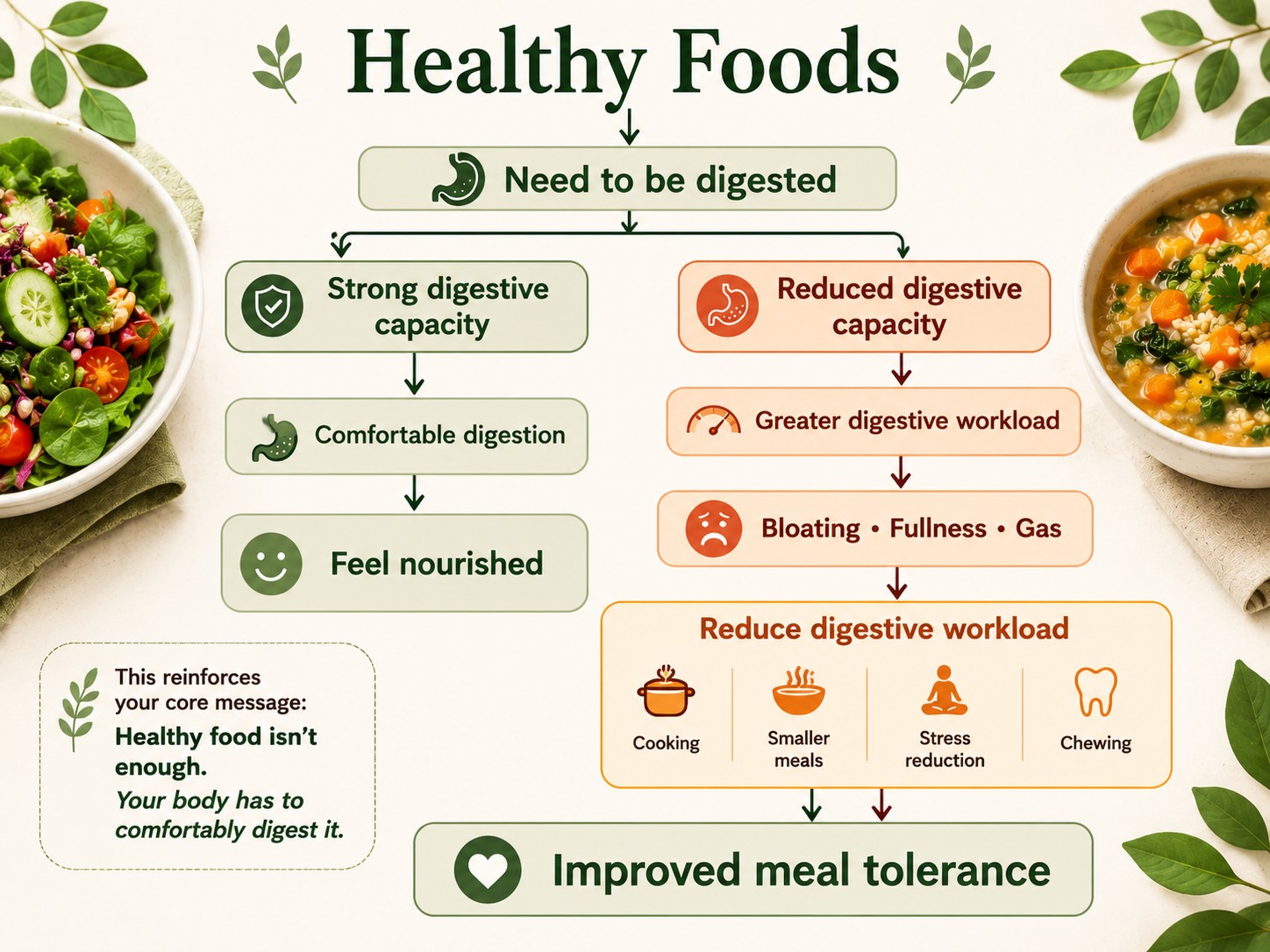
Even the most nutrient-rich meal can only support your health if your body is able to digest it, absorb its nutrients and put them to use.
Over the years, while working with clients and interpreting Hair Tissue Mineral Analysis (HTMA) results as part of their overall assessment, I’ve noticed that many people struggling with bloating don’t necessarily need a completely different diet. Often, they simply need a different way of preparing the foods they’re already eating.
That’s one reason I frequently recommend more warm, gently cooked meals—not because raw foods are unhealthy, but because they may reduce the digestive workload when digestion is already under strain.
In this article, you’ll learn why healthy foods sometimes cause bloating, why raw vegetables often feel harder to tolerate than cooked ones, and how small changes to the way you prepare meals may help you enjoy nutritious foods more comfortably.
Article Contents
- Why Healthy Foods Can Cause Bloating
- Why Raw Salads Often Feel Harder to Digest
- Does Cooking Make Food Easier to Digest?
- Can Stress Make Healthy Foods Harder to Digest?
- When Healthy Foods Become Harder to Tolerate
- What I’ve Observed in Practice
- How to Make Healthy Foods Easier to Tolerate
- Could Reduced Digestive Capacity Be Affecting You?
- Does Everyone Benefit from More Cooked Foods?
- The Takeaway
Why Healthy Foods Can Cause Bloating
If healthy foods are good for us, why do they sometimes leave us feeling worse?
Many nutritious foods are naturally rich in fibre and certain carbohydrates that are fermented by our gut bacteria. When more of these carbohydrates reach the large intestine than your digestive system comfortably handles, bacteria break them down and produce gas.
Gas is a normal part of digestion. The problem arises when enough gas is produced to create pressure, bloating or discomfort, or when the digestive system becomes particularly sensitive to that stretching.
That’s why two people can eat exactly the same meal and have completely different experiences. One feels satisfied and energised, while the other spends the afternoon feeling swollen and uncomfortable.
The meal itself wasn’t necessarily the problem. The food, the portion size and the person’s digestive capacity simply weren’t well matched at that moment.
Another factor that’s often overlooked is that not all healthy foods require the same amount of digestive work.
Large amounts of raw vegetables, legumes, nuts, seeds and other coarse, high-fibre foods naturally require more work to break down. For someone with robust digestion, this is usually well tolerated. When digestive capacity is reduced, however, these same foods may contribute to bloating, fullness or discomfort after meals.
More healthy food isn’t always better
When people decide to “eat healthier,” they often change everything at once. Breakfast becomes a fruit smoothie, lunch becomes a large raw salad, and dinner includes beans, whole grains and extra vegetables.
Individually, these are nutritious choices. Together, they can represent a dramatic increase in fibre and fermentable carbohydrates, especially if your previous diet contained much less.
Both your digestive system and your gut microbiome need time to adapt. That’s why gradually increasing fibre intake is generally better tolerated than making a sudden dramatic change.
Portion size also matters.
For example, someone may comfortably tolerate a small serving of broccoli but feel bloated after eating several cups in one meal. That doesn’t necessarily mean broccoli needs to be eliminated—it may simply mean the serving exceeded their current digestive capacity.
This is an important distinction because many people begin removing healthy foods unnecessarily when the real issue is how much they’re eating, how quickly they’re eating, or how those foods are prepared.
Key takeaway: A healthy food can still cause digestive symptoms. Comfort after eating depends not only on the food itself, but also on the portion, preparation method and your current digestive capacity.
Raw meals differ from cooked meals in several important ways—and that’s often where salads become the sticking point.
Why Raw Salads Often Feel Harder to Digest
If you’ve ever felt perfectly comfortable after a bowl of vegetable soup but bloated after a large salad, you’re not imagining it.
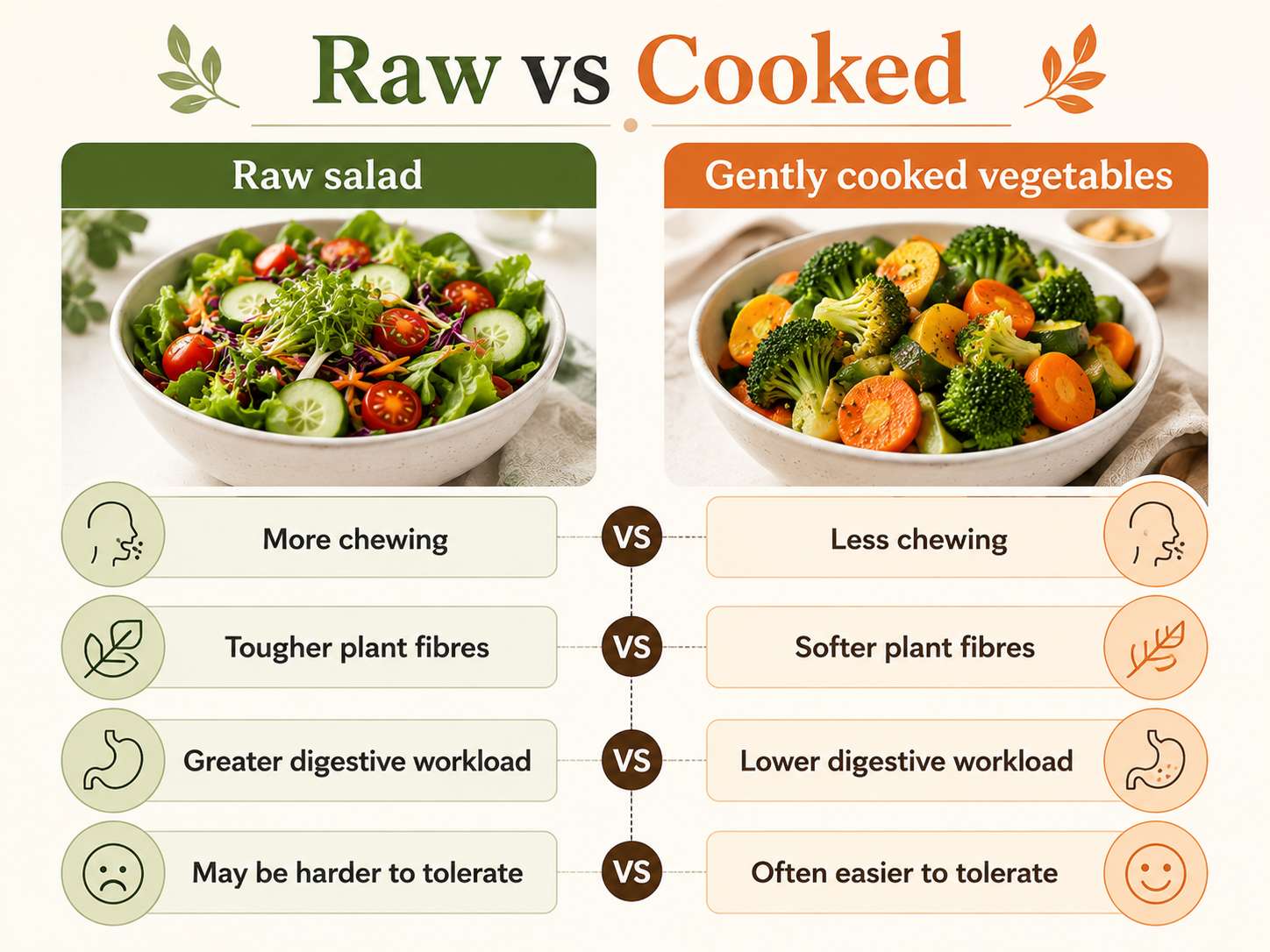
Raw vegetables are physically different from cooked vegetables. They retain their firm structure, require more chewing and often reach the stomach in larger, tougher pieces than vegetables that have been steamed, roasted or slow-cooked. That simply means your digestive system has more work to do before nutrients become available.
It’s not just the lettuce
Large salads often contain much more than leafy greens.
They may also include raw broccoli, cabbage, onions, chickpeas, nuts, seeds, dried fruit and rich dressings—all in the same bowl.
Many of these foods are highly nutritious, but several are also rich in fibre or fermentable carbohydrates. Combined into one large meal, they can place a greater demand on digestion than many people realise.
The issue usually isn’t one ingredient. It’s the overall digestive workload of the meal.
Smoothies can have the same effect
Green smoothies are another good example.
Blending reduces the size of food particles, but it doesn’t remove the fibre or fermentable carbohydrates. In fact, smoothies often make it easy to consume far more fruit and vegetables than you would normally eat in one sitting.
A single smoothie may contain spinach, kale, banana, berries, seeds, nut butter and protein powder—all finished within a few minutes.
Most people would never chew that quantity of food in its whole form.
For someone with a sensitive digestive system, the total amount of food can become just as important as the ingredients themselves.
Chewing matters more than most people realise
Digestion doesn’t begin in the stomach. It begins with chewing.
Breaking food into smaller pieces increases the surface area available to digestive enzymes while mixing food with saliva. Raw vegetables generally require much more chewing than cooked vegetables, yet many of us eat quickly, distracted or under stress.
Over time, that can leave larger pieces of food for the digestive system to process.
When someone tells me that salads always cause bloating, I don’t immediately conclude that raw vegetables are the problem.
Instead, I consider the whole picture.
How large are the meals? How quickly are they eating? What ingredients are being combined? Would the same vegetables be better tolerated if they were cooked instead?
Often, small adjustments are enough to make nutritious foods much more comfortable to eat.
This raises a natural question: does cooking actually make food easier to digest, or is it simply a matter of personal preference?
Does Cooking Make Food Easier to Digest?
For many people, it can.
Cooking changes the structure of food before it ever reaches your plate. Vegetables become softer, proteins unfold, and some starches absorb water, making them easier to digest. Your digestive system still has work to do, but cooking can make digestion more efficient.
Think about the difference between a raw carrot and one that’s been gently steamed.
They’re the same vegetable, yet their texture is completely different. One is firm and crunchy, while the other breaks apart with very little effort. That change in texture also affects how easily food can be chewed and processed during digestion.
For someone with healthy digestion, the difference may be barely noticeable. But if you’re already experiencing bloating, early fullness or digestive discomfort, reducing the amount of work required to break down a meal can sometimes make a meaningful difference.
How Cooking Changes Food
One way to think about cooking is that it begins changing food before your digestive system takes over.
Heat softens the cell walls that give vegetables their structure. Proteins lose their tightly folded shape, making them easier for digestive enzymes to break apart. Starches gelatinise, allowing digestive enzymes better access than they have in many raw foods.
This doesn’t mean every cooked meal will automatically be easier to tolerate. Digestion is influenced by many factors, including the type of food, portion size and the health of your digestive system.
It does, however, help explain why many people find soups, stews and slow-cooked meals gentler on the stomach than large raw salads.
Easier Digestion Doesn’t Mean Fewer Nutrients
One of the biggest concerns I hear is:
“If I cook my vegetables, won’t I destroy all the nutrients?”
The answer is more nuanced than a simple yes or no.
Some nutrients are sensitive to heat. Vitamin C and certain B vitamins can decrease during cooking, particularly when vegetables are boiled for long periods and the cooking water is discarded.
At the same time, cooking can increase the bioavailability of other nutrients and beneficial compounds.
Lycopene, the antioxidant that gives tomatoes their red colour, becomes more bioavailable after cooking. Beta-carotene from carrots is also generally absorbed more efficiently from cooked carrots than raw ones.
In other words, the amount of a nutrient in a food isn’t always the same as the amount your body can absorb. That’s why nutrition researchers increasingly focus on bioavailability—how much of a nutrient your body can actually use—rather than simply how much is present in the food itself.
A meal isn’t nourishing simply because it contains nutrients. It becomes nourishing when those nutrients can be released, absorbed and utilised by the body.
It’s About Balance, Not Choosing Sides
Discussions about raw versus cooked foods often become unnecessarily polarised. Some argue that raw foods preserve more nutrients, while others emphasise that cooked foods are easier to digest. In reality, both can be true.
Raw vegetables offer freshness, texture and nutrients that are best preserved without heat. Cooked vegetables may improve the digestibility or availability of certain nutrients while making meals more comfortable for people with sensitive digestion.
Neither approach is universally better. The best choice depends on the food itself, how it’s prepared and, most importantly, how your body responds.
That’s why I rarely recommend an entirely raw or entirely cooked diet. Most people benefit from a balance, adjusted to their individual digestive capacity.
If raw salads consistently leave you feeling bloated but cooked vegetables don’t, your body is giving you useful information. It’s worth listening to rather than forcing yourself to eat a particular way because it’s considered healthier.
Key takeaway: Cooking doesn’t make vegetables “better” or “worse.” It changes how food is broken down, how some nutrients become available and how comfortably many people digest a meal.
Food preparation is only part of the picture. Even a well-cooked meal may feel difficult to digest if your body is under chronic stress. Stress is another factor that can significantly influence digestion.
Can Stress Make Healthy Foods Harder to Digest?
Absolutely.
Have you ever eaten the same meal on two different days and had completely different experiences? One day you feel perfectly fine. The next, you’re bloated, uncomfortable or unusually full.
The food may not have changed—but your body has.
Digestion isn’t simply controlled by what you eat. It’s also influenced by your nervous system. When you’re relaxed, your body naturally directs energy towards digestion. When you’re stressed, it shifts its priorities elsewhere.
This is often described as the difference between the “rest and digest” state and the “fight or flight” response.
In the short term, this response is helpful. If you’re facing immediate danger, digesting lunch isn’t your body’s top priority.
The problem is that modern stress is rarely short-lived. Many people spend weeks, months or even years juggling work pressures, financial concerns, poor sleep, chronic illness or emotional stress. While the causes are very different from physical danger, the body often responds in similar ways.
What Stress Does to Digestion
Stress can affect digestion in several ways. It may slow stomach emptying in some people while speeding it up in others. It can alter the movement of food through the intestines, influence digestive secretions and increase how sensitive the gut becomes to normal amounts of gas or stretching.
That’s one reason stress doesn’t affect everyone the same way.
Some people lose their appetite. Others experience nausea. Some develop constipation, while others have diarrhoea. Many simply notice that foods they usually tolerate suddenly become difficult to digest.
If you’ve ever experienced “butterflies” before an important presentation or felt your stomach tighten during a stressful conversation, you’ve already experienced the close connection between the brain and the gut.
When Healthy Foods Suddenly Become Difficult
This is something I see regularly.
Someone tells me, “I’ve eaten salads for years, but over the past year they seem to upset my stomach.”
Often, the change didn’t begin with the food. It began with everything else that changed around it.
Perhaps work became more demanding. Sleep deteriorated. A new baby arrived. They developed another health condition. Or they simply reached a point where their body no longer had the same digestive capacity it once did.
The salad didn’t necessarily become harder to digest. Their digestive capacity changed.
That’s an important distinction because it shifts the focus away from blaming individual foods and towards understanding the broader picture.
Supporting Digestion Sometimes Means Simplifying Meals
When digestion is under strain, eating more gently doesn’t mean eating less healthily. Sometimes it simply means choosing foods that require less effort to process while your body recovers.
That might include:
- replacing one large raw salad with cooked vegetables
- choosing soups or stews instead of bulky meals
- slowing down and chewing more thoroughly
- avoiding very large meals when stressed
- eating in a calmer environment whenever possible
These changes don’t treat the underlying cause of chronic stress, but they may reduce the burden on a digestive system that’s already working harder than usual.
Over time, many people find they can comfortably reintroduce a wider variety of foods as their overall health improves.
Certain digestive conditions can have a similar effect, making otherwise nutritious foods much harder to tolerate.
When Healthy Foods Become Harder to Tolerate
Sometimes, changing how you prepare your meals is enough to improve digestion. Other times, persistent digestive symptoms may point to an underlying condition that deserves further investigation.
If bloating, abdominal pain or changes in bowel habits happen regularly—especially if they’re becoming worse rather than better—it’s important not to assume that healthy foods are the problem.
Instead, they may simply be revealing that your digestive system is already under strain.
Several common digestive conditions can reduce your capacity to tolerate foods that are otherwise nutritious.
Irritable Bowel Syndrome (IBS)
People with irritable bowel syndrome (IBS) often find that certain foods trigger symptoms such as bloating, abdominal pain, constipation or diarrhoea.
Many common IBS triggers—including onions, garlic, legumes and some fruits—are rich in nutrients. They also contain fermentable carbohydrates (known as FODMAPs) that can produce more gas during digestion in susceptible individuals.
For many people with IBS, symptoms improve not because these foods are permanently eliminated, but because the amount, timing or preparation is adjusted under professional guidance.
Cooking may also improve tolerance for some vegetables by softening their structure, although it doesn’t remove all fermentable carbohydrates.
Small Intestinal Bacterial Overgrowth (SIBO)
SIBO occurs when unusually large numbers of bacteria are present in the small intestine, where they ferment carbohydrates earlier than they normally would.
This can lead to symptoms such as bloating, abdominal discomfort, excessive gas and altered bowel habits, often soon after eating.
People with SIBO frequently notice that foods they once tolerated—including vegetables, fruit and whole grains—suddenly cause significant discomfort.
The underlying digestive condition has changed the body’s ability to handle those foods comfortably.
If SIBO is suspected, assessment and treatment should be guided by an appropriately qualified healthcare professional.
Other Reasons Digestion Changes
IBS and SIBO are only two of many possible explanations.
Digestive capacity can also change because of:
- reduced digestive enzyme production
- coeliac disease or other gastrointestinal disorders
- previous gastrointestinal infections
- certain medications
- ageing
- chronic stress
- changes in gut motility
That’s why there isn’t a single diet that works for everyone. Two people can eat exactly the same meal and have completely different experiences because their digestive systems are functioning differently.
Listen to Your Symptoms—But Don’t Fear Healthy Foods
One of the biggest mistakes I see is people becoming afraid of nutritious foods after experiencing bloating.
Vegetables, fruit, legumes and whole grains aren’t suddenly “bad.” They’re often telling you something important about how your digestive system is functioning right now.
Sometimes the solution is as simple as reducing portion size or choosing cooked instead of raw vegetables for a period of time. Other times, persistent symptoms deserve further investigation rather than another restrictive diet.
The goal isn’t to avoid healthy foods forever. It’s to understand why they’re difficult to tolerate and address the underlying issue whenever possible.
Exploring these questions eventually led me to notice another interesting pattern. It wasn’t based on diagnoses such as IBS or SIBO, but on recurring trends I observed while interpreting Hair Tissue Mineral Analysis (HTMA) reports.
What I've Observed in Practice
Over the years, I’ve noticed a recurring pattern.
Many of the people who struggle most with bloating aren’t eating a poor diet. In fact, they’re often eating more vegetables, salads and whole foods than the average person.
Yet despite making healthy choices, they still finish meals feeling bloated, overly full or uncomfortable. That led me to look beyond what they were eating and ask whether their body was ready to digest those foods comfortably.
One example is a client with persistent bloating, low ferritin and hair loss who improved after we simplified her diet, increased animal protein and focused on supporting digestion rather than simply adding an iron supplement. You can read her story in my case study, How One Woman Improved Low Ferritin Without Iron Supplements.
Looking Beyond the Food
As I interpreted more Hair Tissue Mineral Analysis (HTMA) results, I noticed another recurring pattern.
Many of those clients also showed signs of low mineral reserves.
Within the Nutritional Balancing framework, these patterns are thought to reflect a body with fewer resources available for energy production, stress adaptation and normal physiological function. HTMA cannot diagnose digestive disorders or explain the cause of bloating. However, it often provides another piece of information that helps me understand why someone’s digestive capacity may be reduced.
Some of the patterns I commonly see include:
- Low sodium and low potassium, which Nutritional Balancing associates with reduced vitality and a lower capacity to adapt to physical and emotional stress.
- Low phosphorus, which Nutritional Balancing associates with reduced digestive efficiency and nutrient assimilation.
- Low zinc, an essential mineral involved in stomach acid production, digestive enzyme activity, maintaining the intestinal lining and normal immune function.
- Three Lows, where sodium, potassium and phosphorus are all low. Within Nutritional Balancing, this pattern is commonly associated with reduced metabolic activity and lower physiological resilience.
None of these patterns, on their own, explains why someone experiences digestive symptoms.
However, when these findings appear alongside symptoms such as bloating after healthy meals, early fullness, reduced appetite or poor tolerance of raw vegetables, they often point to the same clinical picture—a body that may benefit from reducing the digestive workload while its overall nutritional status is being rebuilt.
Why This Influences My Recommendations
This is one reason I often recommend more warm, gently cooked meals at the beginning of a nutritional programme.
The goal is to make nutritious foods easier to digest while addressing the broader factors that may be contributing to reduced digestive capacity.
As mineral balance and overall health improve, many people find they can comfortably tolerate a wider variety of foods again.
Every person is different, so my recommendations are always based on the individual’s symptoms, health history and overall clinical picture—not their HTMA results alone.
Key takeaway: My recommendation to include more cooked meals isn’t based on the belief that raw vegetables are unhealthy. It’s based on years of clinical observation that people with reduced digestive capacity—often accompanied by patterns of low mineral reserves on HTMA—frequently feel more comfortable with warm, gently cooked meals while their overall nutritional status is being restored.
How to Make Healthy Foods Easier to Tolerate
If healthy foods consistently leave you feeling bloated, the answer isn’t necessarily to remove them from your diet.
More often, it’s about reducing the digestive effort required by a meal while supporting your body’s ability to digest and absorb nutrients.
Small, practical changes are usually more sustainable—and often more effective—than completely overhauling your diet.
Start by Changing How You Prepare Your Food
One of the simplest changes is to prepare the same vegetables differently.
Instead of eating a large raw salad every day, try replacing it with:
- lightly steamed vegetables
- gently simmered soups
- slow-cooked vegetable stews
- vegetables cooked in broths or other water-based dishes
These moist cooking methods soften plant fibres while using relatively gentle temperatures. They also avoid the higher levels of advanced glycation end products (AGEs) that can form during high-temperature dry cooking methods such as grilling, frying or heavy roasting. For this reason, I generally recommend steaming, simmering and slow-cooking as everyday cooking methods.
You’re still eating vegetables—you’re simply preparing them in a way that may be easier for your digestive system to handle.
Simplify the Meal
A meal doesn’t have to be unhealthy to be difficult to digest.
Large salads containing several raw vegetables, legumes, nuts, seeds, rich dressings and other high-fibre ingredients can place a considerable demand on digestion. Likewise, smoothies packed with multiple fruits, raw greens, nut butters, seeds and protein powders may be nutritious, but combining many ingredients into a single meal doesn’t necessarily make it easier for your digestive system to process.
If these meals regularly leave you feeling bloated, try simplifying them. Choose fewer ingredients, eat moderate portions and pay attention to how your body responds.
Slow Down and Let Digestion Begin
Digestion starts before food reaches your stomach.
Taking time to chew thoroughly breaks food into smaller particles and mixes it with saliva, making it easier for the rest of the digestive system to do its job.
Whenever possible:
- sit down for meals
- eat without rushing
- chew thoroughly before swallowing
- pause occasionally during meals and notice how comfortably full you feel
These simple habits won’t solve every digestive problem, but they often improve meal tolerance and are among the easiest changes to implement.
Let Your Body Guide You
Your body gives you valuable feedback.
If gently cooked vegetables consistently leave you feeling more comfortable than raw salads, that’s worth paying attention to. If smaller, simpler meals improve your symptoms, that’s useful information too.
Rather than forcing yourself to follow someone else’s idea of the “perfect” diet, look for the approach that allows you to eat nutritious foods comfortably and consistently.
At the same time, persistent digestive symptoms shouldn’t simply be accepted as normal. If bloating continues despite sensible dietary changes—or is accompanied by symptoms such as unexplained weight loss, blood in the stool, persistent vomiting or severe abdominal pain—seek assessment from a qualified healthcare professional.
Could Reduced Digestive Capacity Be Affecting You?
If you regularly experience any of the following, your digestive system may benefit from a gentler approach to eating:
- bloating after meals, especially after raw vegetables or large salads
- feeling overly full after eating only a small amount
- excessive gas or abdominal discomfort after healthy meals
- frequent indigestion or a heavy feeling after eating
- digestive symptoms that become worse during periods of stress
- feeling better with soups, stews or other cooked meals than with raw foods
These symptoms don’t necessarily point to a specific diagnosis.
However, they may suggest that your digestive system is under greater demand than it can comfortably manage.
Rather than pushing through the discomfort or assuming healthy foods are the problem, consider reducing the digestive workload while exploring the underlying factors contributing to your symptoms.
If your digestive symptoms are persistent, worsening, or accompanied by concerning signs such as unexplained weight loss, blood in the stool, persistent vomiting or severe abdominal pain, seek assessment from a qualified healthcare professional.
Digestive discomfort shouldn’t simply be accepted as a normal part of healthy eating.
Does Everyone Benefit from More Cooked Foods?
In my opinion, yes.
That said, this isn’t about avoiding raw foods altogether. Rather, I believe most people benefit from making gently cooked foods the foundation of their diet.
Cooking softens plant fibres, often improves digestibility and can increase the availability of certain nutrients. Gentle, water-based cooking methods such as steaming, simmering and soups also minimise the formation of advanced glycation end products (AGEs) associated with high-temperature dry cooking.
Where people differ is not whether cooked foods are beneficial, but how much raw food they comfortably tolerate.
Those with robust digestive function may enjoy larger amounts of raw foods, while others feel better with a greater emphasis on cooked meals.
The goal isn’t to label foods as “good” or “bad.” It’s to choose a way of eating that allows your body to comfortably digest, absorb and benefit from nutritious foods.
As digestive health and overall resilience improve, many people naturally become more tolerant of a wider variety of foods.
Key takeaway: I generally recommend making gently cooked foods the foundation of the diet. Raw foods can certainly have a place, but the amount should reflect your individual digestive capacity rather than a one-size-fits-all rule.
The Takeaway
If there’s one message I’d like you to remember, it’s this:
Healthy eating isn’t just about choosing nutritious foods. It’s also about choosing foods that your body can comfortably digest, absorb and use.
If a large salad leaves you feeling bloated while a bowl of vegetable soup leaves you feeling satisfied and energised, that doesn’t mean you’ve failed at healthy eating. It may simply mean your digestive system needs a different approach right now.
Rather than forcing yourself to follow someone else’s definition of the “perfect” diet, pay attention to how your body responds.
For many people, shifting towards more warm, gently cooked foods is a simple way to reduce the digestive workload while still providing the body with the nutrients it needs.
As digestive health and overall resilience improve, many people naturally become more tolerant of a wider variety of foods.
Healthy eating isn’t about following rigid rules. It’s about nourishing your body in a way that supports healing, energy and long-term health.
Ultimately, the healthiest diet isn’t the one that looks best on social media or follows the latest nutrition trend.
It’s the one your body can digest, absorb and truly benefit from.
Ready to Better Understand Your Digestion?
If healthy foods consistently leave you feeling bloated, overly full or uncomfortable, it may be worth looking beyond the food itself.
Hair Tissue Mineral Analysis (HTMA) doesn’t diagnose digestive disorders, but it can provide valuable insight into mineral patterns that influence energy production, stress adaptation and digestive capacity. When interpreted alongside your symptoms, health history and overall clinical picture, it helps me develop nutritional recommendations that are tailored to you—not based on a one-size-fits-all approach.
If you’d like to better understand what may be contributing to your symptoms, you can learn more about HTMA, explore a sample report or order your personalised analysis below.

About the Author
Koay Yih Zi is a Hair Tissue Mineral Analysis practitioner and founder of Health Balancing. She specialises in interpreting HTMA mineral patterns and imbalances, and partners with health and pet professionals to integrate hair mineral testing into their services.