Written by Koay Yih Zi
Introduction
You already know you’re wired but tired.
You may have even read that cortisol is the reason — that your stress hormones are disrupting your sleep cycle, keeping your nervous system switched on when it should be winding down.
That explanation is true. But it’s incomplete.
Because if cortisol were the whole story, fixing your cortisol rhythm would fix the problem. Reducing stress would fix the problem. Better sleep would fix the problem.
And yet here you are.
This article is for the person who has already done the work — the magnesium, the sleep hygiene, the adrenal supplements, maybe even the cortisol testing — and still cannot fully switch off. Still wakes at 3am. Still crashes in the afternoon but lies awake at night. Still feels like the internal engine is running even when the body is clearly exhausted.
What you may not have been told is this: cortisol dysregulation is a symptom of a deeper imbalance. And that imbalance shows up not in your blood — but in your mineral tissue stores.
Article Contents
- Why Cortisol Testing Only Shows Part of the Picture
- The Nervous System Pattern Behind “Wired but Tired”
- The Hidden Driver: It’s Not Just Stress
- The Three Amigos: The Other Hidden Stimulants
- The Second Wind Trap
- When the Pattern Has Gone On Too Long: Burned Out Sympathetic Dominance
- Why the Thyroid Connection Doesn’t Complete the Picture Either
- What HTMA Actually Measures That Other Tests Miss
- What Recovery Actually Looks Like
- The Question Worth Asking
Why Cortisol Testing Only Shows Part of the Picture
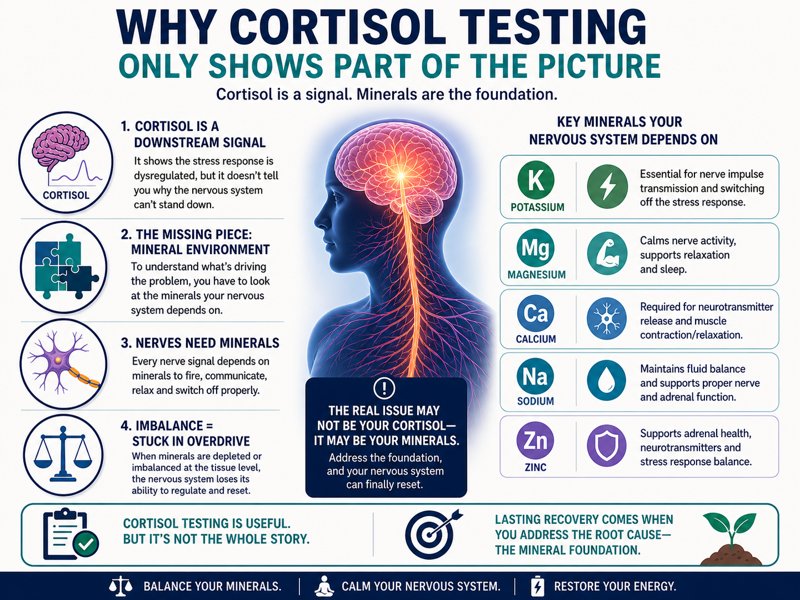
When people investigate the wired-but-tired pattern, cortisol is the first thing they look at — and for good reason. Cortisol is the primary stress hormone. When its rhythm is disrupted, you can feel alert at night and foggy in the morning, anxious without cause, and unable to fully rest even when you’re exhausted.
But cortisol is a downstream signal. It tells you the stress response is dysregulated. It doesn’t tell you why the nervous system can’t stand down — or what’s keeping it locked in that state.
For that, you have to look at the mineral environment the nervous system is operating in.
Every nerve signal in your body depends on minerals. Potassium, magnesium, calcium, sodium, and zinc all govern how nerves fire, how muscles relax, how the stress response activates and — critically — how it turns off. When these minerals are depleted or imbalanced at the tissue level, the nervous system loses its ability to regulate itself properly.
This is why many people with wired-but-tired symptoms never fully resolve them through cortisol management alone. The hormonal pattern is real, but the mineral foundation underneath it has not been addressed.
The Nervous System Pattern Behind “Wired but Tired”
In nutritional balancing science, the wired-but-tired experience has a specific name and a specific mineral signature: sympathetic dominance.
Sympathetic dominance means the body is chronically overusing its fight-or-flight system just to get through the day. Not because of acute stress, but because the energy reserves and mineral status that would normally allow the nervous system to shift into rest-and-repair mode have been depleted.
The key marker on a Hair Tissue Mineral Analysis (HTMA) is low tissue potassium — specifically, a potassium level of 4 mg% or less, combined with a slow oxidation rate. This pattern indicates the body is running on its emergency system as a baseline. The fight-or-flight switch is stuck in the on position.
This is not detected on blood tests. Blood potassium is tightly regulated and will appear normal even when tissue stores are critically low. The mineral depletion driving sympathetic dominance exists at the cellular level, which is precisely where HTMA measures.
(For a full explanation of the sympathetic dominance pattern and its symptoms, see our main article: Sympathetic Dominance: Why You Feel Wired but Tired.)
What this companion piece focuses on is what’s driving the pattern — the hidden mineral and toxic metal layer that keeps the nervous system locked in overdrive even when you’re trying to recover.
The Hidden Driver: It’s Not Just Stress
Here is what is rarely discussed in mainstream content about wired-but-tired symptoms:
In every case of sympathetic dominance, there is hidden copper imbalance.
Copper is an essential mineral — but when it accumulates in excess or becomes biounavailable, it becomes a significant nervous system stimulant. Unbound copper increases nerve excitability, drives anxiety and racing thoughts, and keeps the brain in a heightened state of alertness.
The mechanism is specific: copper is a cofactor in the conversion of dopamine to norepinephrine and epinephrine. When copper is elevated, this conversion is accelerated — producing excess adrenaline and norepinephrine. The result, as described in published clinical commentary, is an “amphetamine-like” effect on the nervous system: agitation, anxiety, racing thoughts, restlessness, and insomnia. This is not a stress response to external circumstances. It is a chemically driven state arising from inside the body.
When copper levels are elevated, the conversion of dopamine to norepinephrine and epinephrine accelerates — producing an amphetamine-like effect on the nervous system. The result is agitation, racing thoughts, restlessness, and insomnia that no amount of stress management will resolve.
This explains something that many people in this pattern experience but can’t account for: the sense of mental overstimulation that persists even when the body is clearly exhausted. The overactive mind at bedtime. The inability to stop thinking even when every other signal says to rest.
Copper imbalance is rarely identified on standard blood tests. It does not reliably show up on a basic serum copper panel. It shows up — along with its relationship to zinc, potassium and other key minerals — on a properly interpreted HTMA.
The Three Amigos: The Other Hidden Stimulants
Beyond copper, there is another layer that is almost never discussed outside of nutritional balancing practice.
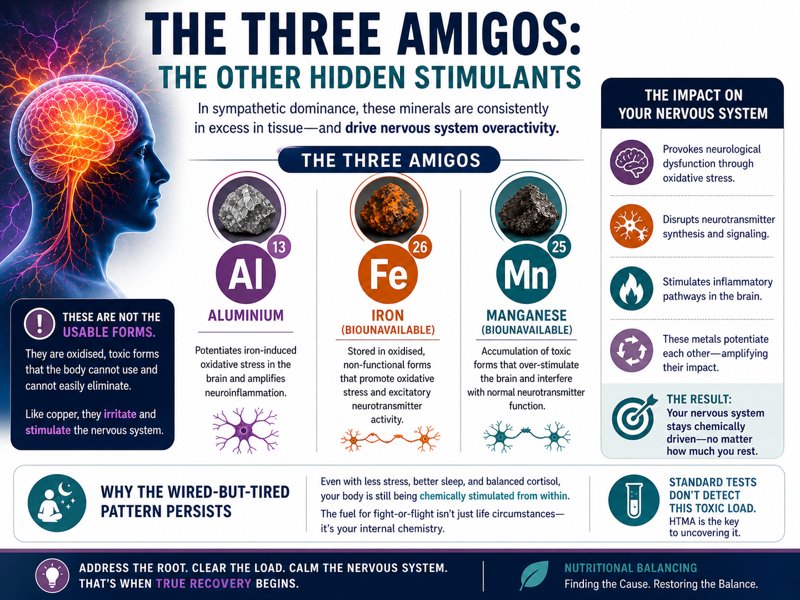
In sympathetic dominance, three additional minerals are consistently found in excess in tissue: aluminum, and biounavailable forms of iron and manganese — sometimes called “the three amigos” in nutritional balancing science.
These are not the usable, functional forms of iron and manganese. They are accumulations of oxidised, toxic forms that the body cannot use and cannot easily eliminate. Like copper, they irritate and stimulate the nervous system.
A 2021 peer-reviewed paper published in PubMed Central reviewing copper, iron, and manganese toxicity in neuropsychiatric conditions found that imbalances in these three metals provoke neurological dysfunction through oxidative stress, disruption of neurotransmitter synthesis, and stimulation of inflammatory pathways in the brain. Separately, research published in PubMed has shown that aluminum potentiates iron-induced production of reactive oxygen species in cerebral tissue — meaning these metals do not simply act in isolation, but can amplify each other’s impact on the nervous system.
What this means practically: even if someone reduces external stress, improves their sleep environment, and supports their cortisol rhythm, the nervous system is still being chemically driven from within. The stimulation is coming from the inside — from accumulated mineral toxicity that standard testing does not detect.
This is why the wired-but-tired pattern can persist for years despite significant lifestyle effort. The fuel for the fight-or-flight response is not coming from life circumstances alone. It is coming from the body’s internal chemistry.
The Second Wind Trap
There is a behavioural dimension to this pattern that is worth understanding, because it explains why it often goes unrecognised for so long.
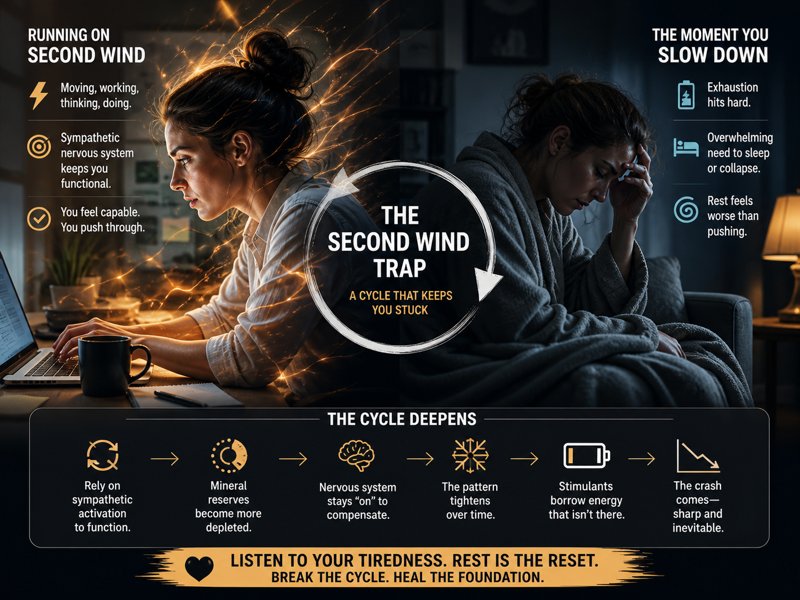
People in sympathetic dominance frequently do not feel tired in the way we expect tired to feel. They feel tired only when they stop. While they are moving — working, thinking, doing — the body sustains itself on a kind of emergency second wind. The sympathetic nervous system keeps them functional.
The moment they slow down, the exhaustion surfaces. And it surfaces heavily — a sudden, overwhelming desire to sleep, a drop in energy that feels alarming.
So they get up and go again. They put themselves back into activity, back into sympathetic mode, because resting feels worse than pushing. The tiredness they feel when they stop becomes something to avoid rather than something to listen to.
This cycle is self-reinforcing. The more someone relies on sympathetic activation to function, the more depleted the underlying mineral reserves become. The more depleted the reserves, the more the nervous system must compensate by staying “on.” The pattern tightens over time.
This is also why stimulants feel helpful in the short term — caffeine, intense exercise, high-pressure work environments — and why the inevitable crash after them feels so sharp. The body was already running close to empty. The stimulation borrowed energy that wasn’t there.
When the Pattern Has Gone On Too Long: Burned Out Sympathetic Dominance
There is a more advanced version of this pattern that occurs when sympathetic dominance has been sustained for a very long time, or has been very severe.
In this stage — sometimes called burned out sympathetic dominance — the adrenal glands have become so exhausted from years of emergency-mode operation that the Na/K ratio drops below 2.5. The body no longer has the reserve capacity to maintain even the compensatory push.
The presentation shifts. Instead of wired-but-tired, the person may now feel simply depleted — flat, depressed, chronically fatigued, unable to generate the drive that used to come automatically. Some describe it as having run out of the ability to push.
This pattern is associated with most chronic fatigue presentations, and with a significantly higher burden of toxic metal accumulation. It is also the pattern in which recovery takes the longest, because the adrenal and mineral rebuilding process must happen slowly and carefully — aggressive supplementation or detox protocols at this stage typically cause significant setbacks.
Why the Thyroid Connection Doesn’t Complete the Picture Either
Many people with wired-but-tired symptoms are told to investigate their thyroid — and thyroid function is genuinely relevant. Slow oxidation, which is always present in sympathetic dominance, involves impaired thyroid and adrenal communication.
But the same limitation applies here as with cortisol: thyroid treatment addresses a downstream signal without necessarily correcting the mineral environment the thyroid is trying to operate in.
Thyroid hormones depend on specific minerals to be synthesised, converted, and used at the cellular level. When those minerals are depleted or imbalanced — which HTMA reveals and blood tests do not — thyroid support may produce incomplete or temporary results.
This is a common experience: thyroid medication that helps at first, then seems to stop working. Or labs that normalise but symptoms that persist. The mineral foundation was not addressed.
What HTMA Actually Measures That Other Tests Miss
Hair Tissue Mineral Analysis measures mineral levels in the tissues — not in the blood. This distinction is significant.
Blood mineral levels are tightly regulated. The body will pull minerals from tissues and bones to maintain blood homeostasis, meaning blood tests can read as normal even when tissue stores are critically low. By the time a deficiency shows up in blood, it has often been present in the tissues for a significant period.
Blood tests reflect metal exposure over hours to days. Hair reflects accumulated exposure over months. This is why the mineral burden driving your symptoms doesn’t show up on standard panels.
This is not a functional medicine opinion — it is supported by published research. A 2021 peer-reviewed paper in the International Journal of Molecular Sciences reviewing copper, iron, and manganese toxicity in neuropsychiatric conditions notes that blood and urinary measurements reflect only brief, recent exposure — hours to days — whereas hair reflects accumulated exposure over months. This is precisely why tissue-level testing captures the chronic mineral burden that drives sympathetic dominance, while standard blood panels miss it entirely.
HTMA bypasses this regulatory system. It measures what is actually stored and being used at the cellular level — where the nervous system, adrenal glands, and thyroid actually operate.
On an HTMA, sympathetic dominance has a measurable, quantifiable severity. The pattern can be mild or it can be layered — multiple overlapping indicators that suggest the nervous system has been in emergency mode for months or years. This level of specificity is not available from cortisol saliva tests, thyroid panels, or standard blood work.
It also reveals the toxic metal picture — copper accumulation, the biounavailable iron and manganese, aluminum, mercury, lead — that is sustaining nervous system stimulation from the inside. These are not incidental findings. They are central to why the pattern persists.
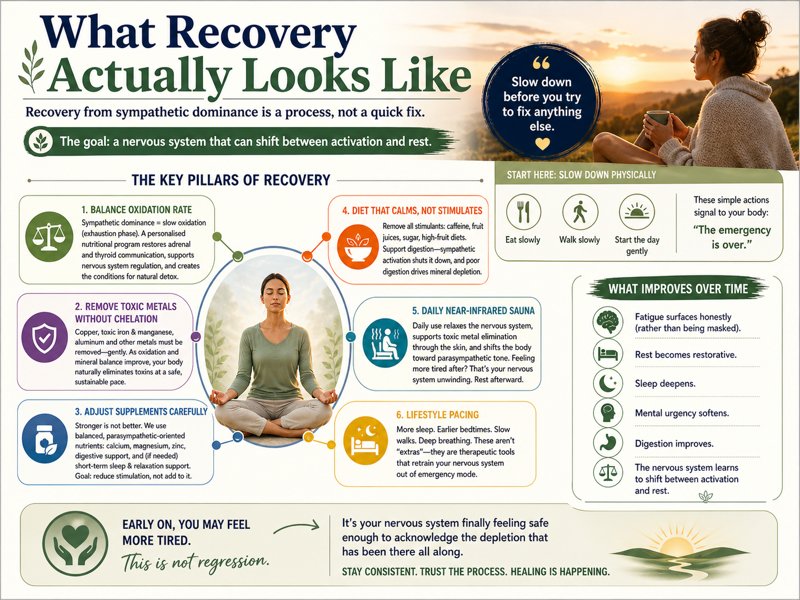
What Recovery Actually Looks Like
Recovery from sympathetic dominance — particularly when copper imbalance and toxic metal accumulation are involved — is not a quick process. And it does not follow a linear path.
The starting point is counterintuitive: slow down physically before attempting anything else. Eating slowly, walking slowly, starting the day gently — these are not trivial suggestions. They are specific interventions that begin to shift the autonomic nervous system out of fight-or-flight. For someone who has been running on a sympathetic second wind for years, deliberately slowing physical pace is one of the most direct signals the body receives that the emergency is over.
From there, recovery involves several interconnected layers:
Balancing the oxidation rate. Sympathetic dominance always occurs in slow oxidation — an exhaustion phase of the stress response. Correcting the oxidation rate through a personalised nutritional program helps restore adrenal and thyroid communication, supports the nervous system’s ability to regulate itself, and creates the metabolic conditions for toxic metal elimination to occur naturally.
Removing toxic metals without chelation. The copper accumulation, biounavailable iron and manganese, aluminum, and other toxic metals driving nervous system stimulation must be removed — but not aggressively. Chelation therapy is contraindicated in depleted systems. The preferred approach is metabolism-led removal: as the oxidation rate is corrected and mineral balance is restored, the body gradually releases toxic metals through its natural elimination pathways. This process is slower, but it does not create the setbacks that forced chelation can cause in an already exhausted system.
Adjusting supplements carefully. This is a point that distinguishes nutritional balancing from generic supplementation. With sympathetic dominance, stronger is not better. Stimulating supplements — even ones that seem supportive on paper — can worsen the pattern. The program intentionally uses more balanced, parasympathetic-oriented nutrients: calcium, magnesium, zinc, digestive support, and in some cases short-term support for sleep and relaxation. The goal is to reduce the overall stimulation load, not add to it.
Dietary changes that reduce nervous system load. All stimulants are removed — caffeine, fruit juices, sugar, and high-fruit diets — because these sustain sympathetic activation. Digestion is supported specifically because the sympathetic nervous system suppresses it, and poor digestion compounds mineral depletion over time.
**Daily near-infrared sauna.** A near-infrared lamp sauna used daily is particularly effective for this pattern. It relaxes the autonomic nervous system directly, supports toxic metal elimination through the skin, and over time helps shift the body toward parasympathetic tone. It is common to feel temporarily more tired after sessions — this is the nervous system unwinding, not a negative reaction, and rest afterward is recommended.
Lifestyle pacing. More sleep, earlier bedtimes, slow walks during the day, and regular deep breathing are not optional extras — they are functional interventions that accumulate over time. For someone whose nervous system has been in emergency mode for years, consistent pacing is part of the therapeutic protocol, not a lifestyle preference.
The general direction of recovery is toward a nervous system that can genuinely shift between activation and rest. Fatigue surfaces honestly rather than being masked. Rest becomes restorative. Sleep deepens. The mental urgency softens. Digestion improves.
Early in recovery, some people experience a temporary intensification of tiredness. This is not regression. It is the nervous system finally feeling safe enough to acknowledge the depletion that has been there all along.
The Question Worth Asking
If you have been living in the wired-but-tired pattern — and especially if you have tried the standard approaches without full resolution — the question worth asking is not “how do I manage my cortisol better?”
It is: “what is the mineral environment my nervous system is actually operating in?”
That question cannot be answered by blood work. It can be answered by HTMA.
Curious What Your Mineral Pattern Looks Like?
Hair Tissue Mineral Analysis provides a detailed picture of the tissue-level mineral status and toxic metal load that drives sympathetic dominance. It reveals not just whether the pattern is present, but how severe it is, what is sustaining it, and what specific nutritional support the body needs to begin shifting out of it.
If the wired-but-tired pattern has persisted despite your best efforts, the mineral layer is worth looking at.
Start with the free guide. Why You’re Still Exhausted walks through the mineral patterns behind chronic fatigue and burnout — including sympathetic dominance, copper imbalance, and why standard testing misses them. It’s a practical introduction to what HTMA reveals and how nutritional balancing works.
If you’re ready to see your own mineral pattern, the HTMA test includes a full practitioner report and personalised email support.
Read the main article on sympathetic dominance →