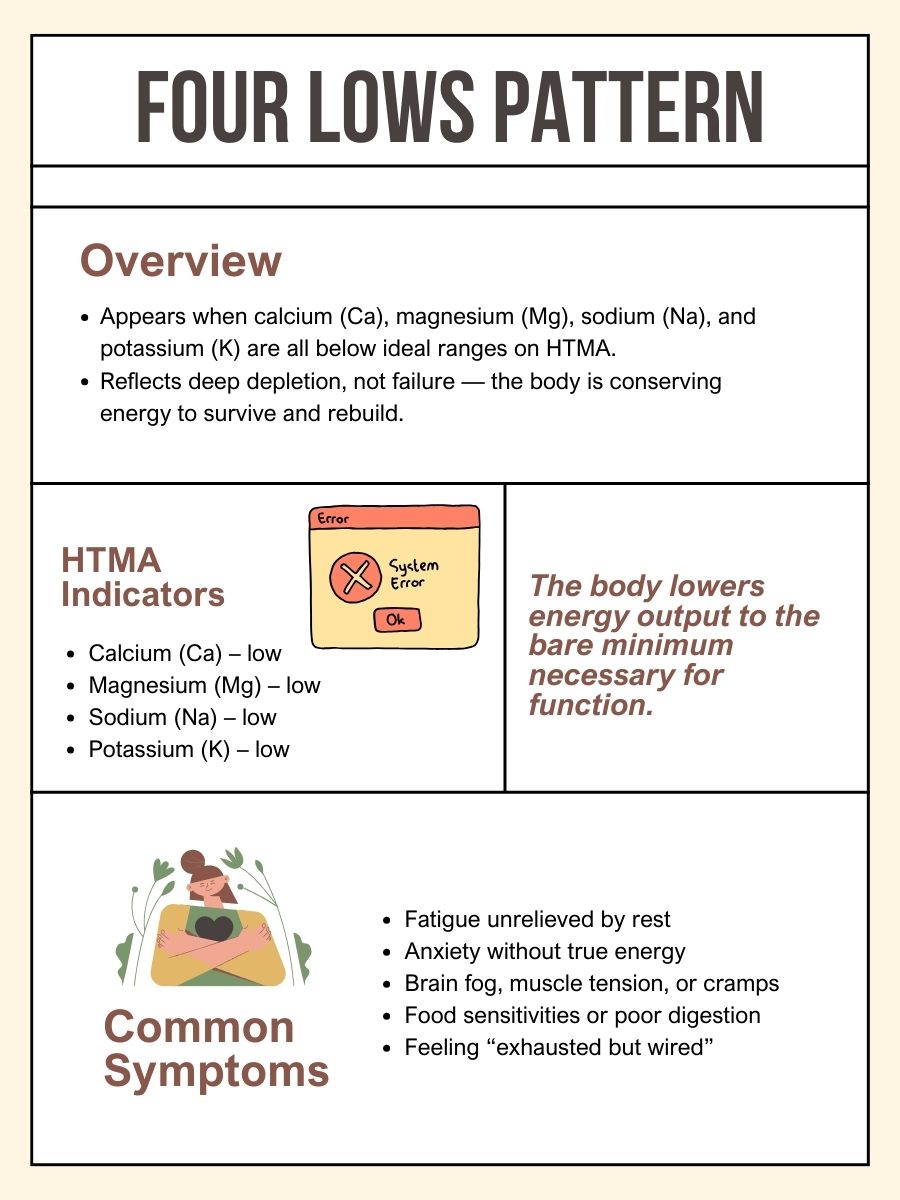
Many people in a Four Lows pattern have already tried sleep, supplements, or restrictive diets without lasting improvement — because the deeper mineral environment has not been addressed.
People dealing with burnout and chronic fatigue or feeling tired but wired often recognise this pattern.
Frequently Asked Questions
Can your oxidation rate change over time, or is it fixed for life?
Oxidation rate is not fixed — it can shift with age, accumulated stress, nutrition, and mineral reserves throughout life. True fast oxidation is considered most common in infancy and early childhood, when adrenal and thyroid activity is naturally high, while many adults gradually transition towards slow oxidation as stress and mineral depletion accumulate over time. Within the Nutritional Balancing framework, roughly 80–85% of adults are considered to fall into the slow oxidation pattern. Oxidation can also shift temporarily in response to life events, supplement changes, or other physiological changes, which is one reason Mixed Oxidation may appear during transitional periods. Because of this fluidity, an HTMA test reflects a current mineral pattern rather than a permanent label, and retesting can be used to track how the pattern changes over time with appropriate support.
If I feel energetic and driven, does that mean I'm a fast oxidizer in a good way?
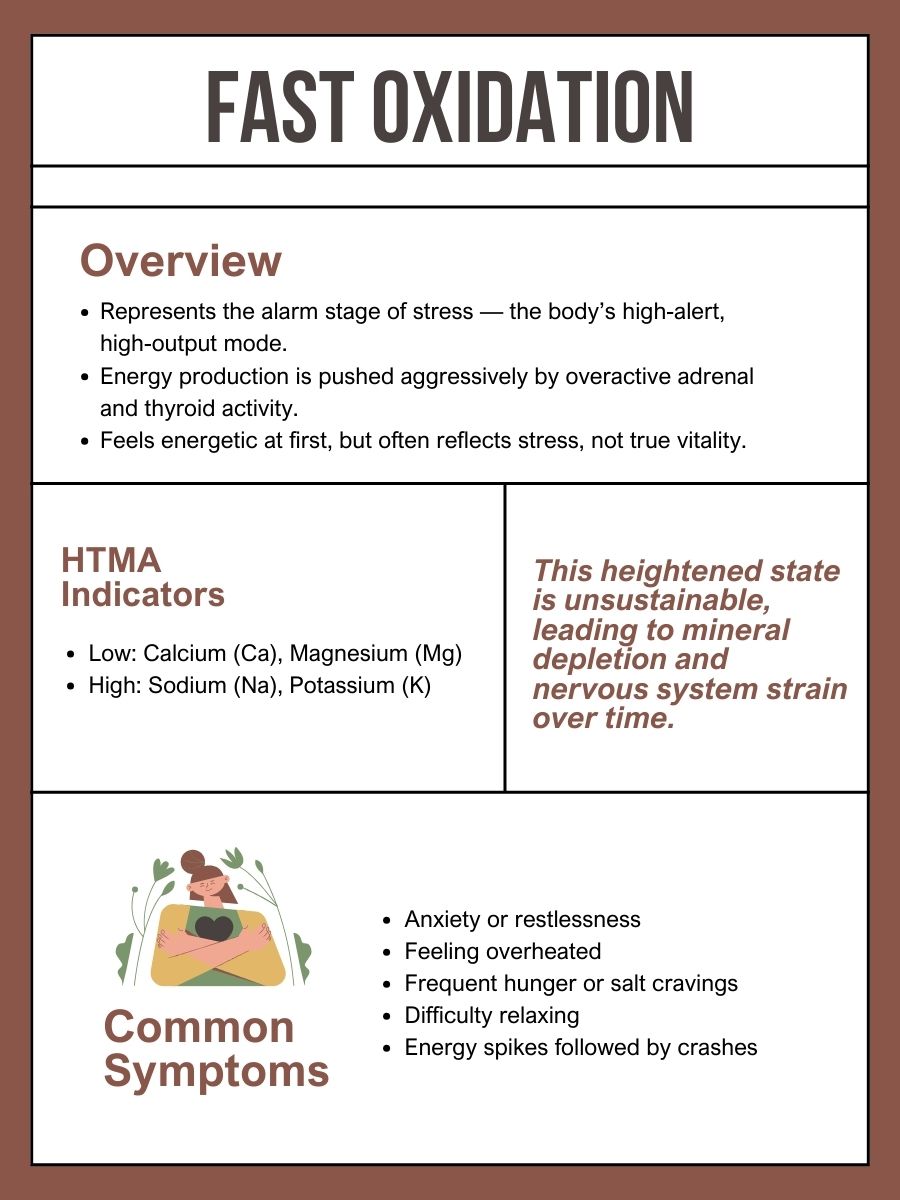
Not necessarily — feeling energized or “driven” as an adult is often interpreted within Nutritional Balancing as a possible sign of stress rather than healthy fast oxidation. When fast oxidation appears in adults, it is generally considered more likely to be stress-driven, potentially influenced by stimulants, sugar, emotional pressure, or other stressors, rather than reflecting genuine long-term vitality. This pattern is associated within the Nutritional Balancing framework with the alarm stage of stress, where the body may increase energy production in response to pressure. Although this can feel productive in the short term, sustained stress may contribute to increased demands on the body’s nutrient and mineral reserves. True, sustainable fast oxidation is considered most common in infants and young children, so adult fast oxidation is generally interpreted in context rather than automatically viewed as a positive baseline.
What's the difference between the Sodium/Magnesium ratio and the Calcium/Potassium ratio on an HTMA report?
These two ratios measure different hormonal systems that together determine oxidation rate. The Sodium/Magnesium (Na/Mg) ratio reflects adrenal gland activity, while the Calcium/Potassium (Ca/K) ratio reflects thyroid cellular effect — and it’s the combination of these two ratios, discovered by Dr. Paul Eck and later refined by Dr. Lawrence Wilson, that determines whether someone shows a fast, slow, or mixed oxidation pattern. When both ratios point in the same direction, a clear fast or slow oxidation pattern emerges; when they point in opposite directions, the result is Mixed Oxidation, where one system is essentially pressing the accelerator while the other applies the brakes, creating unstable energy.
Why does slow oxidation feel restful or calm if it's described as a low-energy state?
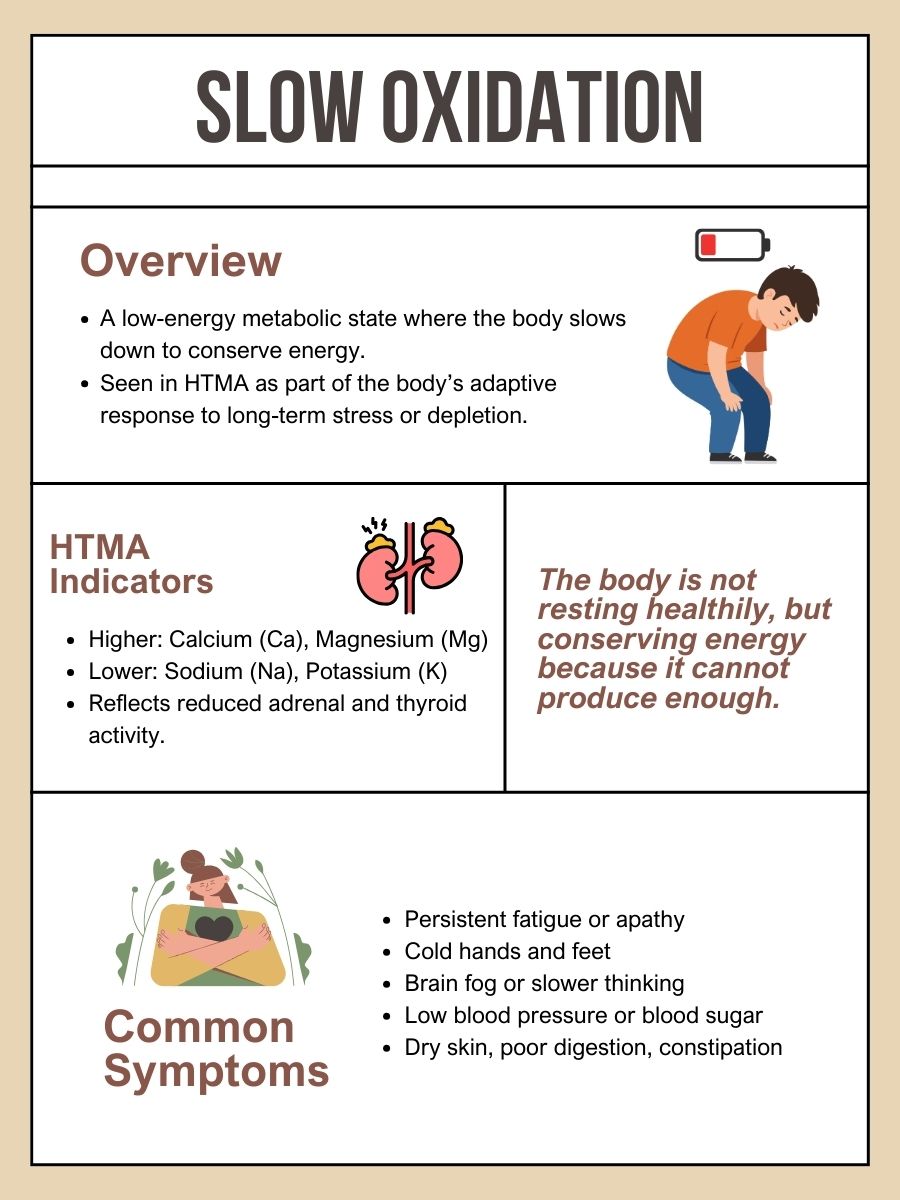
Slow oxidation can feel calm on the surface, but within the Nutritional Balancing framework, this is not necessarily considered a healthy resting state — it is interpreted as the body conserving energy when it cannot sustainably produce more. Dr. Eck described slow oxidation as corresponding to the exhaustion stage of stress, meaning the apparent calmness reflects reduced metabolic activity rather than true relaxation or recovery. On an HTMA, this pattern typically shows as higher calcium and magnesium alongside lower sodium and potassium. Common experiences associated with this “calm” surface may include persistent fatigue, brain fog, cold hands and feet, and low blood pressure or blood sugar, which is why the pattern is interpreted as energy conservation rather than restorative rest.
How long does Mixed Oxidation typically last, and does it need separate treatment?
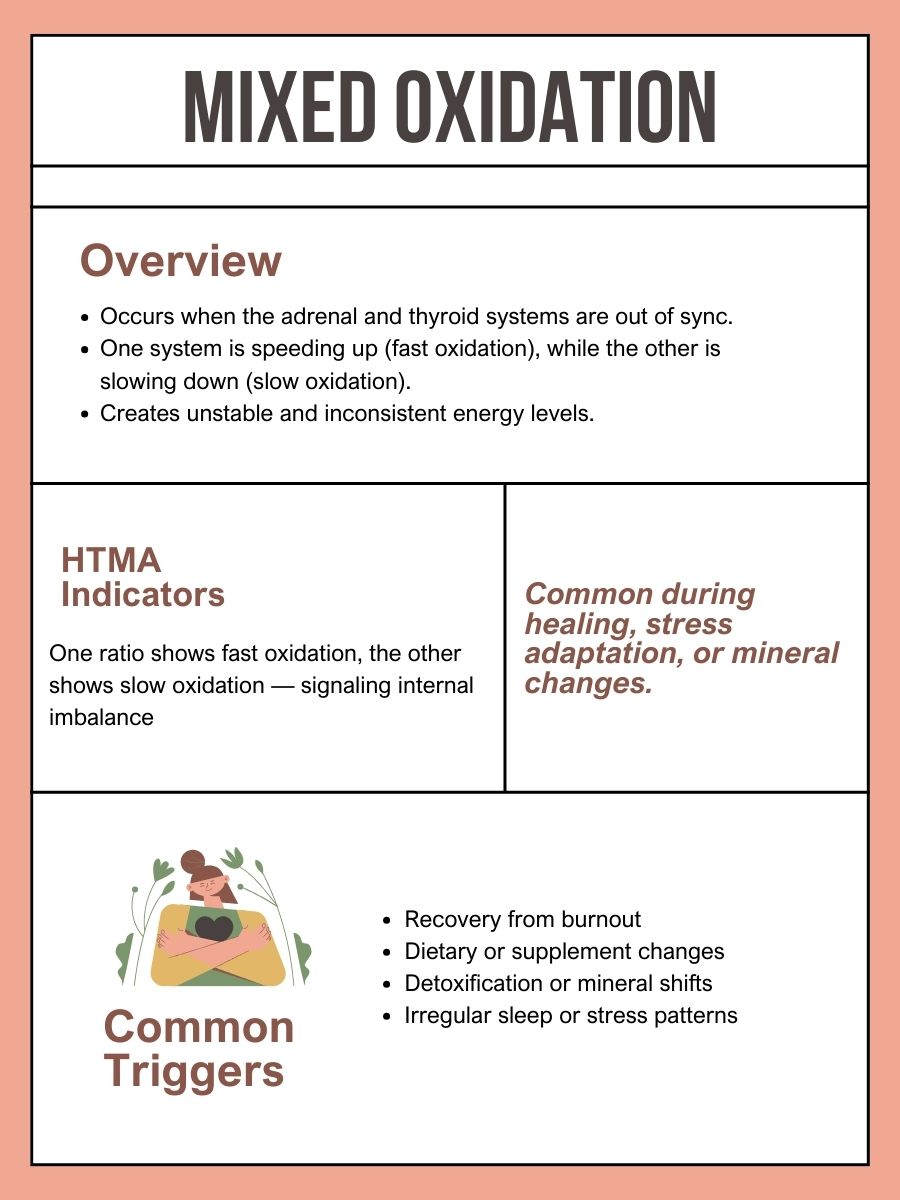
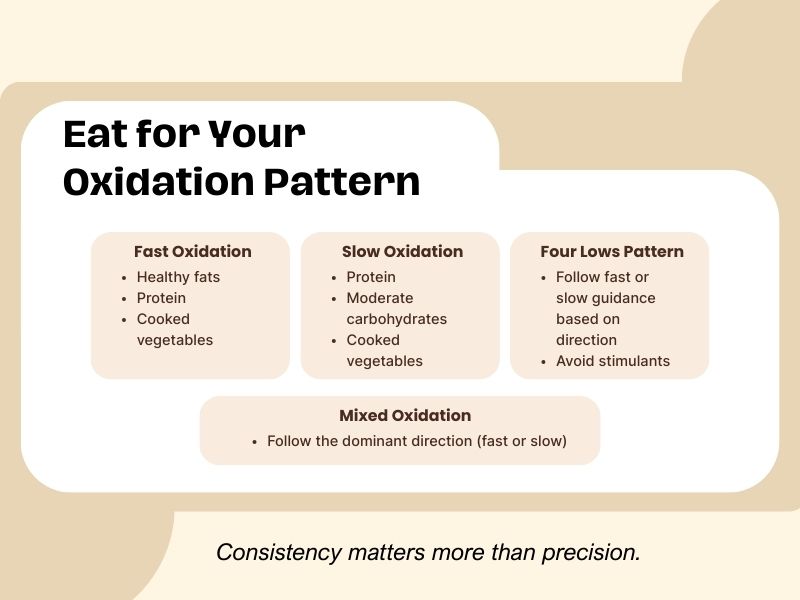
Mixed Oxidation is generally considered temporary, with many mixed patterns resolving over time with consistent support. It occurs when the adrenal and thyroid ratios appear out of sync — one reflecting fast oxidation and the other slow — and may appear during periods of recovery, dietary or supplement changes, detoxification, or irregular sleep and stress patterns. Rather than requiring a completely separate treatment approach, support for Mixed Oxidation focuses within the Nutritional Balancing framework on the dominant direction of the pattern, alongside consistency and rhythm in diet and lifestyle. Because the pattern is inherently transitional, it is typically monitored through retesting rather than treated as a fixed long-term state.
Why do fast and slow oxidizers need such different diets if they're both about "energy"?
Fast and slow oxidizers need different diets because their cells are processing energy through different metabolic pathways at different speeds, so feeding them the same way works against the body rather than with it. At the cellular level, carbohydrates and protein supply pyruvate while fats supply acetyl-CoA, and both pathways feed into the Krebs cycle for steady ATP production — but oxidation rate determines which pathway needs more support. Slow oxidizers benefit from feeding and warming the metabolic flame with protein and moderate carbohydrates, while fast oxidizers need to slow and stabilize energy release using healthy fats and protein. This is why diet recommendations in Nutritional Balancing are built around oxidation pattern rather than generic nutrition advice.
Is Four Lows just a more extreme version of Slow Oxidation?
No, Four Lows is a distinct pattern rather than simply an extreme version of slow oxidation, even though both involve reduced energy output. Slow oxidation typically shows higher calcium and magnesium alongside lower sodium and potassium, reflecting a body that is still applying brakes within a relative ratio system. Four Lows, by contrast, occurs when all four macrominerals, calcium, magnesium, sodium, and potassium, are below their ideal ranges simultaneously, which Dr. Eck described as a “dead battery” state where the body lowers output to the bare minimum needed for survival. This makes Four Lows a deeper depletion state requiring nourishment without any stimulation, distinguishing it from the relative conservation seen in standard slow oxidation.
Can stimulants like caffeine make someone look like a fast oxidizer on an HTMA even if they're not naturally one?
Yes, stimulants can temporarily push an adult’s metabolism toward a fast oxidation pattern without necessarily reflecting underlying vitality. Adult fast oxidation is generally interpreted within the Nutritional Balancing framework as potentially stress-driven, with stimulants, sugar, emotional pressure, or other stressors capable of increasing metabolic demand. When a stressor such as caffeine or high sugar intake is reduced or removed, the mineral pattern may shift, potentially revealing a different underlying pattern. This is one reason HTMA results are interpreted alongside lifestyle context rather than in isolation, and why retesting after stabilising habits may provide additional insight into how the mineral pattern changes over time.