

HTMA Oxidation Rates: Understanding How Your Body Produces Energy
Ever wonder why some people seem naturally energized while others feel stuck in slow motion — no matter how well they eat or how much they rest?
Hair Tissue Mineral Analysis (HTMA) offers a different lens. It reveals your oxidation rate — how efficiently your body converts food into usable energy at the cellular level.
This page is an overview. Its role is to help you understand the major oxidation patterns and how they differ. Each pattern links to a deeper guide with detailed explanations, diet considerations, and support strategies.
You don’t need to decide your exact oxidation type just by reading this page.
Think of this as orientation — noticing patterns, not labeling yourself.
The Four Oxidation Patterns at a Glance
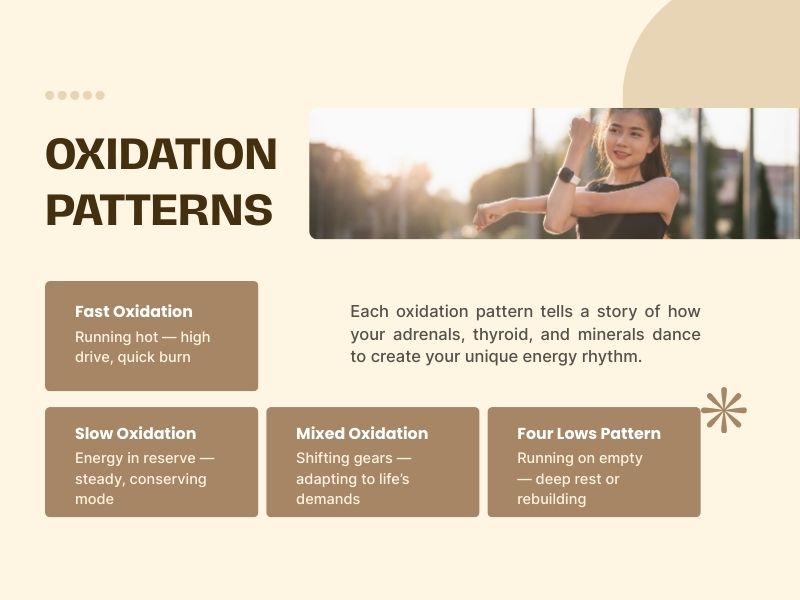
HTMA identifies four primary energy patterns:
- Fast Oxidation – the metabolic engine runs hot and fast
- Slow Oxidation – the body applies the brakes to conserve energy
- Mixed Oxidation – shifting between fast and slow depending on stress and demand
- Four Lows Pattern – deep depletion, burnout, or a protected rebuilding phase
Each pattern reflects how your adrenal glands, thyroid cellular effect, and mineral balance are interacting — all visible through a simple hair sample.
Energy: Your Body’s Electricity
Energy isn’t just about motivation or sleep quality. At a biological level, it’s chemical.
As Dr. Paul Eck explained:
“It is the balance of the minerals within the body that controls the rate at which energy is produced and used.”
Minerals act like conductors in an electrical system. They regulate how quickly fuel is burned, how the nervous system responds to stress, and how well cells repair and regenerate.
Your oxidation rate describes the pace at which this internal system runs.
When that pace is too fast, too slow, or uneven, you feel it — in energy, mood, focus, and resilience.
HTMA becomes valuable because it shows how your minerals have been working together over time, not just what’s happening in the moment.
What Is Oxidation Rate, Really?
Oxidation rate reflects how efficiently your body converts food into usable cellular energy (ATP).
It is primarily influenced by:
- adrenal gland activity
- thyroid cellular effect
- the balance between calcium, magnesium, sodium, and potassium
Dr. Eck discovered that oxidation rate could be measured using mineral ratios on a hair analysis. His colleague, Dr. Lawrence Wilson, later refined how these ratios reflect adrenal and thyroid function.
The Two Key Ratios in HTMA
- Sodium / Magnesium (Na/Mg) – adrenal activity
- Calcium / Potassium (Ca/K) – thyroid cellular effect
From these ratios, oxidation patterns emerge.
Oxidation Rate Across the Life Cycle
Oxidation rate is not fixed. It changes with age, stress load, nutrition, and mineral reserves.
In Hair Tissue Mineral Analysis (HTMA), true fast oxidation is most common in infants and young children. During early growth, the adrenal and thyroid systems are naturally active, driving rapid energy production and tissue development.
As the body matures, metabolism naturally slows. By adulthood, the majority of people transition into slow oxidation, reflecting higher cumulative stress, mineral depletion, and reduced adrenal and thyroid output. Research in Nutritional Balancing suggests that 80–85% of adults fall into slow oxidation patterns.
When fast oxidation appears in adults, it is usually stress-driven, not a sign of high vitality. Stimulants, sugar, emotional pressure, or toxic metals can temporarily push metabolism into a faster state. Once the stressor is removed, the body typically shifts back toward slow oxidation.
This life-cycle progression explains why many people feel energetic in youth, then experience fatigue, burnout, or slower recovery later in life — even when standard blood tests appear normal.
HTMA provides a long-term view of metabolic adaptation, showing how the body has been responding to stress and energy demands over time, rather than offering a single snapshot. With this context, the four primary oxidation patterns seen on HTMA become easier to understand.
The Mineral–Hormone Connection (Briefly)
When adrenal and thyroid activity is elevated:
- sodium and potassium rise
- calcium and magnesium become more soluble
This corresponds with fast oxidation.
When adrenal and thyroid activity is reduced:
- sodium and potassium fall
- calcium and magnesium accumulate in tissues
This corresponds with slow oxidation.
These mineral shifts do not represent good or bad health. They show how the body is adapting to stress, nutrition, and life demands.
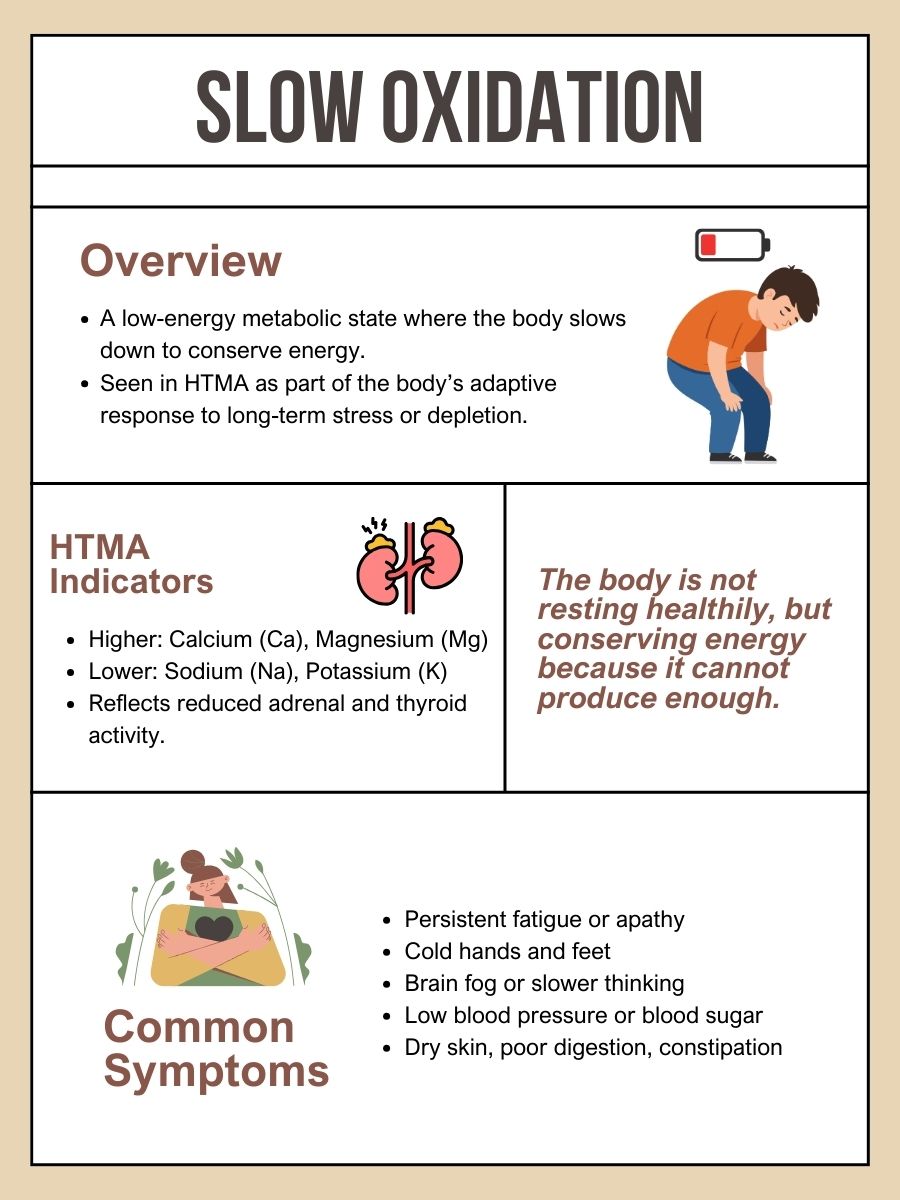
Slow Oxidation: When the Body Hits the Brakes
Slow oxidation is a low-energy metabolic state.
On an HTMA, it typically shows:
- higher calcium and magnesium
- lower sodium and potassium
This reflects reduced adrenal and thyroid cellular activity. Dr. Eck described slow oxidation as identical to the exhaustion stage of stress.
Although it sounds restful, this is not a healthy parasympathetic state. The body is conserving energy because it cannot sustainably produce more.
Common experiences include:
- persistent fatigue or apathy
- cold hands and feet
- brain fog or slower thinking
- low blood pressure or blood sugar
- dry skin, poor digestion, or constipation
Read more: Slow Oxidation (HTMA)
Fast Oxidation: The Body in Overdrive
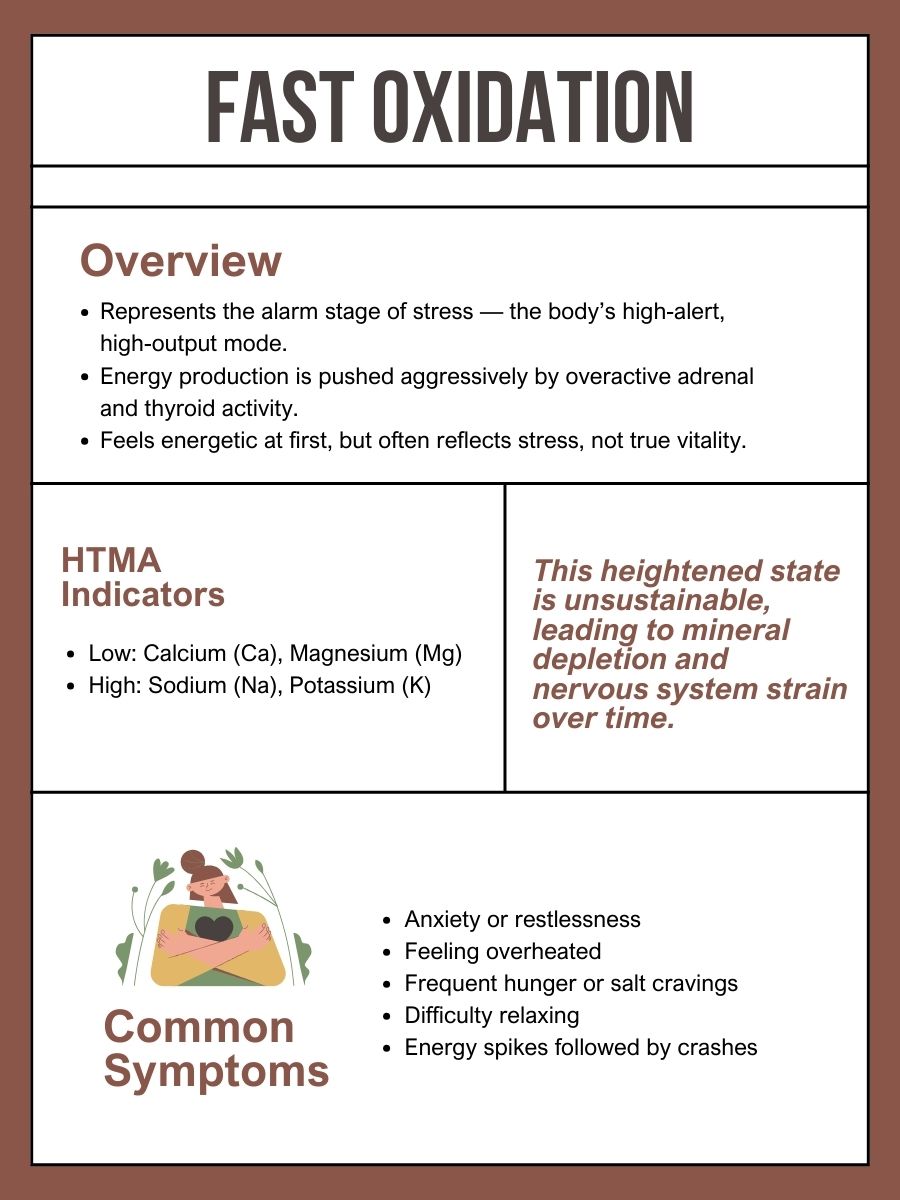
Fast oxidation reflects the alarm stage of stress.
On an HTMA, it typically shows:
- low calcium and magnesium
- high sodium and potassium
Here, the adrenals and thyroid are pushing energy production aggressively. This can feel productive at first, but it often reflects pressure rather than true vitality.
Common experiences include:
- anxiety or restlessness
- feeling overheated
- frequent hunger or salt cravings
- difficulty relaxing
- energy spikes followed by crashes
Over time, fast oxidation burns through mineral reserves and strains the nervous system.
Read more: Fast Oxidation (HTMA)
Mixed Oxidation: The Body in Transition
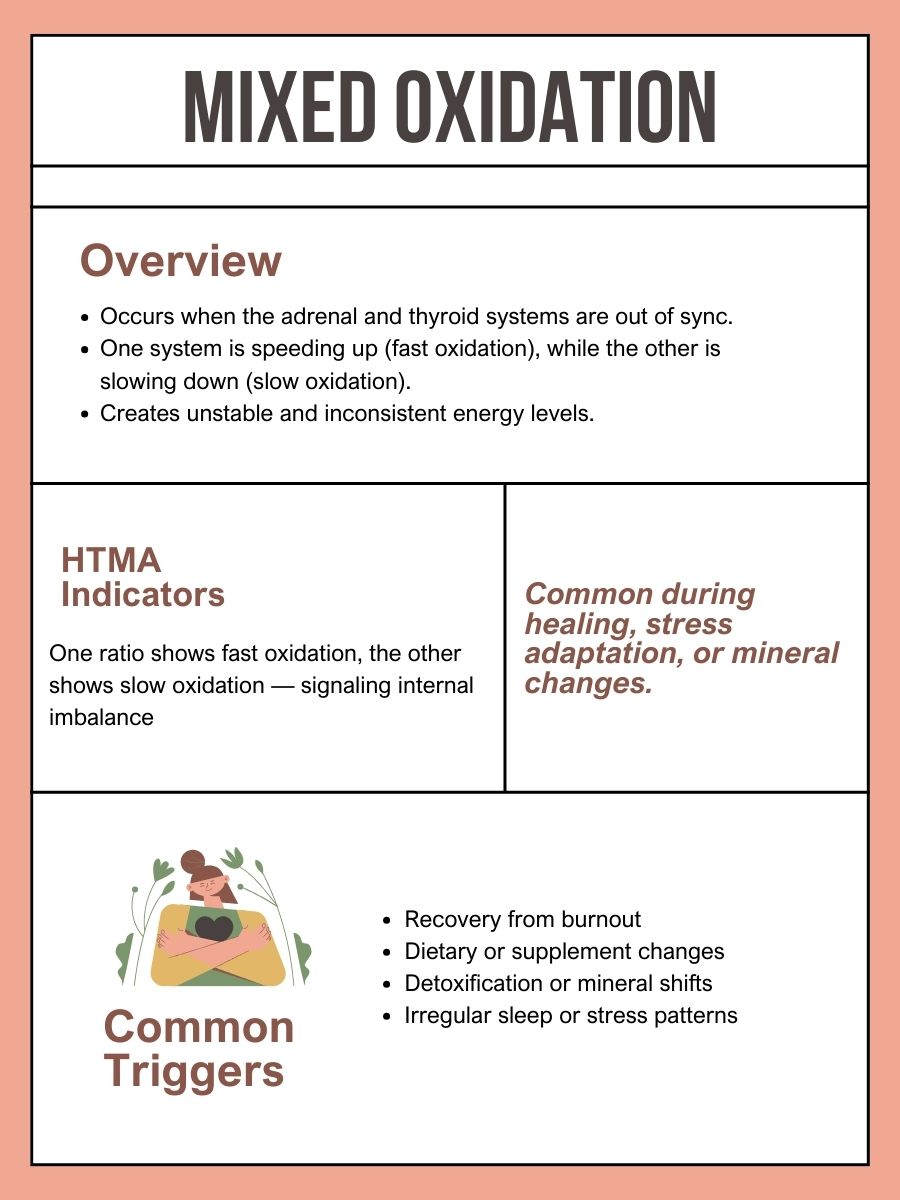
Mixed oxidation occurs when adrenal and thyroid systems are out of sync.
One ratio reflects fast oxidation while the other reflects slow. One system presses the accelerator while the other applies the brakes.
This creates unstable, inconsistent energy.
Mixed oxidation is temporary by nature and often appears during:
- recovery from burnout
- dietary or supplement changes
- detoxification or mineral shifts
- irregular sleep or stress patterns
With consistent support, most mixed patterns resolve within a few months.
Read more: Mixed Oxidation (HTMA)
Four Lows Pattern: When the System Conserves Everything to Survive
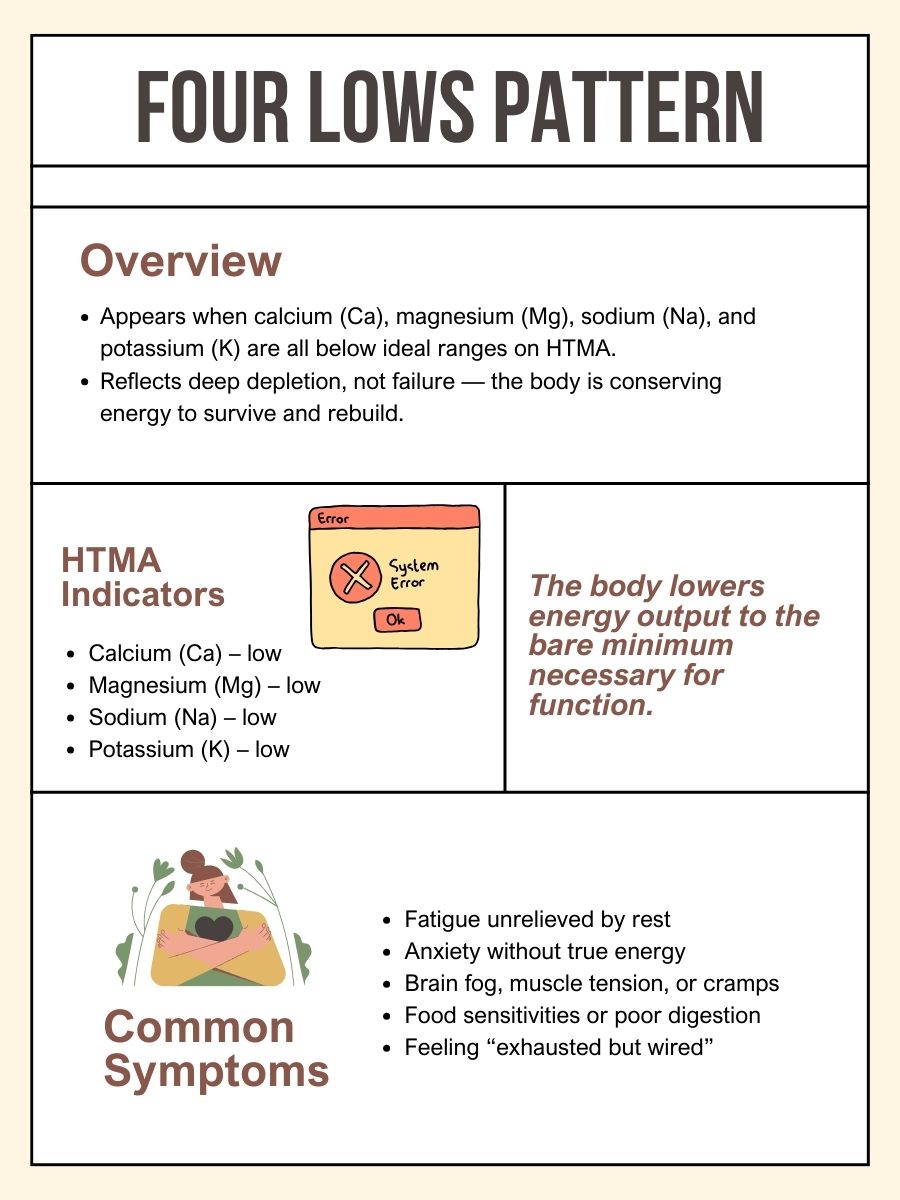
The Four Lows pattern appears when calcium, magnesium, sodium, and potassium are all below their ideal ranges.
This reflects deep depletion, not failure.
Dr. Eck described this as a “dead battery” state — the body lowers output to the minimum necessary for survival.
Four Lows often follows:
- prolonged emotional or physical stress
- years of overwork or perfectionism
- stimulant use layered over exhaustion
- chronic malabsorption or nutrient depletion
It can also appear temporarily during healing, when the body finally slows down enough to rebuild.
Common experiences include:
- fatigue that sleep does not resolve
- anxiety without real energy
- brain fog, muscle tension, or cramps
- food sensitivities or digestive difficulty
- feeling exhausted but wired
Read more: Four Lows Pattern (HTMA)
Why Diet Needs to Differ by Oxidation Pattern
Diet works best when it follows the oxidation pattern rather than forcing energy prematurely.
At the cellular level:
- carbohydrates and protein supply pyruvate
- fats supply acetyl-CoA
Both are required for steady ATP production in the Krebs cycle. Oxidation rate determines which pathway needs support.
- Slow oxidizers need to feed and warm the metabolic flame
- Fast oxidizers need to slow and stabilize energy release
- Mixed oxidizers need consistency and rhythm
- Four Lows requires nourishment without stimulation
Cooked vegetables support all patterns by supplying minerals that regulate energy production.
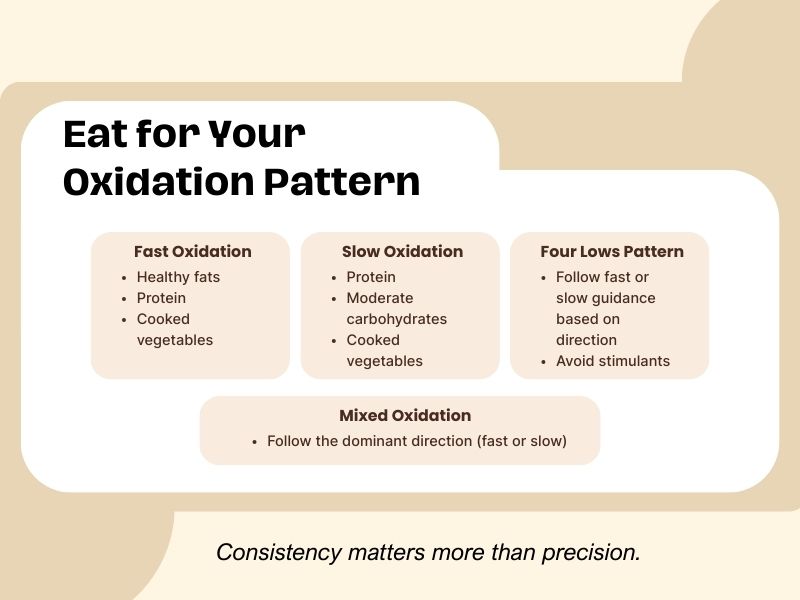
How to Eat for Your Oxidation Pattern
- Slow Oxidation: protein, moderate carbohydrates, cooked vegetables
- Fast Oxidation: healthy fats, protein, cooked vegetables
- Mixed Oxidation: follow the dominant direction
- Four Lows: follow fast or slow guidance without stimulants, based on direction
Consistency matters more than precision.
Supplement Guidelines (Overview Only)
Supplement needs shift every three to four months and are best guided by retesting.
In general:
- slow oxidation focuses on rebuilding output
- fast oxidation focuses on calming overdrive
- mixed oxidation requires gentle, directional support
- four lows requires low-dose, non-stimulating nourishment
Detailed protocols belong in the individual oxidation guides.
The Takeaway: From Awareness to Action
Fast, slow, mixed, and Four Lows are not diagnoses. They are adaptive stages.
- Fast oxidation reflects pressure
- Slow oxidation reflects conservation
- Mixed oxidation reflects transition
- Four Lows reflects protection
None are permanent.
As mineral balance improves, energy production becomes more efficient — and when energy improves, healing follows naturally.
Your body is not random. It is responding intelligently to its environment.
Ready to Learn Your Oxidation Pattern?
HTMA shows how your body has been producing energy over time, not just today.
If you want clarity on what your system is ready for right now, an HTMA test provides the map.
Read more: Learn Your Oxidation Pattern Through HTMA