

A Simple, Step-by-Step Guide to Mineral Balance, Stress Patterns & Toxic Metals
How to Read Your HTMA Result
If you’ve just received your Hair Tissue Mineral Analysis (HTMA) report, it’s normal to feel both relief and confusion.
Relief — because something finally shows up.
Confusion — because the numbers, ratios, and patterns don’t immediately tell you what to do.
This guide helps you read your HTMA results clearly and calmly, without overwhelm.
You’ll learn:
- what to look at first
- how each section of your report fits together
- why certain symptoms finally make sense
- and how to tell what matters now versus what can wait
This is an orientation guide, not a diagnosis or protocol.
Why HTMA Can Explain Symptoms Blood Tests Miss
HTMA looks at mineral patterns stored in tissues over time, rather than what’s circulating in the blood at a single moment.
This makes it especially useful if you’ve experienced:
- chronic fatigue or burnout
- poor stress tolerance
- mood changes or anxiety
- blood sugar instability
- slow or inconsistent recovery despite “doing everything right”
Blood tests often appear normal because the body prioritises keeping blood values stable — even when tissues are depleted, overloaded, or compensating.
HTMA helps answer a different question:
What has my body been adapting to — and at what cost?
Step 1: Oxidation Rate — Your Metabolic Pace
The first place to look on an HTMA report is your oxidation rate.
Oxidation rate reflects how efficiently your body converts food into energy.
In simple terms, it shows how fast or slow your system is running right now.
HTMA estimates oxidation rate using two ratios:
- Calcium to Potassium (Ca/K)
- Sodium to Magnesium (Na/Mg)
From these, metabolism is described as:
- slow oxidation
- fast oxidation
- mixed oxidation
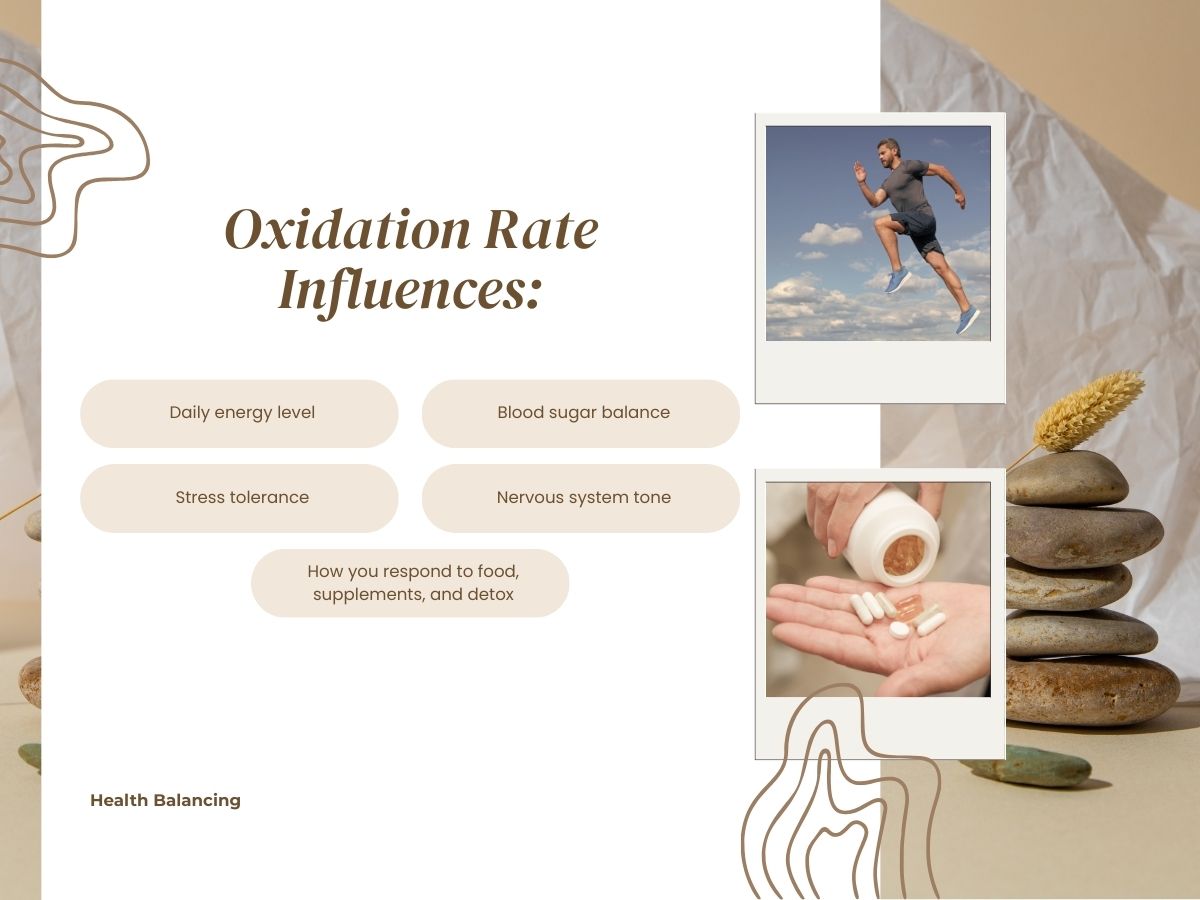
Your oxidation rate influences:
- daily energy levels
- stress tolerance
- blood sugar balance
- nervous system tone
- how you respond to food, supplements, and detox
Many people with fatigue, burnout, or anxiety are slow oxidisers, even if they feel wired rather than slow. This often explains why stimulation, fasting, or aggressive detox hasn’t helped.
Read more: HTMA Oxidation Rates: Understanding How Your Body Produces Energy
Step 2: Mineral Levels — Depletion vs Accumulation
Next, review mineral levels, especially the four primary electrolytes:
- calcium
- magnesium
- sodium
- potassium
On HTMA, mineral levels are best understood as patterns, not isolated numbers.
- High levels don’t automatically mean excess
- Low levels don’t always mean deficiency
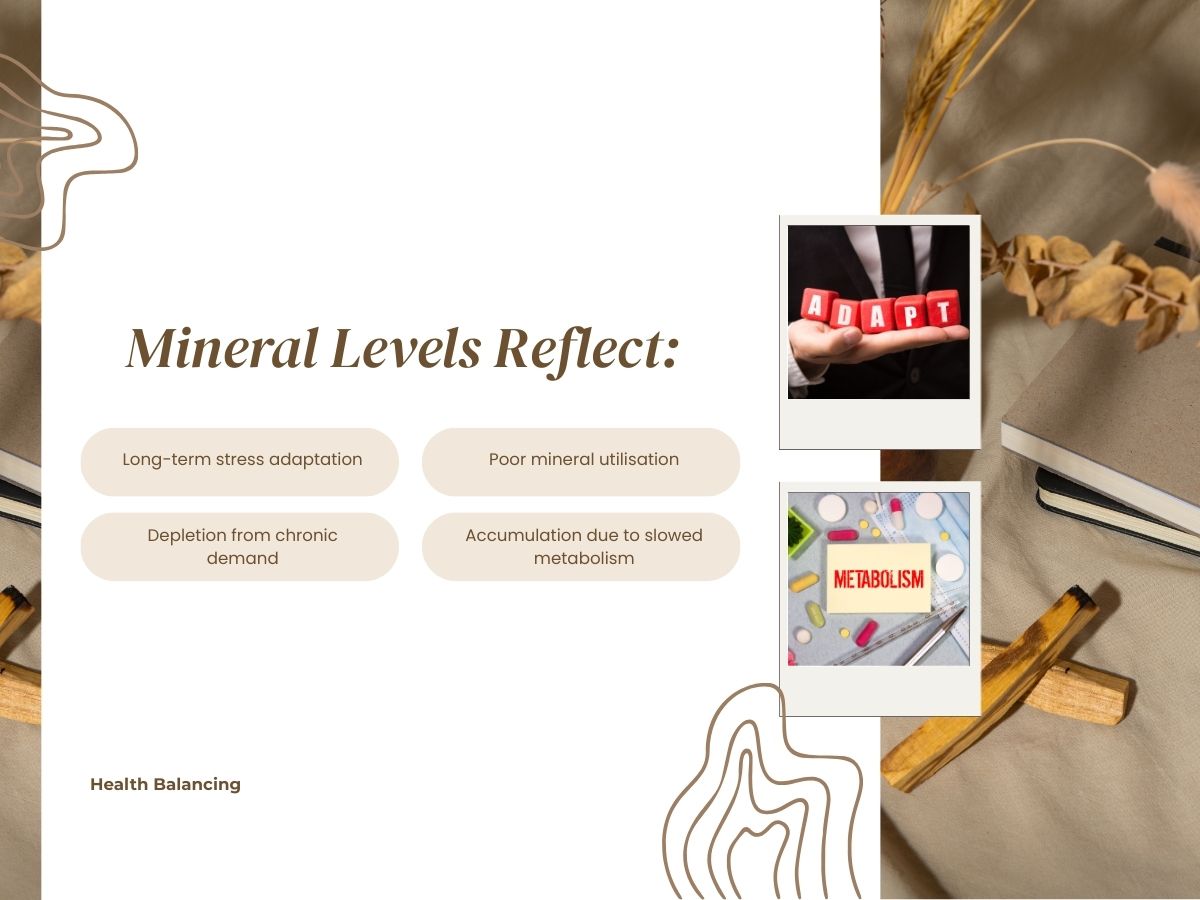
Instead, levels often reflect:
- long-term stress adaptation
- poor mineral utilisation
- depletion from chronic demand
- accumulation due to slowed metabolism
For example:
- Elevated calcium commonly reflects stress adaptation or slowed metabolic activity
- Low magnesium often reflects chronic tension or difficulty relaxing
- Low sodium and potassium frequently indicate adrenal exhaustion or burnout
These patterns help explain why pushing harder often leads to setbacks rather than progress.
Read more: Calcium patterns and stress adaptation
Read more: Magnesium and nervous system balance
Read more: Sodium and potassium and adrenal health
Other minerals (such as zinc, copper, iron, and selenium) matter too, but are always interpreted in context, not alone.
Read more: Complete HTMA mineral guide
Step 3: Mineral Ratios — Where Symptoms Start to Make Sense
Mineral ratios are often where HTMA results finally click.
While mineral levels show what is present, ratios show how the body is regulating energy, stress, and recovery. They reflect long-term adaptation rather than simple supply.
Ratios often explain:
- fluctuating energy
- feeling wired but exhausted
- sensitivity to supplements or detox
- why some approaches help briefly, then backfire
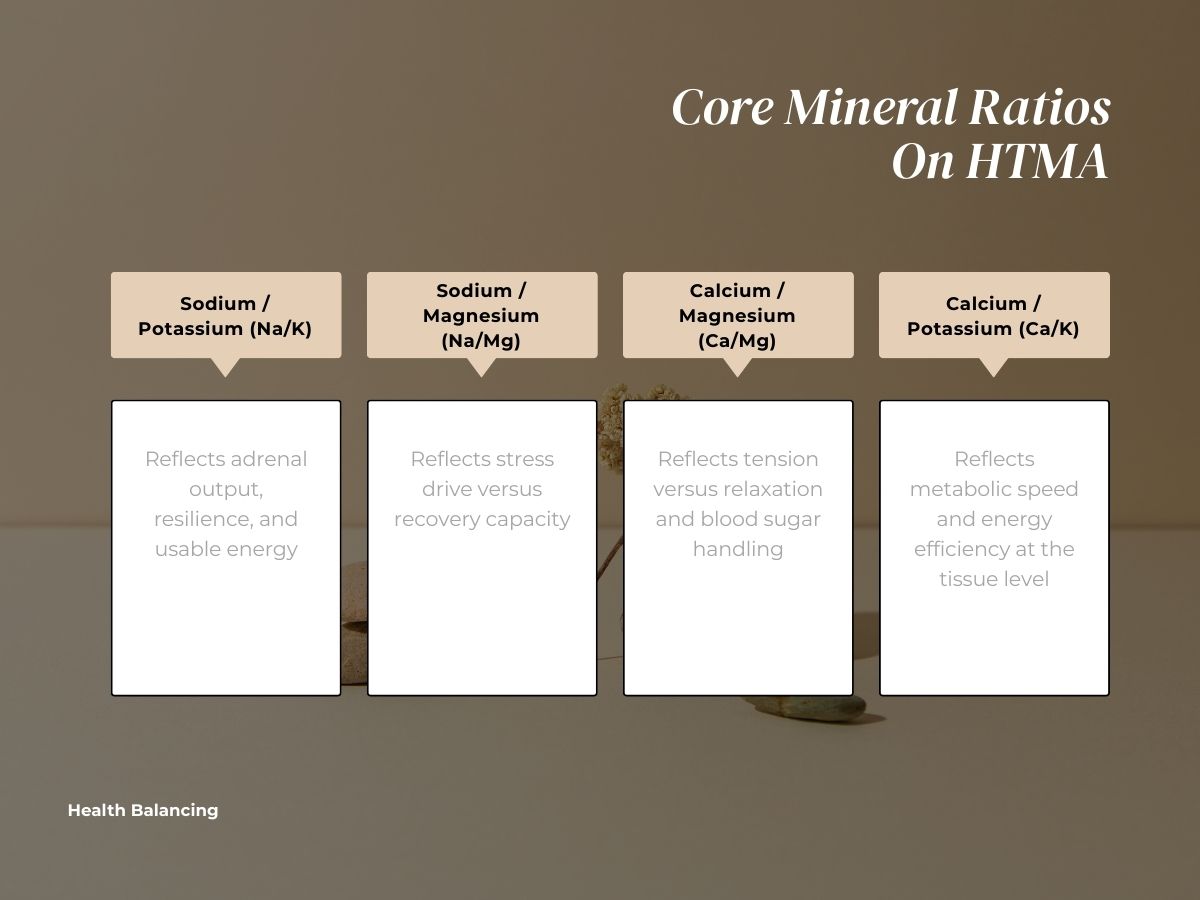
Core Mineral Ratios on HTMA
HTMA commonly evaluates four key ratios:
Stress, energy & vitality
- Sodium / Potassium (Na/K) – reflects adrenal output, resilience, and usable energy
- Sodium / Magnesium (Na/Mg) – reflects stress drive versus recovery capacity
Blood sugar & nervous system balance
- Calcium / Magnesium (Ca/Mg) – reflects tension versus relaxation and blood sugar handling
Metabolic pace
- Calcium / Potassium (Ca/K) – reflects metabolic speed and energy efficiency at the tissue level
In classical HTMA interpretation, Na/K and Ca/Mg are often prioritised because they strongly reflect overall vitality and regulation.
When ratios are significantly out of balance, symptoms may include:
- anxiety, irritability, or emotional flatness
- fatigue that doesn’t improve with rest
- poor stress tolerance
- strong reactions to supplements or detox
These are not failures. They are signals that stabilisation and rebuilding are needed before pushing further.
Read more: Mineral Ratios on HTMA
Step 4: Common HTMA Patterns — The Bigger Picture Behind Burnout
HTMA often reveals mineral patterns that explain why recovery feels slow or unpredictable.
Patterns don’t diagnose disease.
They describe adaptive states that develop after prolonged stress, illness, depletion, or long-term compensation.
These patterns often explain why:
- rest alone doesn’t restore energy
- detox makes symptoms worse
- progress feels non-linear
- “doing everything right” still doesn’t work
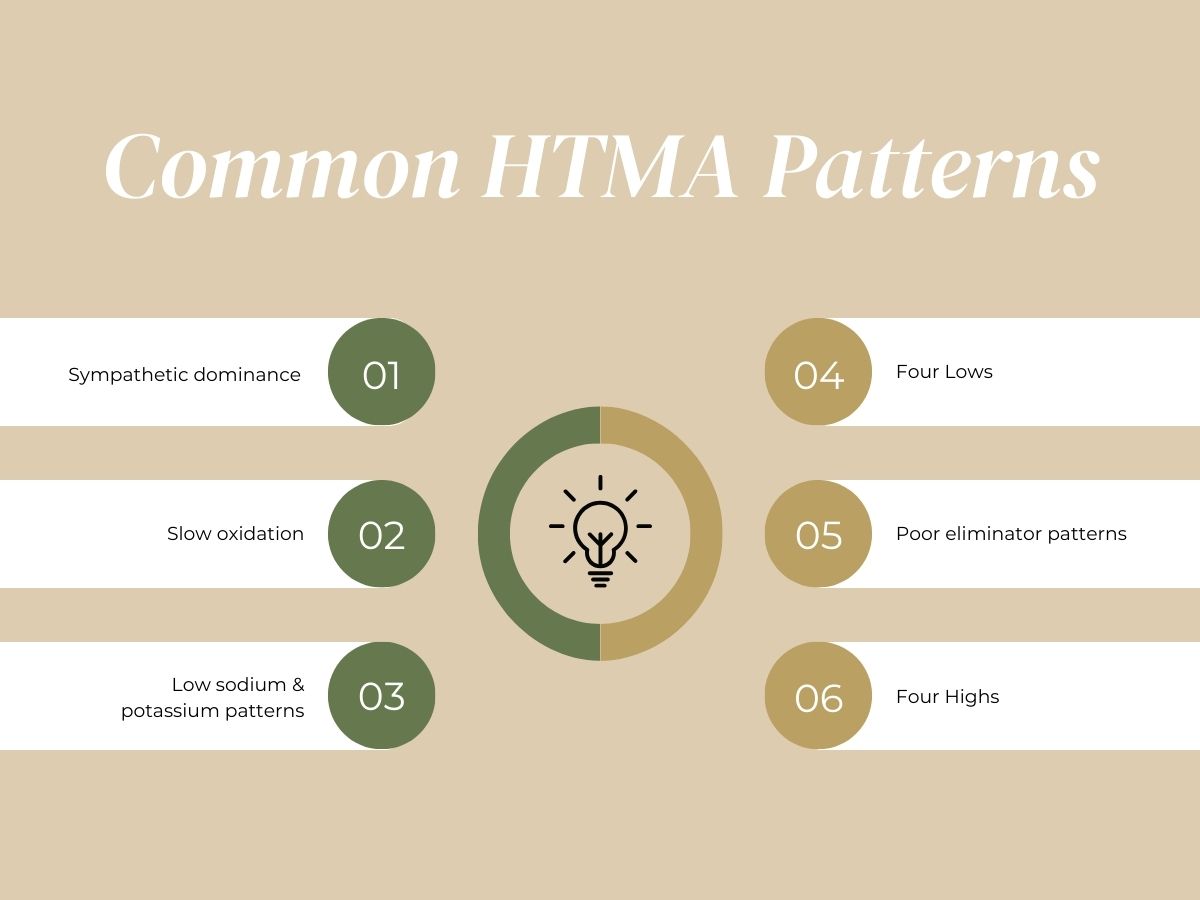
Common patterns include:
- sympathetic dominance (chronic fight-or-flight)
- slow oxidation (energy conservation)
- low sodium & potassium patterns (reduced stress tolerance)
- Four Lows (deep exhaustion and low reserves)
- poor eliminator patterns (limited detox capacity)
- Four Highs (acute stress and inflammation)
Recognising patterns shifts the focus from urgency to timing, pacing, and rebuilding capacity.
Read more: Mineral Patterns: The Bigger Picture Behind Symptoms
Step 5: Toxic Metals — It’s About Capacity, Not Panic
Seeing toxic metals on an HTMA report can feel alarming.
Mercury.
Lead.
Aluminium.
Cadmium.
HTMA is not a simple exposure test and does not diagnose heavy metal poisoning. Instead, it shows how well the body is handling what it’s carrying.
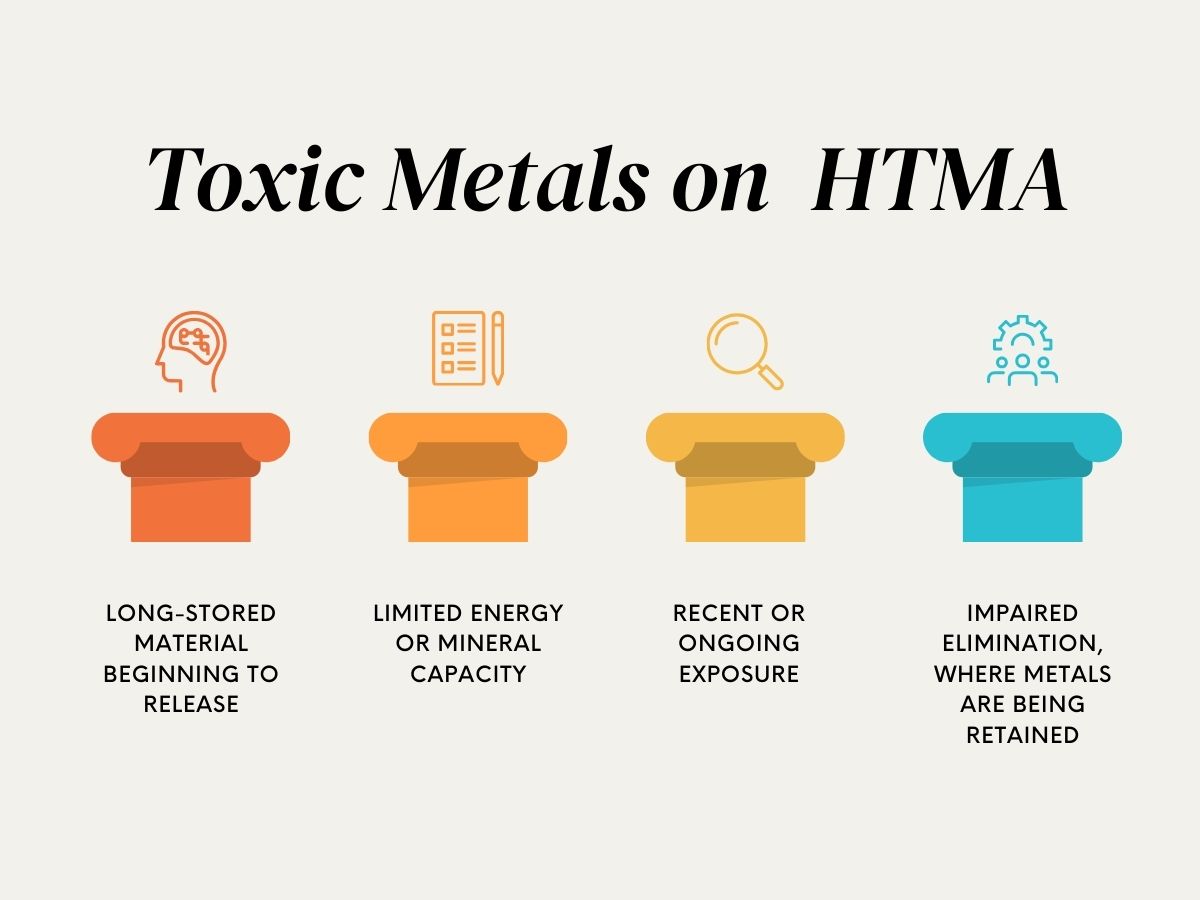
Toxic metals on HTMA may reflect:
- recent or ongoing exposure
- long-stored material beginning to release
- impaired elimination, where metals are being retained
- limited energy or mineral capacity
Key points:
- Low metal levels don’t always mean “no metals”
- Metals may rise on a retest as elimination improves
- Detox symptoms don’t always match lab values
In chronic stress or exhaustion, the body may temporarily retain metals as a survival strategy. In these cases, rebuilding capacity matters more than forcing detox.
HTMA helps answer a critical question:
When does detox support healing — and when does it interfere with it?
Read more: Mercury on HTMA — why timing matters
Read more: Lead on HTMA: Why Blood Tests Miss It and What It Really Means
Read more: Detox readiness explained
How to Use Your HTMA Results
HTMA is not about fixing everything at once.
It helps you understand:
- where your body is under strain
- what it has been prioritising
- what it can realistically handle right now
Most HTMA reports point toward:
- restoring mineral balance
- stabilising energy and blood sugar
- supporting adrenal and nervous system regulation
- improving digestion and absorption
- rebuilding capacity before detox
When these foundations are respected, progress becomes steadier and more sustainable.
Want Help Interpreting Your HTMA?
You can use this guide to orient yourself to your report.
If you’d like personalised support, a practitioner-prepared HTMA interpretation connects mineral levels, ratios, patterns, and symptoms into a clear picture with practical next steps — without overwhelm.
Read more: HTMA interpretation support
Final thought
HTMA isn’t about doing more.
It’s about understanding what your body needs first — and responding in the right order.

Frequently Asked Questions About HTMA Results
What is the first thing to look at on an HTMA report?
The first thing to look at is your oxidation rate. It shows how efficiently your body is producing energy and provides the context needed to interpret mineral levels, ratios, and detox capacity correctly.
Do high mineral levels on HTMA mean toxicity?
Not necessarily. High mineral levels often reflect poor utilisation or stress-related accumulation rather than excess intake or toxicity. HTMA results must be interpreted in context with ratios, oxidation rate, and overall patterns.
Why does detox sometimes make symptoms worse?
Detox is an energy-dependent process. If mineral reserves, adrenal function, or nervous system regulation are low, elimination can outpace capacity, leading to increased fatigue, anxiety, or sensitivity.
Why can toxic metals increase on a retest?
Toxic metals may rise on a retest when energy and mineral balance improve. This often indicates better elimination and release of stored metals, not worsening toxicity.
Can HTMA explain symptoms when blood tests are normal?
Yes. HTMA reflects long-term tissue mineral patterns rather than short-term blood levels, which helps explain chronic symptoms such as fatigue, burnout, and poor stress tolerance that may not appear on standard blood tests.