
Do you feel tired, but unable to fully rest?
Productive, yet secretly exhausted?
Calm on the outside, but wired inside?
You might not be “lazy,” unmotivated, or failing at self-care.
You may be dealing with sympathetic dominance — a nervous system and mineral imbalance that keeps your body stuck in fight-or-flight, even when there’s no real emergency.
This pattern doesn’t show up clearly on blood tests.
But it shows up loudly in how you feel.
Article Contents
- What Is Sympathetic Dominance?
- The Key HTMA Indicator: Low Potassium
- The Mechanism: Why Sympathetic Dominance Keeps Potassium Low
- Why Fight-or-Flight Is Depleting
- Common Symptoms of Sympathetic Dominance
- Why Pushing Harder Makes It Worse
- How Nutritional Balancing Helps
- What Healing Often Feels Like
- You’re Not Lazy — You’re Depleted
- How HTMA Can Help
What Is Sympathetic Dominance?
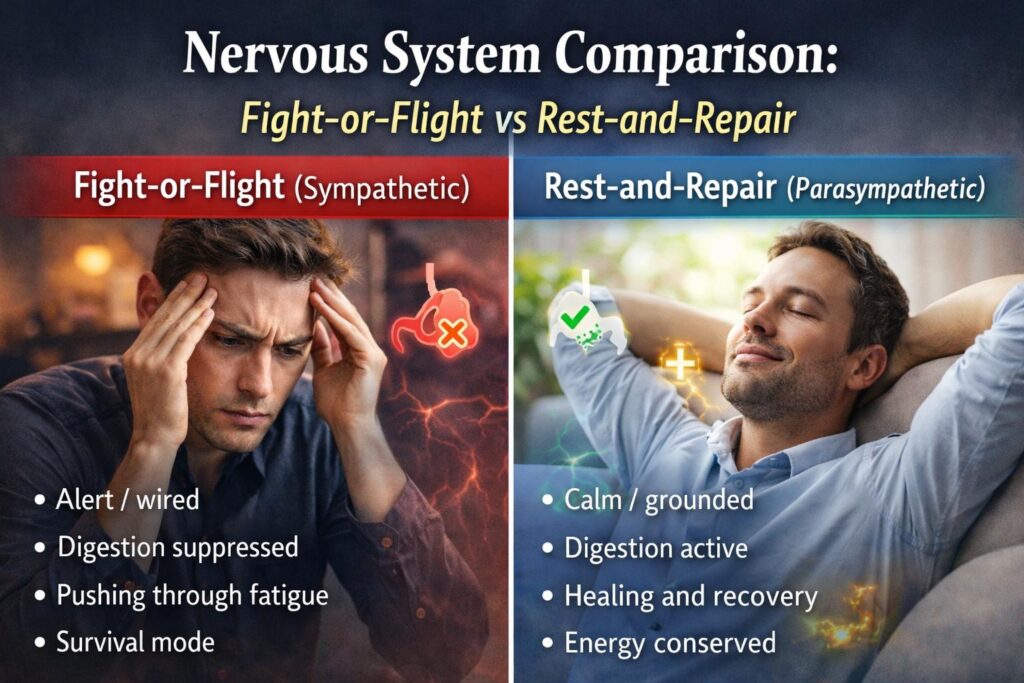
Sympathetic dominance means your body is overusing its emergency system just to function day to day.
The sympathetic nervous system — also known as fight-or-flight — is designed for short-term survival, not long-term living.
When it stays switched on:
- Energy reserves get depleted
- Digestion and detox slow down
- The nervous system loses flexibility
- Rest starts to feel uncomfortable
Over time, this leads to burnout that doesn’t resolve with sleep or willpower.
The Key HTMA Indicator of Sympathetic Dominance
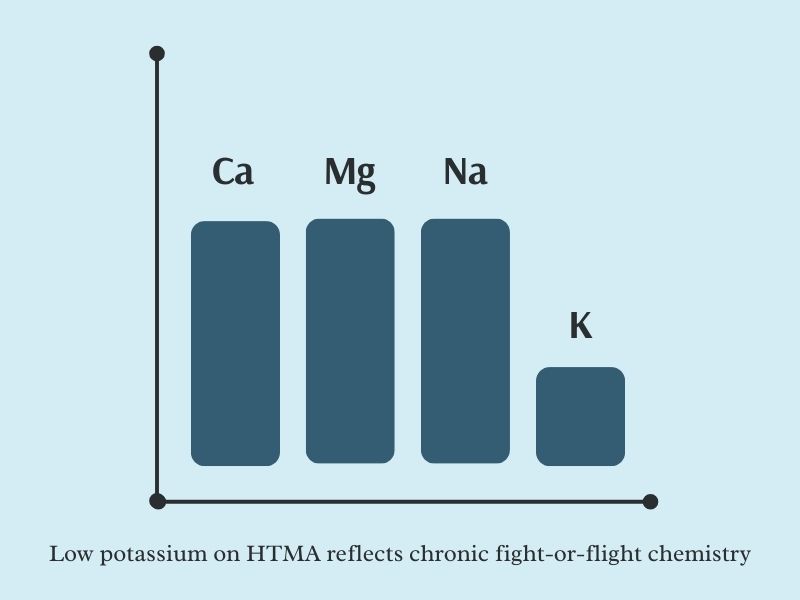
On a Hair Tissue Mineral Analysis (HTMA), the single most important indicator of sympathetic dominance is:
👉 A hair potassium level of 4 mg% or less
That’s it.
Low potassium at the tissue level reflects chronic overuse of fight-or-flight.
What This Means
Potassium is closely tied to:
- Nervous system regulation
- Adrenal resilience
- Cellular energy balance
When potassium is low:
- The body is compensating by pushing
- The nervous system stays “on”
- Depletion is already happening
In simple terms:
Low potassium means the body has been pushing itself for too long — and it’s paying the price.
The Mechanism: Why Sympathetic Dominance Keeps Potassium Low
Low potassium in sympathetic dominance isn’t a dietary issue — it’s a nervous system survival pattern.
When stress has been prolonged, adrenal hormone output begins to decline. To compensate, the body shifts control to the sympathetic nervous system to maintain basic function.
In short:
- Hormonal regulation weakens
- The nervous system takes over
- Fight-or-flight stays switched on
This directly affects potassium.
How Sympathetic Dominance Depletes Potassium
1. Stress Signals Push Potassium Out of Cells
Chronic sympathetic activation keeps nerves and muscles primed. To maintain alertness, potassium is pushed out of cells — where it cannot be retained long-term — leading to gradual tissue depletion.
2. The Body Prioritises Survival Over Cellular Repair
As adrenal output drops, the kidneys favour circulation and blood pressure. Sodium is prioritised, while potassium is sacrificed. This trade-off helps short-term survival but worsens long-term depletion.
3. Sympathetic Dominance Blocks Potassium Re-Entry
For potassium to rise in tissues, the body needs parasympathetic tone, cellular energy, and insulin sensitivity. Fight-or-flight suppresses all three, so potassium intake often fails to correct the pattern.
The Role of Copper and Toxic Metals
Hidden copper imbalance and toxic metals (such as mercury, lead, and aluminum) further stimulate the nervous system.
These metals:
- Increase nerve excitability
- Drive anxiety and mental overactivity
- Prevent full parasympathetic activation
Copper in particular is highly stimulating to the brain. When unbound or poorly regulated, it can keep the nervous system in a heightened state — accelerating potassium loss and blocking true relaxation.
Missing “Calming” Minerals Make It Worse
Low potassium rarely acts alone.
When calcium, magnesium, and zinc are also poorly regulated:
- Nerves lose stability
- Muscles struggle to relax
- Emotional reactivity increases
- Stress tolerance drops
These minerals normally help buffer the nervous system. When depleted or imbalanced, sympathetic dominance becomes harder to shut off.
The Self-Reinforcing Loop
Over time, a loop forms:
Chronic stress → nervous system compensation → potassium loss → increased nerve excitability → continued fight-or-flight
The body isn’t energised.
It’s over-compensating on low reserves.
This is why people feel tired but wired — exhausted, yet unable to fully rest.
What This Means Clinically
Low potassium in sympathetic dominance does not mean:
- You aren’t eating enough potassium
- You need to push supplements harder
It means the nervous system doesn’t yet feel safe enough to stand down.
Potassium rises as adrenal function improves, nervous system regulation returns, toxic stressors are reduced, and calming minerals are restored — not through force, but through rebuilding balance.
Why Sympathetic Dominance Is Depleting (Not Energising)
Fight-or-flight can feel energising temporarily.
But it’s expensive.
Chronic sympathetic nervous system activity:
- Burns through minerals and nutrients
- Suppresses digestion and stomach acid
- Interferes with proper toxin elimination
- Keeps muscles and the spine tense
- Disrupts sleep and hormone balance
This is why many people feel:
- Better briefly with stimulants
- Worse when they try to relax
- Crashed after “pushing through”
Common Symptoms People Don’t Realise Are Connected
Wired but Tired
You can function — until you stop.
Then the fatigue hits hard.
Anxiety, Worry, or an Overactive Mind
Worry is fight-or-flight happening in the mind.
You’re not “overthinking” — your nervous system is overstimulated.
Difficulty Resting or Slowing Down
Sitting still feels uncomfortable.
Rest feels unproductive.
Doing nothing feels wrong.
Digestive & Detox Issues
Because sympathetic dominance suppresses digestion, many experience:
- Constipation
- Bloating or poor appetite
- Feeling worse with detox protocols
- Sensitivity to supplements
The body is prioritising survival, not repair.
Sleep Problems
- Trouble falling asleep
- Light or restless sleep
- Waking unrefreshed
A nervous system on high alert doesn’t power down easily.
Why Blood Tests Often Miss This
Sympathetic dominance is a tissue-level pattern.
Blood tests reflect short-term circulation.
HTMA reflects long-term storage and depletion.
That’s why many people are told:
“Everything looks normal”
…while they still feel exhausted, anxious, and burned out.
Why Pushing Harder Makes It Worse
This is one of the most important takeaways:
Sympathetic dominance does not improve by pushing harder.
More exercise.
More detox.
More supplements.
More stimulation.
These often create:
- A short-term boost
- Followed by a deeper crash
This cycle reinforces depletion.
How Nutritional Balancing Helps Resolve Sympathetic Dominance
Sympathetic dominance improves when the body’s chemistry no longer requires emergency mode.
This is where nutritional balancing comes in.
1. Balancing the Oxidation Rate
Sympathetic dominance typically occurs in slow oxidation — an exhaustion phase of stress.
Balancing the oxidation rate helps:
- Restore energy regulation
- Support adrenal and thyroid communication
- Calm nervous system overdrive
- Improve elimination and detox capacity
As metabolism becomes more efficient, the nervous system no longer needs to compensate by staying “on.”
2. Removing Toxic Metals — Without Chelation
Another core aspect of nutritional balancing is the gradual removal of toxic metals and toxic forms of nutrient minerals, without chelation therapy.
These irritants:
- Stimulate the nervous system
- Drive anxiety and mental overactivity
- Prevent true relaxation
When removal happens metabolism-led rather than forced, people often notice:
- Calmer thinking
- Less internal tension
- Improved sleep
- Better stress tolerance
This approach is especially important for depleted systems.
3. Rebuilding the Brain and Nervous System With Specific Nutrients
Sympathetic dominance reflects long-term depletion, not a lack of motivation.
Nutritional balancing focuses on:
- Replenishing exhausted tissues
- Supporting nerve function
- Improving digestion and absorption
- Restoring mineral reserves
The goal is repair, not stimulation.
4. Adjusting Supplements to Avoid Overstimulation
With sympathetic dominance, stronger is not better.
Programs are intentionally adjusted to:
- Reduce stimulating supplements
- Use more balanced, gentler support
- Lower overall intensity
This helps prevent the familiar cycle of:
“I felt better for a week… then worse.”
5. Supporting the Parasympathetic (Calming) Nervous System
Because the body is stuck “on,” nutritional balancing often includes parasympathetic-oriented support.
This may involve nutrients and digestive aids that:
- Encourage relaxation
- Improve digestion
- Support sleep quality
- Reduce muscle tension
The goal isn’t sedation.
It’s restoring balance.
What Healing Often Feels Like (And Why That’s Reassuring)
As sympathetic dominance resolves, many people notice:
- Fatigue becomes more honest (not hidden)
- Rest feels easier
- Digestion improves
- Sleep deepens
- Mental urgency softens
This isn’t regression.
It’s the nervous system finally feeling safe enough to slow down.
You’re Not Lazy — You’re Nervous System Depleted
If this article resonates, it’s important to hear this:
You don’t need more discipline.
You don’t need more willpower.
You don’t need to try harder.
Your body needs support, replenishment, and safety.
Curious If Sympathetic Dominance Is Driving Your Symptoms?
If this article resonated, it’s likely because your body has been asking for a different kind of support — not more effort, not more stimulation, and not another generic protocol.
Hair Tissue Mineral Analysis (HTMA) can help uncover what’s happening beneath the surface by looking at long-term mineral patterns rather than short-term blood markers.
Through HTMA, you can gain insight into:
- Low potassium patterns associated with chronic fight-or-flight
- Nervous system stress chemistry linked to anxiety, burnout, and poor sleep
- Adrenal exhaustion patterns that explain why pushing harder no longer works
- Hidden toxic metal stress that can quietly keep the nervous system overstimulated
And most importantly, HTMA helps clarify what your body needs right now —
not what worked years ago,
not what worked for someone else,
and not what requires you to push through exhaustion.
If you’re ready to stop guessing and start supporting your body more intelligently, HTMA can offer a calmer, more personalised starting point.
👉 Learn more about HTMA or explore testing options here.
This content is for educational purposes only and is not intended to diagnose, treat, or cure disease.