
Potassium in HTMA: Stress Adaptation, Thyroid Signaling & Cellular Energy
Potassium doesn’t get the attention that magnesium or calcium do — but in HTMA, it often tells one of the clearest stories about stress physiology, cellular energy, and how hard the body is working to keep going.
It commonly shows up in people who say:
- “I’m tired, but I can’t switch off.”
- “I push through… then crash.”
- “My body feels like it’s running on low battery.”
That’s because potassium is deeply tied to your body’s electrical charge, stress response, and metabolic output at the tissue level.
In HTMA, potassium helps us understand:
- Cellular “battery power” (electrical charge)
- Stress adaptation and fight-or-flight patterns
- Thyroid signaling at the cellular level (Ca/K ratio)
- The sodium/potassium vitality ratio (Na/K)
- Patterns such as sympathetic dominance and Four Lows
Most importantly: potassium on a hair test isn’t just about how much potassium you eat. It reflects how well your body can retain, regulate, and utilize energy under stress.
What Potassium Does in the Body
Potassium is a major electrolyte required in large amounts. It carries a single electrical charge (monovalent), making it:
- A strong electrical conductor
- A solvent for many biochemical reactions
- Highly water-soluble
Potassium = the cellular “polarizer”
Potassium resides mainly inside cells, while sodium lives mostly outside cells.
Together, they create the electrical potential that powers:
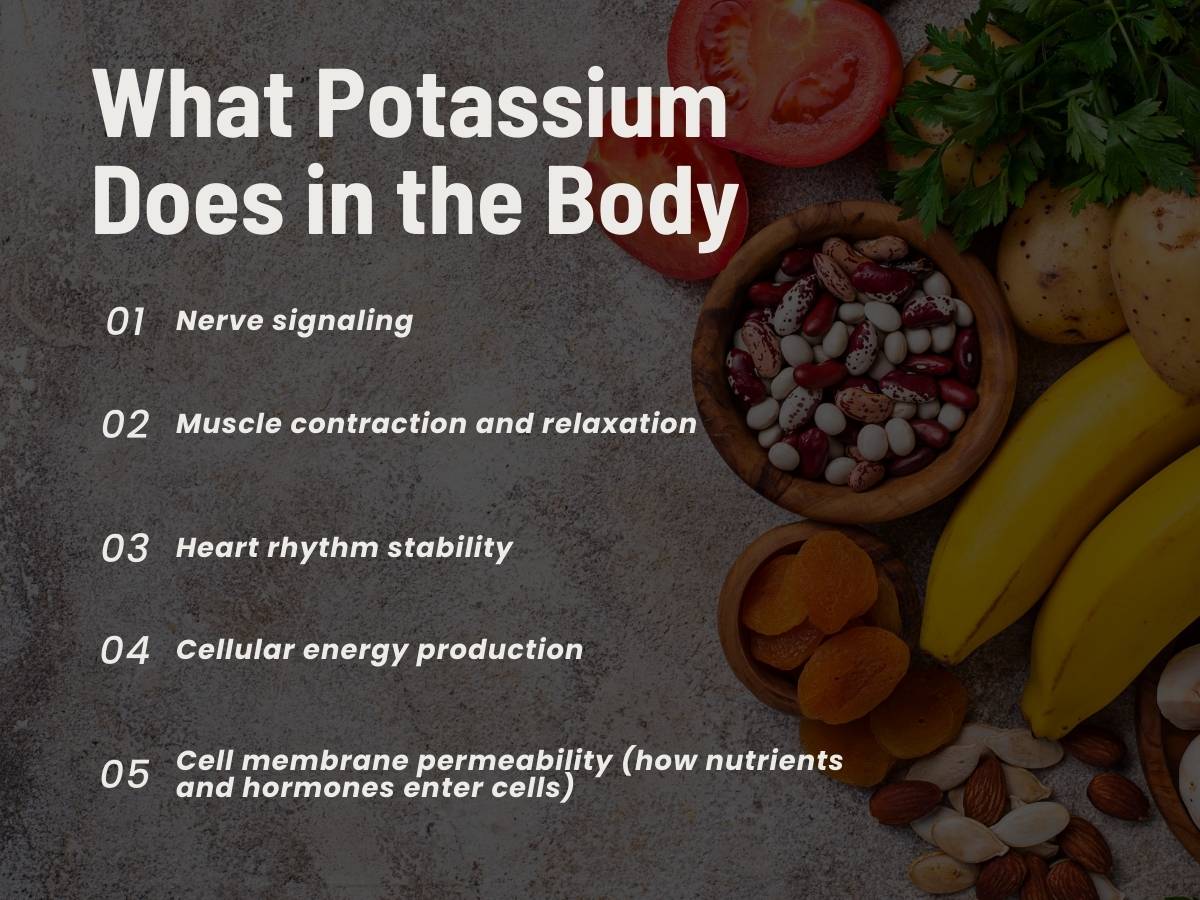
- Nerve signaling
- Muscle contraction and relaxation
- Heart rhythm stability
- Cellular energy production
- Cell membrane permeability (how nutrients and hormones enter cells)
When sodium and potassium are poorly regulated, the system feels unstable — wired, tired, reactive, foggy, or flat.
Potassium and stress hormones (HTMA context)
In mineral balancing interpretation:
- Sodium tends to reflect faster adrenal activity (adrenaline / aldosterone)
- Potassium often reflects longer-term stress load (cortisol patterns)
In simple terms: potassium frequently mirrors how long the body has been under pressure.
Potassium in HTMA
Ideal value
When hair is not washed at the laboratory, a commonly used ideal potassium value is:
~10 mg% (100 ppm)
A practical healthy range is:
6–12 mg%
Important: sodium and potassium become unreliable if hair is washed at the lab, because washing removes these minerals unpredictably.
High vs Low vs Toxic Potassium
Potassium patterns must always be interpreted in context.
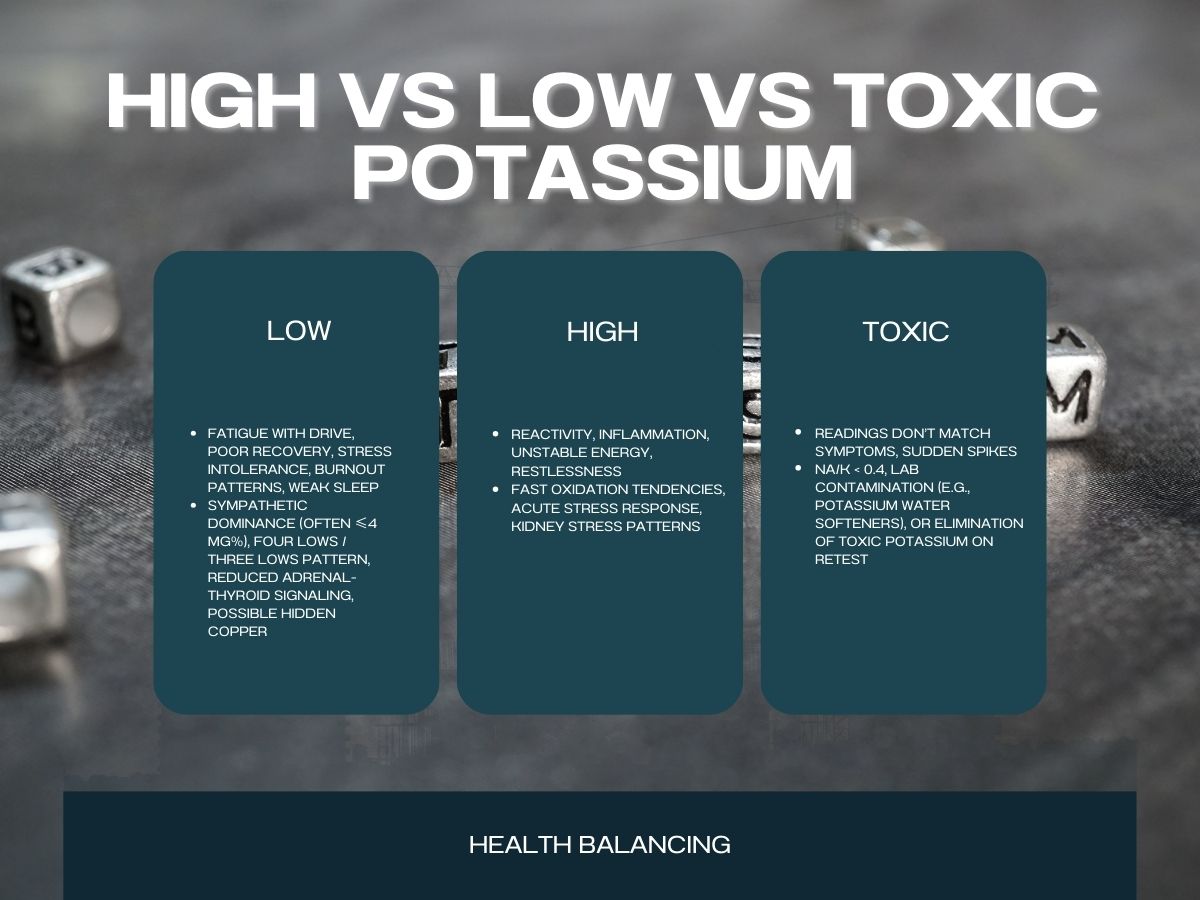
High vs Low vs Toxic Potassium (HTMA Overview)
| Pattern | Common experiences | Typical HTMA context |
| Low potassium | Fatigue with drive, poor recovery, stress intolerance, burnout patterns, weak sleep | Sympathetic dominance (often ≤4 mg%), Four Lows / Three Lows, reduced adrenal-thyroid signaling, possible hidden copper |
| High potassium | Reactivity, inflammation, unstable energy, restlessness | Fast oxidation tendencies, acute stress response, kidney stress patterns |
| Toxic / artifact potassium | Readings don’t match symptoms, sudden spikes | Na/K < 0.4, potassium water softeners, or elimination of toxic potassium on retest |
Client takeaway: potassium isn’t simply “high or low.” It reflects stress stage, regulation capacity, and detox patterns.
Key Ratios & Patterns
Sodium/Potassium Ratio (Na/K) — Vitality Ratio
Na/K reflects cellular electrical charge and stress physiology.
- Low Na/K (<2.5): fatigue, reduced vitality, blood sugar stress, infections, cardiovascular strain, kidney stress
- High Na/K (>5): acute stress, inflammation, irritability, possible fluid retention
Low Na/K often reflects “electrical discharge” — the system is running on depleted reserves.
Calcium/Potassium Ratio (Ca/K) — Thyroid Ratio
Potassium sensitizes cells to thyroid hormone.
- Ca/K > 4: sluggish thyroid effect at the cellular level
- Ca/K < 4: increased thyroid effect at the cellular level
This does not always match blood thyroid tests, because HTMA reflects tissue responsiveness, not circulating hormone levels.
Low Potassium & Sympathetic Dominance
Potassium around 4 mg% or lower commonly reflects sympathetic dominance — a state where the nervous system remains in fight-or-flight even when the body is exhausted.
This often looks like:
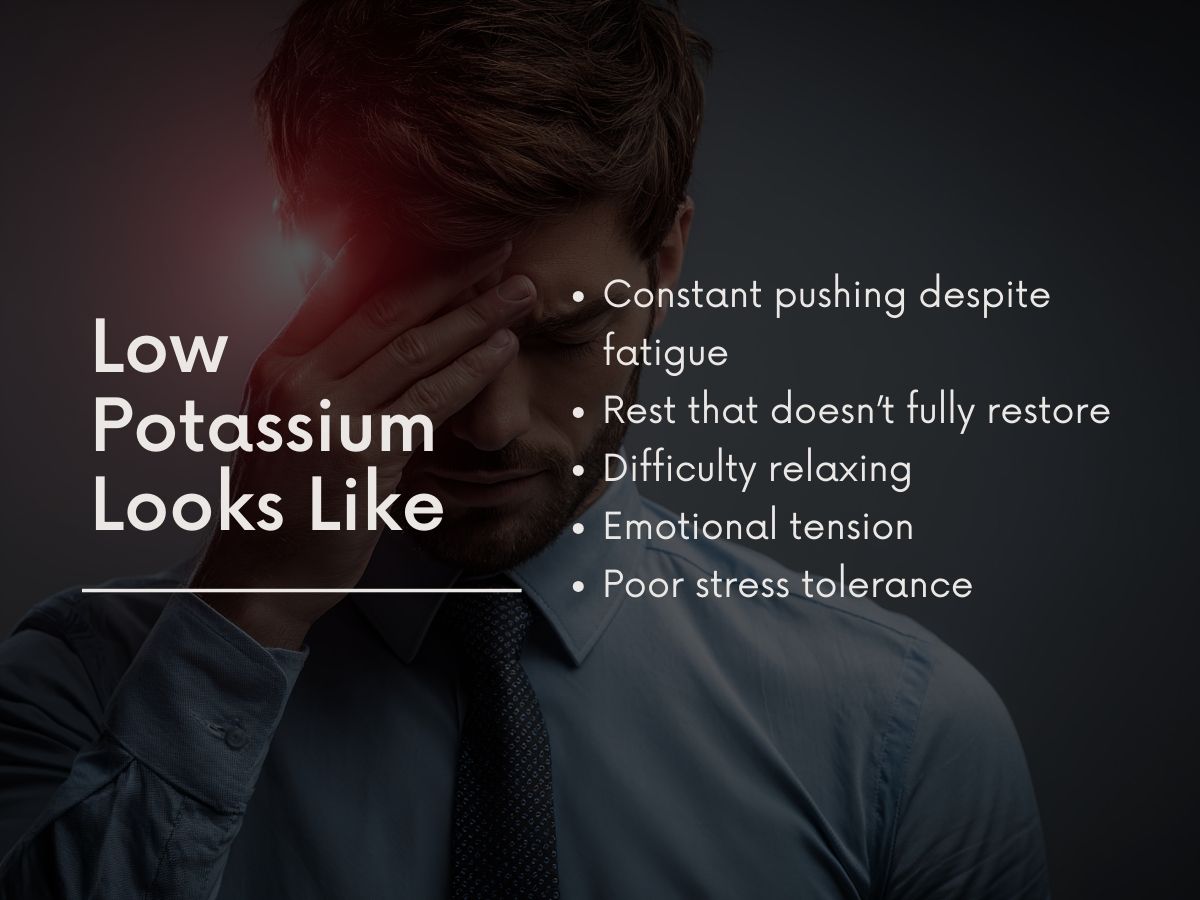
- Constant pushing despite fatigue
- Rest that doesn’t fully restore
- Difficulty relaxing
- Emotional tension
- Poor stress tolerance
In children and teens, this pattern may also appear as restlessness, irritability, or hyperactive-type energy, affecting learning and emotional regulation.
Very Low Potassium
Levels below ~1 mg% (when measurable) strongly indicate trauma-related autonomic stress. While many labs cannot measure this accurately, the principle remains: extremely low potassium reflects deep survival-mode physiology.
Toxic Potassium Elimination
On retests, potassium may rise sharply with Na/K dropping below ~0.4. This often indicates elimination of unusable potassium forms or environmental contamination (such as potassium-based water softeners).
This represents movement, not deterioration — interpretation depends on the full chart.
Food Sources (HTMA-Friendly)
Potassium deficiency is widespread. The most reliable way to restore it is through consistent vegetable intake.
Best sources
- Cooked vegetables (most reliable and digestible)
- Moderate vegetable juice (often ~10–12 oz carrot juice with small greens)
- Mineral-rich water (not distilled or reverse osmosis)
- Some dairy sources, depending on tolerance
A neutral note on fruit
Fruit does contain potassium. However, in many people with fatigue, blood sugar instability, or chronic stress patterns, high fruit intake can:
- Spike blood sugar
- Increase oxidative stress
- Reduce mineral retention over time
For this reason, many individuals do better emphasizing vegetable-based potassium rather than relying heavily on fruit, especially during recovery phases.
Synergists & Antagonists
Synergists
Potassium works closely with:
- Sodium, calcium, magnesium (electrolyte balance)
- Most vitamins and trace minerals via kidney regulation
Zinc is often supportive of potassium regulation.
Antagonists
- Rising calcium or magnesium often accompanies falling potassium
- Copper may suppress potassium (low potassium can suggest hidden copper)
- Toxic metals disrupt potassium handling, frequently through kidney stress
What Potassium Means on a Retest
HTMA is about trends, not single results.
If potassium rises
This may reflect:
- Improved mineral retention
- Increased metabolic activity
- Temporary kidney stress during detox
- Elimination of toxic potassium
A rise usually signals physiological movement.
If potassium falls
This may indicate:
- Ongoing sympathetic strain
- Stress exceeding capacity
- A rebuilding phase where the body conserves energy
Lower values don’t automatically mean worsening — they often reflect deeper stabilization.
Consider contamination if:
- Potassium spikes suddenly with Na/K < 0.4
- Potassium water softeners are used
- Results don’t match clinical symptoms
FAQs
What does potassium mean on an HTMA test?
It reflects cellular electrical charge, stress adaptation, and thyroid signaling at the tissue level.
What does low potassium mean?
Often linked to sympathetic dominance, burnout patterns, reduced recovery, and possible hidden copper.
What does high potassium mean?
May indicate acute stress, fast oxidation, kidney stress, or environmental contamination.