
Article Contents
- Why lead is often missed
- Who this article is for
- How lead affects the body
- How lead is detected (and why tests disagree)
- What HTMA shows about lead
- HTMA indicators linked to lead patterns
- Why higher lead on a retest can be a good sign
- Why HTMA does not start with chelation
- If this feels familiar…
- The benefits of eliminating lead (even when symptoms appear)
- Key takeaway
- Next steps
Why lead is often missed
If you’ve ever been told your blood tests are “normal” — yet you still feel foggy, depleted, or stuck — lead may be part of the picture.
Chronic lead exposure rarely shows up in obvious ways. Instead of dramatic symptoms, it tends to dull energy, slow repair, interfere with minerals, and quietly tax the nervous system over time.
This is why many people live with lead patterns for years, without a clear explanation for why their health won’t quite move forward.
Who this article is for
This article is especially relevant if you:
- feel chronically tired or mentally dull despite “normal” labs
- have mineral imbalances that don’t correct easily
- notice slow or stalled healing
- have a history of long-term stress, burnout, or environmental exposure
- feel worse when you try to “detox”
Lead patterns are extremely common, particularly in depleted or stressed systems — and they are workable when approached correctly.
How lead affects the body
Lead is a persistent structural toxin. Once absorbed, it tends to lodge in tissues rather than circulate in the blood.
Over time, lead can:
- interfere with red blood cell formation → fatigue
- replace calcium in bone → weaker structure (even if scans appear “dense”)
- impair copper-dependent neurotransmitters → mental dullness, irritability, focus issues
- block energy-producing enzymes → low stamina
- strain kidney function → uric acid issues, gout-like symptoms
- displace key minerals → calcium, zinc, magnesium, copper, iron
- interfere with thyroid signaling → slowed metabolism
Importantly, lead is rarely the root problem. In HTMA, it usually reflects mineral depletion, impaired elimination, or prolonged stress, rather than exposure alone.

How lead is detected (and why tests disagree)
Blood serum tests
Useful for acute exposure only. Lead leaves the bloodstream within weeks and moves into tissue, so chronic lead storage is often missed.
Urine challenge tests (EDTA)
Can detect some stored lead, but chelating agents circulate mainly in blood. They often miss lead stored deep in bone and tissue.
Hair Tissue Mineral Analysis (HTMA)
HTMA does not show total body lead burden.
It shows what the body is currently expressing or eliminating, which is often more useful for guiding support.
Retesting over time is what reveals the pattern.
What HTMA shows about lead
HTMA helps answer different questions than blood or urine tests:
- Is lead being retained or released?
- Is elimination capacity strong or weak?
- Are minerals available to safely bind and move lead?
- Is the body ready to detox — or already overloaded?
These distinctions matter more than a single number.
HTMA indicators commonly linked to lead patterns
Lead rarely appears alone. It often travels with recognizable HTMA patterns, such as:
- Very low hair lead → poor eliminator pattern
- Slow oxidation → reduced elimination capacity
- Low calcium, zinc, magnesium, or iron → increased lead absorption
- Calcium shell or bowl patterns → structural storage
- Low sodium/potassium ratio → adrenal strain affecting detox signaling
These indicators help determine timing and pacing, not just presence.
Why higher lead on a retest can be a good sign
This often surprises people.
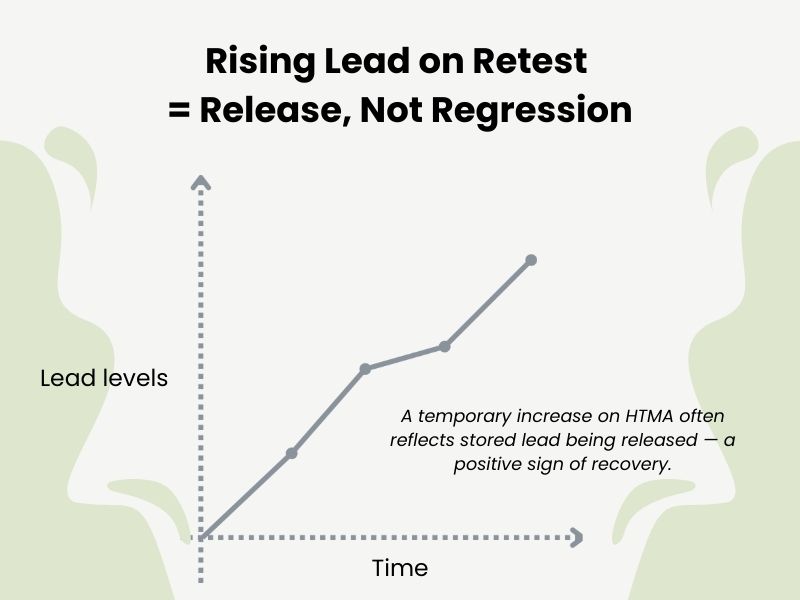
During HTMA-guided programs, lead levels may rise temporarily, then fall, and sometimes rise again later. This usually does not mean new exposure.
Instead, it often reflects natural elimination — lead moving out of deeper storage and exiting through hair and skin. Retesting helps distinguish release from retention.
Why HTMA does not start with chelation
When people hear “lead,” it’s natural to think removal should be immediate.
Chelation can pull metals from the bloodstream, but it does not address why the body stored them or whether the organs of elimination are ready to handle that load. In depleted individuals, forced mobilisation can worsen fatigue, mineral loss, and inflammation.
HTMA takes a different approach.
Rather than forcing metals out, it focuses on:
- restoring mineral reserves
- supporting liver, kidney, bile, and gut function
- improving binding and transport capacity
- allowing lead to release gradually, when the body can tolerate it
This is why HTMA prioritizes readiness over speed.
If this feels familiar…
If you’ve noticed:
- slow progress despite real effort
- symptoms that don’t match lab results
- feeling worse with aggressive detox
- minerals that won’t stabilize
Lead patterns may be part of the picture — not as a crisis, but as context.
The benefits of eliminating lead (even when symptoms appear)
As lead is gradually released, temporary symptoms can occur. This can be uncomfortable — but the benefits are significant and lasting.
Over time, people often experience:
- stronger immune resilience
- clearer thinking and steadier mood
- improved energy production
- better mineral balance
- healthier skin, hair, and nails
- reduced strain on the liver, kidneys, and cardiovascular system
For women and mothers, lowering lead burden is also associated with:
- fewer menstrual and hormonal disruptions
- lower risk of postpartum mood challenges
- improved outcomes for children, who often inherit mineral and metal patterns
Elimination symptoms are temporary. The gains are not.

Key takeaway
Lead is not a problem to attack — it’s a signal to interpret.
HTMA doesn’t chase metals.
It rebuilds the system that knows how to release them.
Next steps
If lead patterns appear on your HTMA, the goal isn’t forced detox.
It’s interpretation, pacing, and support — so elimination happens when the body is ready, not when it’s pushed.
👉 Understand your HTMA results
New to HTMA?
HTMA offers a tissue-level view of mineral balance and elimination patterns that blood tests often miss.
👉 Find out if HTMA is right for you