
Four Lows Pattern (HTMA): When the System Is Depleted, Not Broken
Some people don’t feel fast or slow.
They feel flat.
Energy is low no matter how much they rest. Motivation is gone. Stress tolerance is thin. Even small demands feel like too much.
Hair Tissue Mineral Analysis (HTMA) helps explain this through the Four Lows pattern — a metabolic state marked by deep depletion and reduced adaptive capacity, not failure or disease.
In Nutritional Balancing, there are four primary oxidation-related patterns:
- Fast Oxidation: the metabolic engine runs hot and fast
- Slow Oxidation: the body applies the brakes to conserve energy
- Mixed Oxidation: systems are out of sync
- Four Lows Pattern: the system is temporarily running on reserve
This page focuses specifically on Four Lows — what it means, why it appears, how it shows up on an HTMA, and how it is typically supported.
All information here is educational only and is not intended for diagnosis, treatment, or medical advice.
Article Contents
- Energy: When Output Is No Longer the Problem
- What the Four Lows Pattern Means
- How Four Lows Appears on an HTMA
- Why Four Lows Develops
- First-Test Four Lows vs Retest Four Lows
- Common Physical, Emotional, and Energy Patterns
- Why Pushing Backfires in Four Lows
- Diet Support for Four Lows
- Lifestyle Support: Stabilize Before You Build
- Supplement Considerations
- Retests, Shifts, and Recovery
- The Takeaway: From Survival to Repair
Energy: When Output Is No Longer the Problem
Energy isn’t just about drive or motivation.
At a biological level, it reflects capacity.
As Dr. Paul Eck explained,
energy production depends on mineral balance and glandular support. When those reserves drop too low, the body doesn’t speed up or slow down — it reduces output altogether.
The Four Lows pattern reflects a state where:
- the system is conserving resources
- stress tolerance is minimal
- adaptation is limited
This is not laziness.
It is not lack of willpower.
It is a protective metabolic response.
What the Four Lows Pattern Means
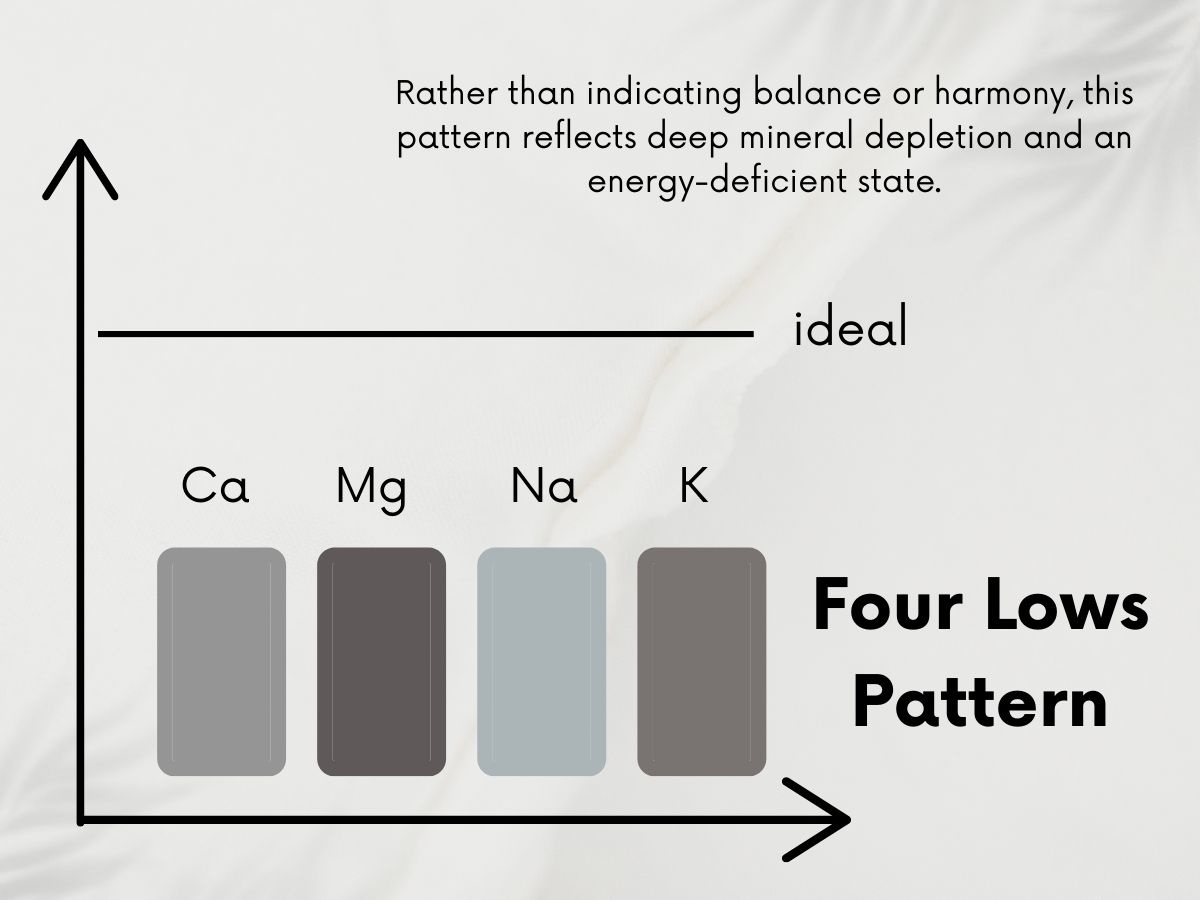
Four Lows refers to a pattern on HTMA where all four primary macrominerals are below ideal:
- calcium
- magnesium
- sodium
- potassium
Rather than indicating balance, this reflects depletion.
In functional terms:
- adrenal activity is low
- thyroid cellular effect is reduced
- nervous system responsiveness is blunted
The body is not choosing rest.
It has run out of reserve.
How Four Lows Appears on an HTMA
The Four Lows pattern is identified when:
- calcium, magnesium, sodium, and potassium are all below ideal ranges
Ratios alone are not sufficient here.
This pattern is identified primarily by absolute mineral levels, not just proportions.
Visually, the chart often looks “empty” — without the highs or lows seen in fast or slow oxidation.
Important notes:
- washing hair at the lab can falsely lower sodium and potassium
- water softeners can falsely raise sodium or potassium
- interpretation requires context and retesting
Four Lows should always be assessed carefully and conservatively.
Why Four Lows Develops
Four Lows does not appear randomly.
It develops when long-term stress exceeds recovery capacity.
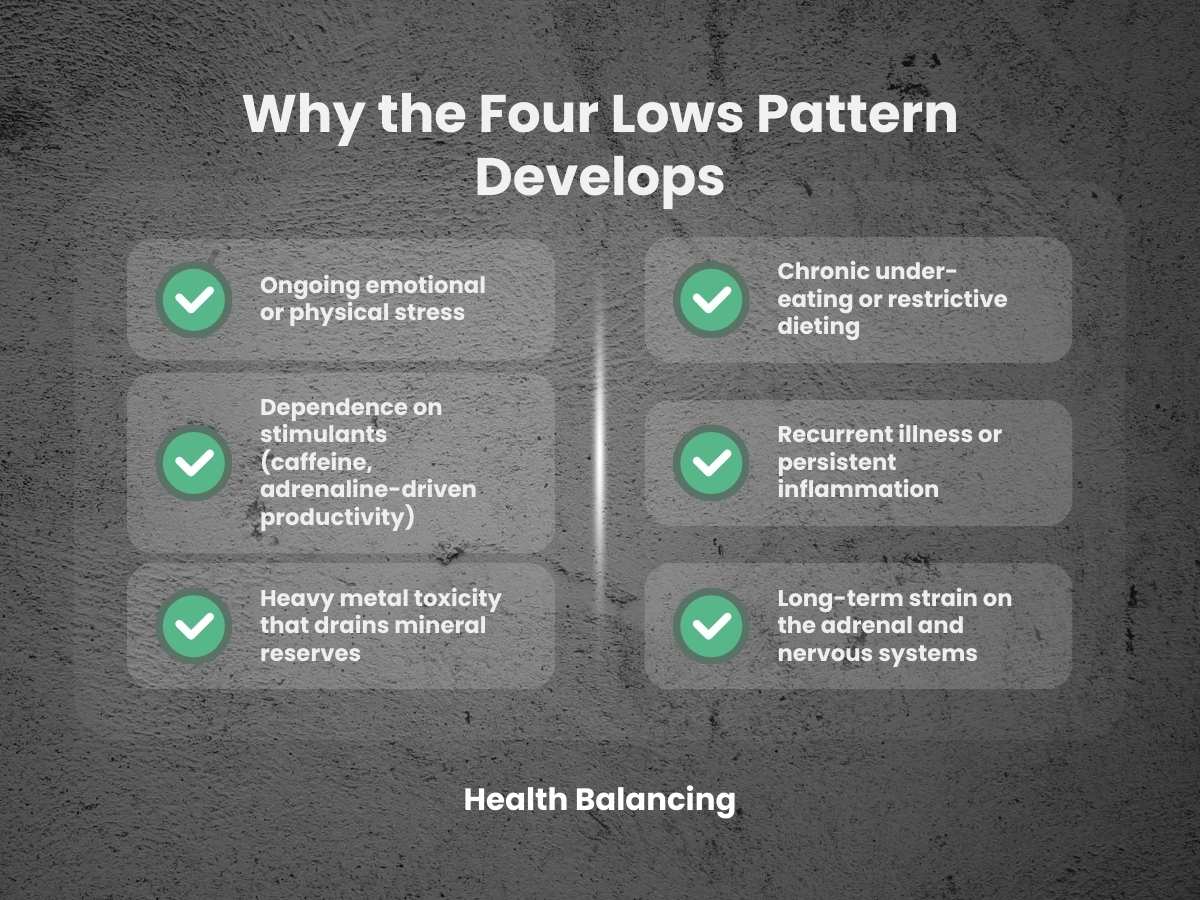
Common contributors include:
- prolonged emotional or physical stress
- chronic under-eating or restrictive dieting
- stimulant dependence (caffeine, adrenaline-driven productivity)
- repeated illness or inflammation
- heavy metal burden that drains mineral reserves
- long-standing adrenal and nervous system strain
In some cases, Four Lows appears after support has begun — which changes its meaning entirely.
First-Test Four Lows vs Retest Four Lows
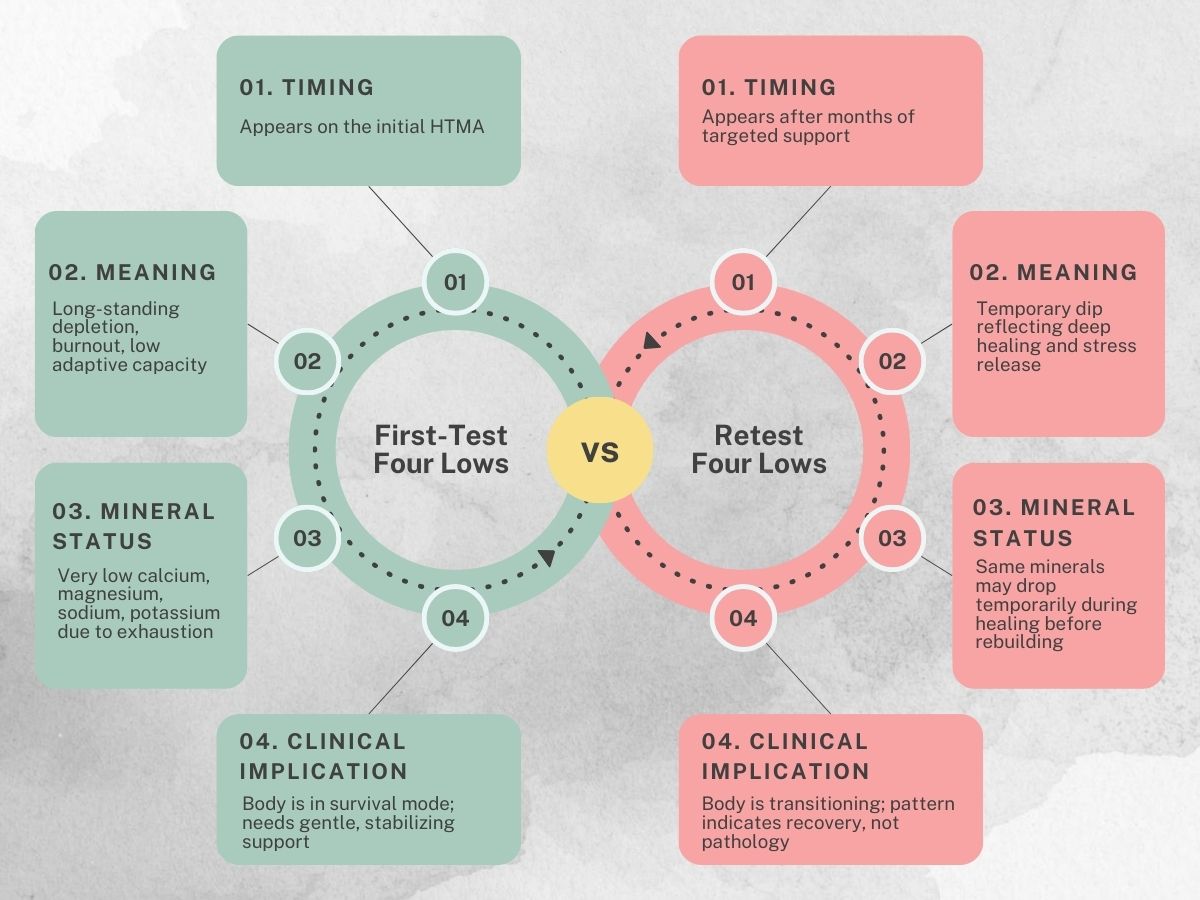
This distinction is critical.
Four Lows on a First Test
This usually reflects:
- long-standing depletion
- burnout or exhaustion stage of stress
- low adaptive capacity
Support must be gentle and stabilizing.
Aggressive detox or stimulation can worsen symptoms.
Four Lows on a Retest (Celebration Pattern)
When Four Lows appears after months of targeted support, it often reflects:
- deep healing
- the nervous system finally letting go
- reduced stress chemistry
- a temporary drop before rebuilding
This is sometimes called a celebration pattern — not because it feels good, but because it suggests the body is no longer surviving on stress hormones.
Context matters more than the pattern itself.
Common Physical, Emotional, and Energy Patterns
Four Lows does not look dramatic.
It looks quiet.
Common experiences include:
- persistent fatigue that rest doesn’t fix
- flat or blunted emotions
- low motivation or apathy
- feeling overwhelmed by small tasks
- poor stress tolerance
- low appetite or inconsistent hunger
Some people feel anxious.
Others feel numb.
Many feel both at different times.
Importantly, symptoms can look mild on the surface while the capacity underneath is very low.
Why Pushing Backfires in Four Lows
Four Lows is not a state where the body needs motivation.
It needs safety and replenishment.
Common mistakes include:
- forcing exercise
- pushing productivity
- aggressive detox protocols
- stimulating supplements
- drastic dietary changes
These often worsen fatigue, anxiety, or shutdown.
The goal is not activation.
It is restoration of reserve.
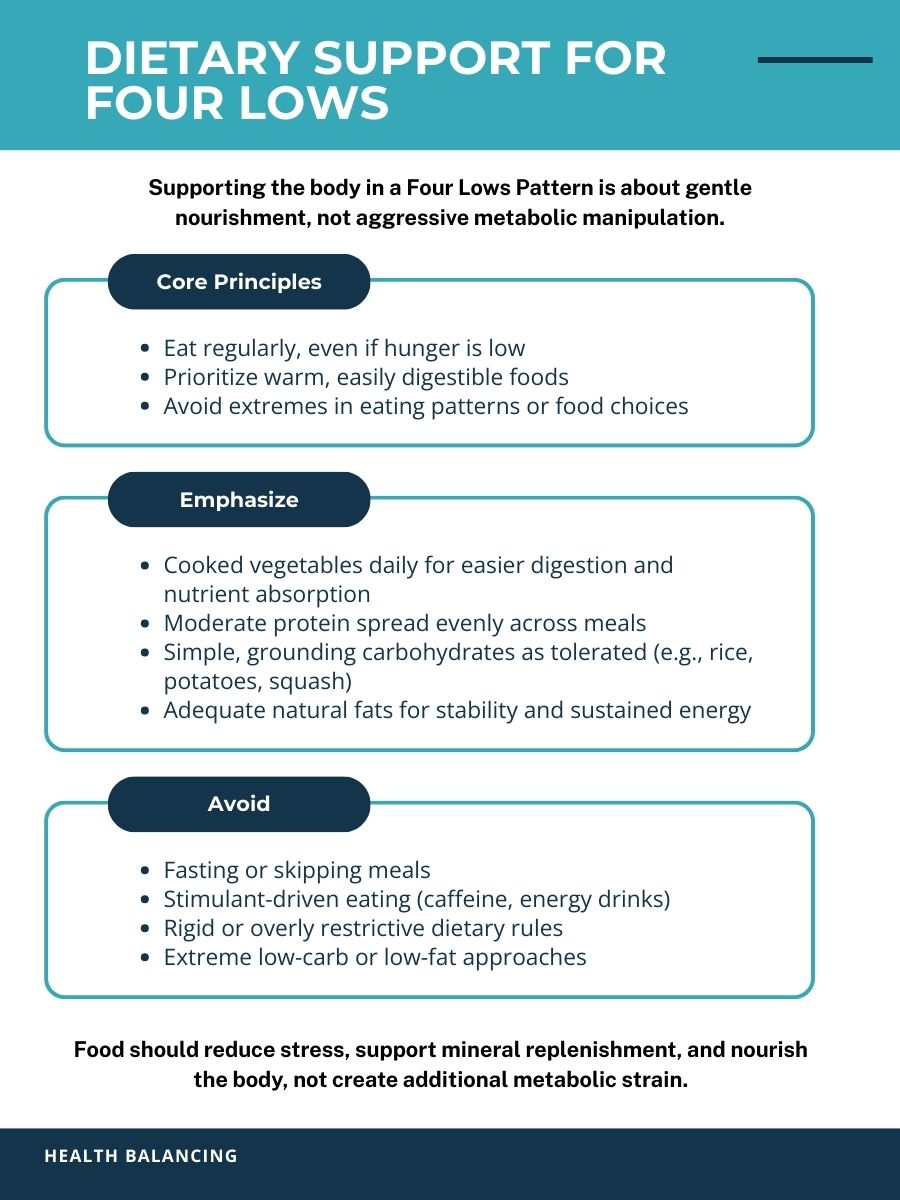
Diet Support for Four Lows
Dietary support for Four Lows is about gentle nourishment, not metabolic manipulation.
Core principles
- eat regularly, even without strong hunger
- prioritize warmth and digestibility
- avoid extremes
Emphasize
- cooked vegetables daily
- moderate protein spread across meals
- simple, grounding carbohydrates as tolerated
- adequate natural fats for stability
Avoid
- fasting or skipping meals
- stimulant-driven eating
- rigid dietary rules
- extreme low-carb or low-fat approaches
Food should reduce stress, not create it.
Lifestyle Support: Stabilize Before You Build
Lifestyle matters as much as nutrition.
Helpful supports include:
- consistent sleep and wake times
- gentle movement only (walking, stretching)
- reducing commitments where possible
- emotional safety and boundaries
- avoiding urgency
Four Lows improves when the body senses predictability and permission to recover.
Supplement Considerations
Supplement support must be:
- conservative
- personalized
- adjusted slowly
In Four Lows, less is often more.
Over-supplementing can overwhelm a system that is already depleted.
Retesting guides timing and progression.
Retests, Shifts, and Recovery
Four Lows is not permanent.
With appropriate support:
- mineral levels rebuild gradually
- oxidation patterns often shift toward slow or mixed first
- energy improves before motivation returns
- resilience increases over time
Progress is measured in capacity, not speed.
The Takeaway: From Survival to Repair
Four Lows does not mean your body has failed.
It means it has been carrying too much for too long.
The path forward is not pressure, optimization, or pushing harder.
It is:
- stabilization
- replenishment
- patience
- sequencing
When reserve is restored, the body naturally begins to rebuild — and energy returns not as urgency, but as resilience.
If you’re unsure whether Four Lows on your chart reflects depletion or deep healing, context and retesting matter. This pattern makes the most sense when interpreted over time, not in isolation.