

Why seeing metals on a hair test is not always a bad sign
Seeing toxic metals on an HTMA report can be unsettling.
Mercury. Lead. Aluminum. Cadmium.
It’s easy to jump straight to worry — “How bad is this?” or “Why is my body holding onto this?”
But HTMA doesn’t work like a simple exposure test.
And the presence (or absence) of metals on a hair test often means something very different than people expect.
This page explains what toxic metals on HTMA are actually showing — and why the numbers need context, not panic.
Article Contents
- What HTMA Really Measures (and What It Doesn’t)
- When Metals Can Reflect Recent Exposure
- Why Metals Can Appear Years After Exposure
- Why “Low” or “Clean” Results Can Be Misleading
- What Rising Metals Often Mean on a Retest
- Armoring: When the Body Temporarily Pauses Elimination
- Why Sauna and Detox Practices Can Raise Hair Metal Levels
- Metals, the Nervous System, and Emotional Shifts
- Common Metals People Ask About on HTMA
- Why HTMA Interpretation Focuses on Patterns, Not Numbers
- If Detox Has Made You Feel Worse Before
- Key Takeaway: How to Read Your Results Calmly
First things first: HTMA doesn’t measure “how toxic you are”
Hair Tissue Mineral Analysis is not a diagnostic test for poisoning.
It doesn’t measure how much metal is sitting in your brain or organs.
What it does show is:
- what the body is able to release through tissue
- how well elimination pathways are functioning
- whether the system is letting go — or holding on
Think of HTMA as a process snapshot, not a verdict.
When metals can reflect recent exposure
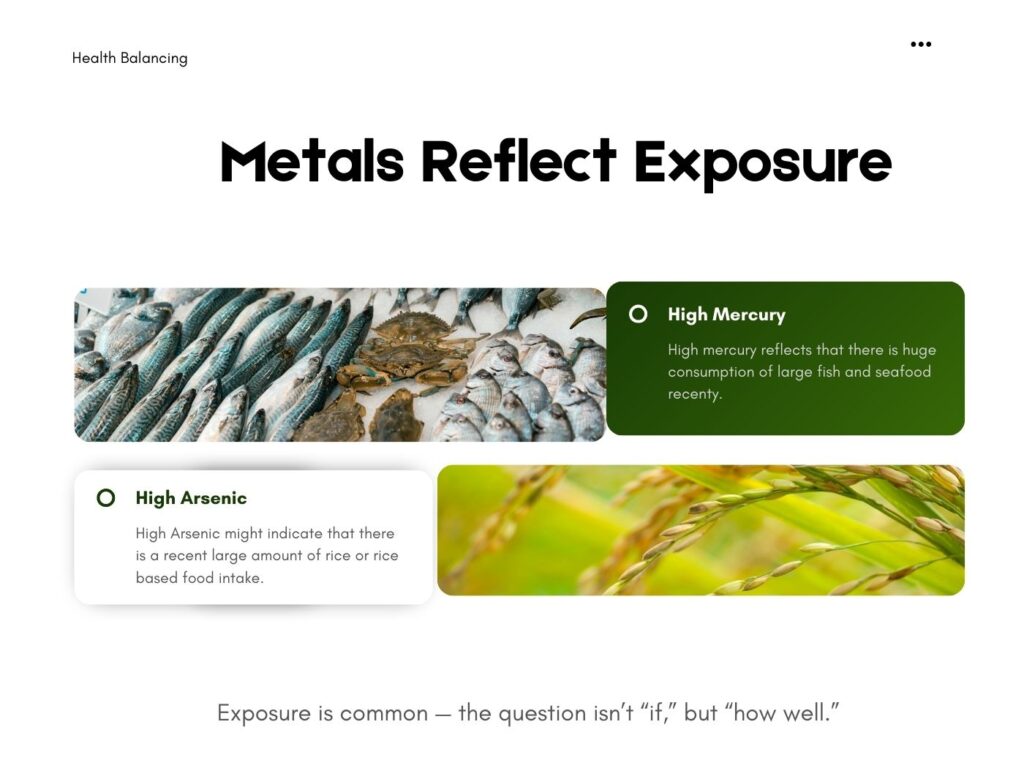
Although HTMA mainly reflects tissue elimination, sometimes higher metals do relate to recent intake, especially when exposure has increased in the last few months.
Common examples:
- Eating more large fish or seafood → higher mercury
- Eating a lot of rice or rice-based foods → higher arsenic
- Increased use of antiperspirants, cookware, or certain water sources → higher aluminum
In these cases, HTMA may be showing a mix of recent exposure and active elimination.
This is why your diet, lifestyle, environment, and timing always matter when interpreting results.
Why metals can show up years after exposure
Toxic metals don’t leave the body quickly.
They’re often stored in:
- connective tissue
- bone
- glands
- nervous system tissue
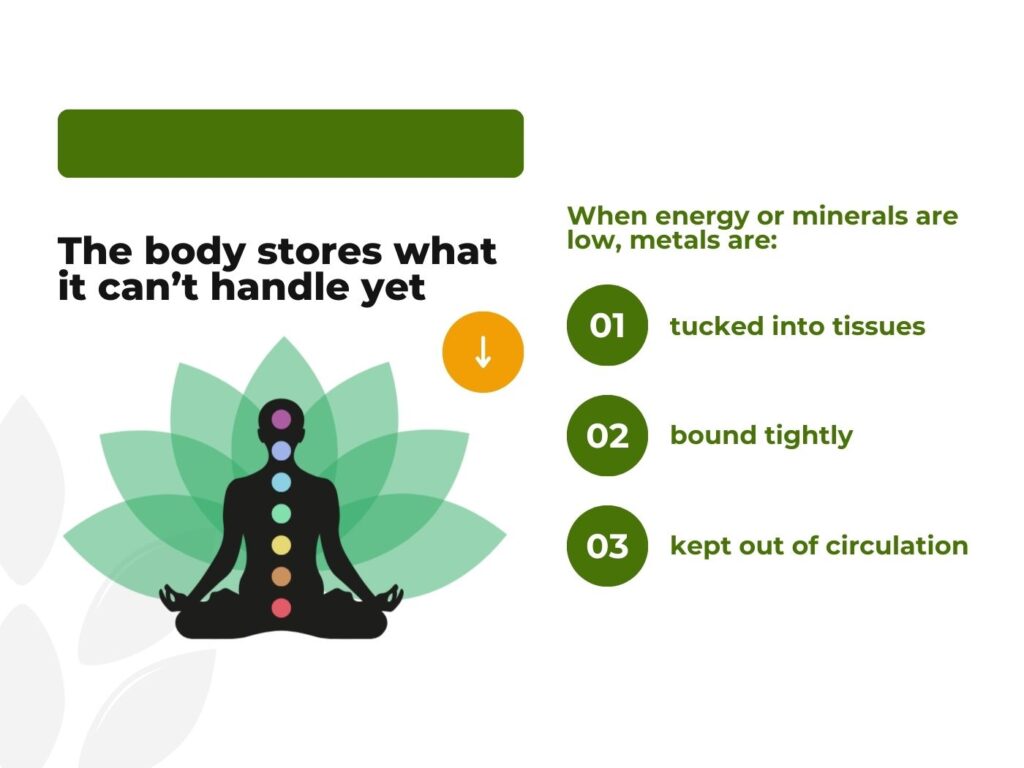
They can sit quietly for years — until the body finally has:
- enough energy
- enough mineral support
- enough nervous system stability
When metals appear on HTMA, it often means:
Your body finally has the capacity to release what it couldn’t before.
This is why metals can show up long after the original exposure.
Why “low” or “clean” results aren’t always reassuring
One of the most misunderstood HTMA findings is the poor eliminator pattern.
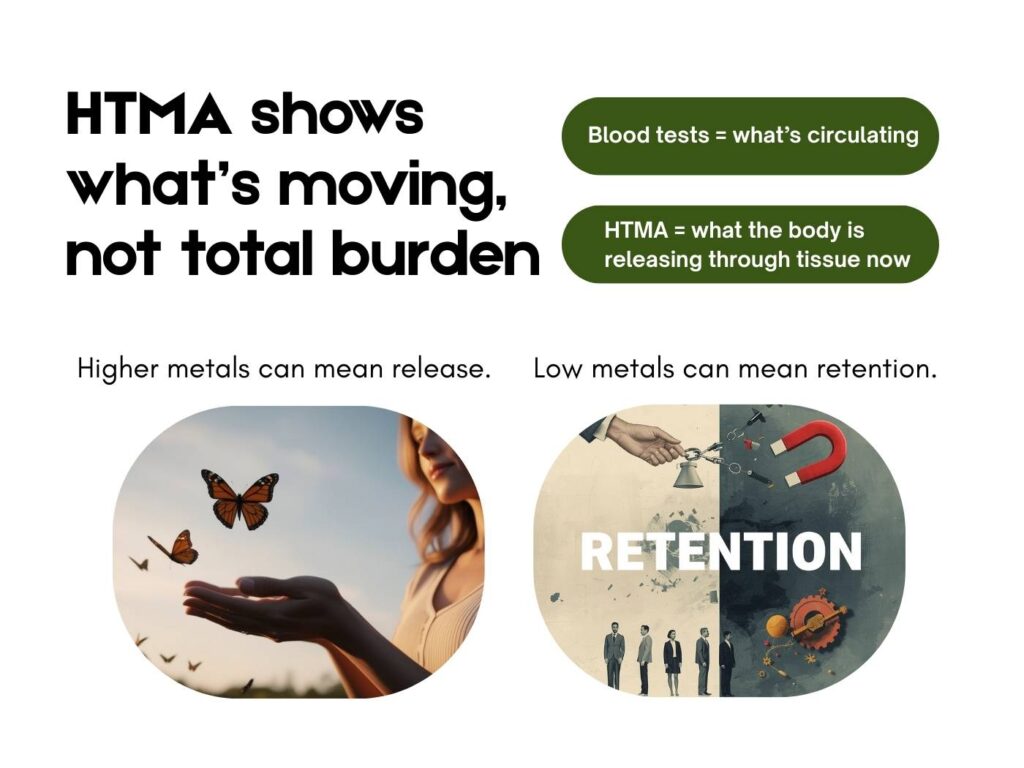
This pattern appears when certain minerals — including toxic metals or some nutrient minerals — show up at extremely low levels.
Here’s the key point:
Low does not mean absent.
It usually means the body is unable to release the mineral, so it remains sequestered in tissues.
In other words:
The body is holding onto metals, not free of them.
When multiple poor eliminator indicators are present, it strongly suggests hidden toxic burden and low elimination capacity. This is one of the main reasons aggressive detox often makes people feel worse rather than better.
What rising metals often mean
When toxic metals increase on an HTMA — especially on a retest — interpretation depends on context.
Rising metals can reflect:
- improved metabolic energy
- better mineral replacement
- re-activation of elimination pathways
- detox finally completing rather than stalling
This is why numbers sometimes go up before they go down.
The “All Out” (Everything Coming Out) pattern
On retests, metals may rise alongside many other minerals. When six or more minerals increase together, this is often referred to as an All Out pattern.
Rather than indicating overload, this usually reflects generalised elimination activity — a sign that the body has enough resources to release stored substances more broadly.
Armoring: when the body pauses elimination
Another pattern that can appear on retests is called armoring.
Armoring occurs when one or more minerals — including toxic metals — drop further into very low (poor eliminator) ranges compared to a previous test.
This doesn’t mean things are going wrong.
It usually reflects a temporary protective pause, where the body:
- tightens its grip on minerals
- reduces elimination through hair and skin
- stabilises in response to stress, fatigue, or retracing old patterns
Think of it as the body putting on armor to get through something.
When energy and stability return, elimination typically resumes — which is why pacing matters.
Why detox practices can raise metals on HTMA
People are often alarmed when metals rise during detox — especially with sauna use.
Here’s what’s actually happening:
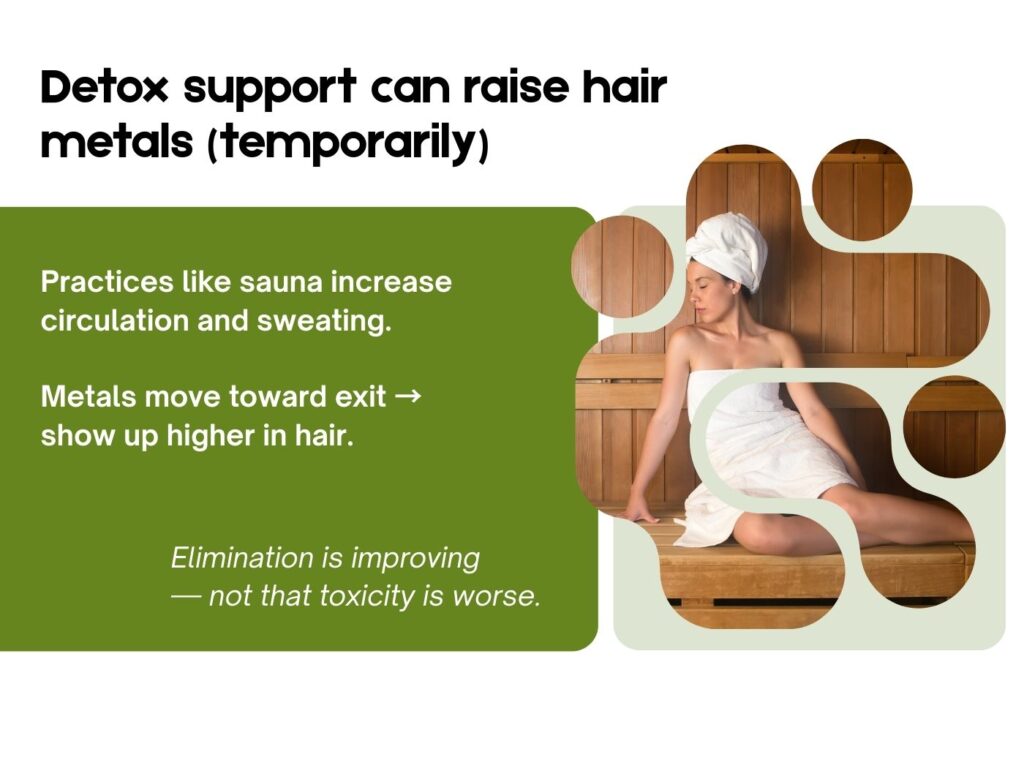
The skin and hair are active elimination routes.
Practices like sauna increase circulation and sweating, which can move stored metals toward exit.
When this happens, metals may become more visible on HTMA — not because toxicity has worsened, but because elimination has improved.
This is a common and expected finding when detox is happening at a pace the body can tolerate.
Metals, minerals, and emotional shifts
Minerals don’t just affect the body — they influence the nervous system and emotional regulation.
As toxic metals shift and release, some people notice:
- emotional sensitivity
- old memories resurfacing
- changes in mood or stress tolerance
This doesn’t mean metals “store memories,” but rather that mineral changes affect the tissues and signalling systems through which emotions are processed.
This connection is explored further in Psychological Aspects of Minerals (article coming soon).
Common metals people ask about
The metals most often questioned on HTMA reports include:
- Aluminum – linked to neurological stress and poor elimination
- Mercury – associated with nervous system and immune burden
- Lead – affects energy, cognition, and mineral regulation
- Cadmium – interferes with zinc-dependent enzymes
- Arsenic – impacts cellular energy pathways
- Copper (toxic or dysregulated forms) – strongly influences mood and hormones
Their significance always depends on:
- mineral reserves
- oxidation rate
- stress patterns
- elimination capacity
Numbers alone never tell the whole story.
Why HTMA always looks at patterns — not single numbers
Effective HTMA interpretation never focuses on one metal in isolation.
It looks at:
- mineral ratios
- oxidation rate
- sodium and potassium status
- calcium and magnesium balance
- stress and conservation patterns
This tells us whether the body is:
- ready to eliminate
- temporarily holding
- overwhelmed
- or rebuilding capacity
If detox has made you feel worse before
This is one of the most common pain points — and it usually doesn’t mean detox is “wrong.”
It often means:
- elimination was pushed before energy was restored
- minerals weren’t replenished first
- the nervous system was overstimulated
That’s explained more fully here:
When Detox Makes You Feel Worse — And What the Body Actually Needs First
Key takeaway
Seeing toxic metals on an HTMA is not a verdict.
It’s information about timing, capacity, and process.
Sometimes it reflects recent exposure.
Often it reflects long-stored release.
Always, it needs context. Healing isn’t about forcing detox.
It’s about giving the body what it needs so it can let go — safely, gradually, and in the right order.