
What It Reveals About Blood Sugar, Stress & Mineral Balance
Calcium-to-Magnesium Ratio (Ca/Mg) on HTMA
The calcium-to-magnesium (Ca/Mg) ratio on a Hair Tissue Mineral Analysis (HTMA) is one of the most important indicators of how your body handles blood sugar, stress, and mineral regulation.
Rather than looking at calcium or magnesium alone, this ratio shows how well your body balances stability with energy — structure with flexibility.
Article Contents
- What the Ca/Mg Ratio Measures
- Ideal & Functional Ca/Mg Ranges
- Why This Is Called the Blood Sugar Ratio
- Why Stress Strongly Affects Ca/Mg
- When Ca/Mg Is High (>13.5): Lifestyle Stress Pattern
- When Ca/Mg Is Low (<4): Low Buffering & Depletion Pattern
- Calcium Precipitation & Magnesium’s Role
- “But I Don’t Eat Carbs” — Common Reasons
- How Ca/Mg Relates to Na/K & Oxidation Rate
- Nutrients That Support Magnesium Balance
- Toxic Metals & Detox Readiness
- What Changes on a Retest Mean
- How Ca/Mg Is Corrected Safely
- Final Takeaway
- Want Personalized Guidance?
- Reference
What the Ca/Mg Ratio Measures
In simple terms:
- Calcium stabilizes, buffers, and slows
- Magnesium energizes, activates, and supports enzymes
A balanced Ca/Mg ratio reflects the body’s ability to stay calm without becoming rigid, and energized without becoming overstimulated.

Ideal & Functional Ca/Mg Ranges
Ideal Ca/Mg ratio (unwashed hair):
6.67 : 1
General interpretation:
- ~4.5 – 8.5 → balanced carbohydrate tolerance
- <4.5 or >8.5 → increased sugar sensitivity
- 3.0 – 3.3 or 10 – 12 → reactive blood sugar patterns
- <3.0 or >12.0 → severe stress or carbohydrate intolerance
These ranges reflect tolerance and capacity, not how “good” or “bad” your diet is.
Why This Is Called the Blood Sugar Ratio
The Ca/Mg ratio directly affects insulin regulation:
- Calcium supports insulin release
- Magnesium prevents excessive insulin secretion
When this balance is off, blood sugar becomes harder to regulate — even if standard blood tests appear normal.
Common signs include:
- Energy crashes after meals
- Sugar or carb cravings
- Anxiety or irritability tied to food
- Fatigue that worsens with stress
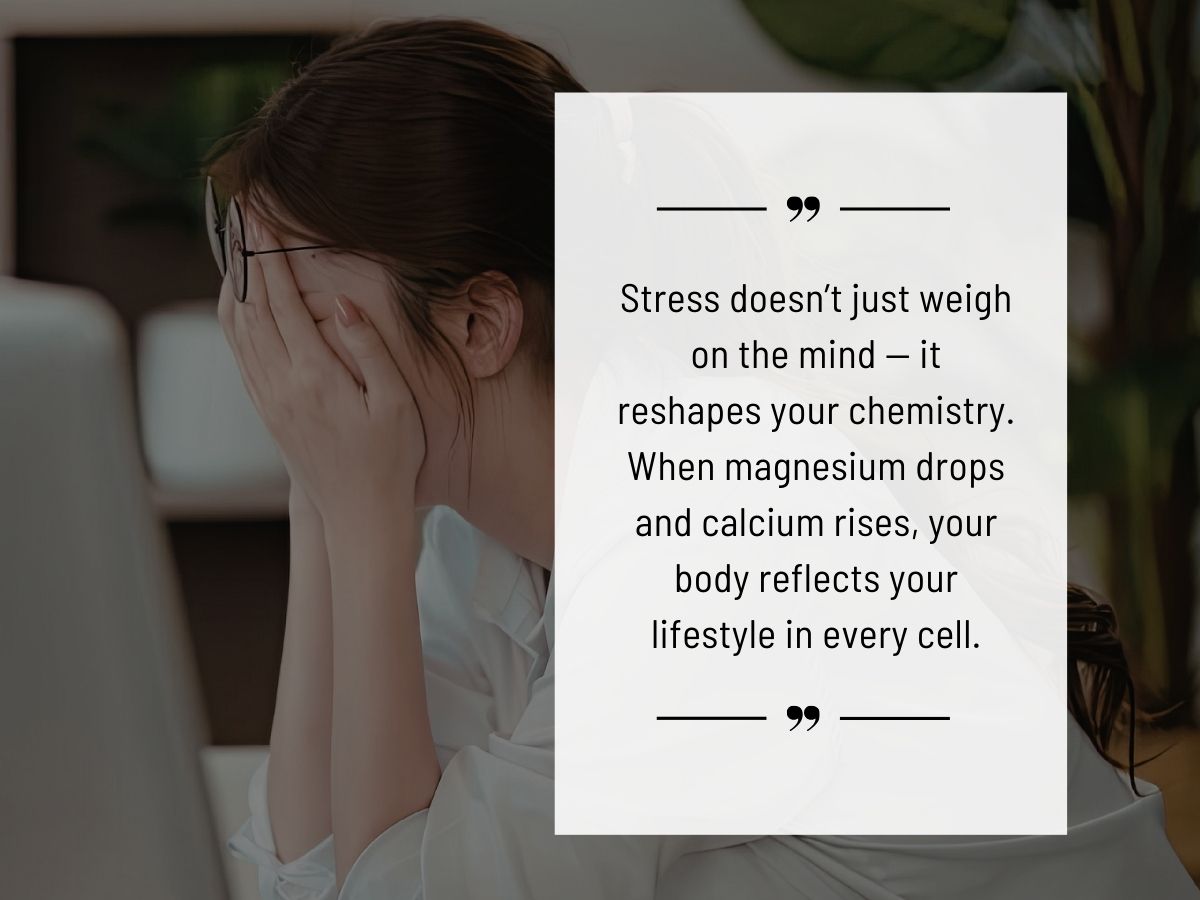
Why Stress Strongly Affects Ca/Mg
The Ca/Mg ratio is also known as the lifestyle ratio.
Stress — emotional, mental, or physical — can:
- Raise cortisol and blood sugar
- Deplete magnesium
- Alter calcium regulation
This means your Ca/Mg ratio can shift even without dietary changes.
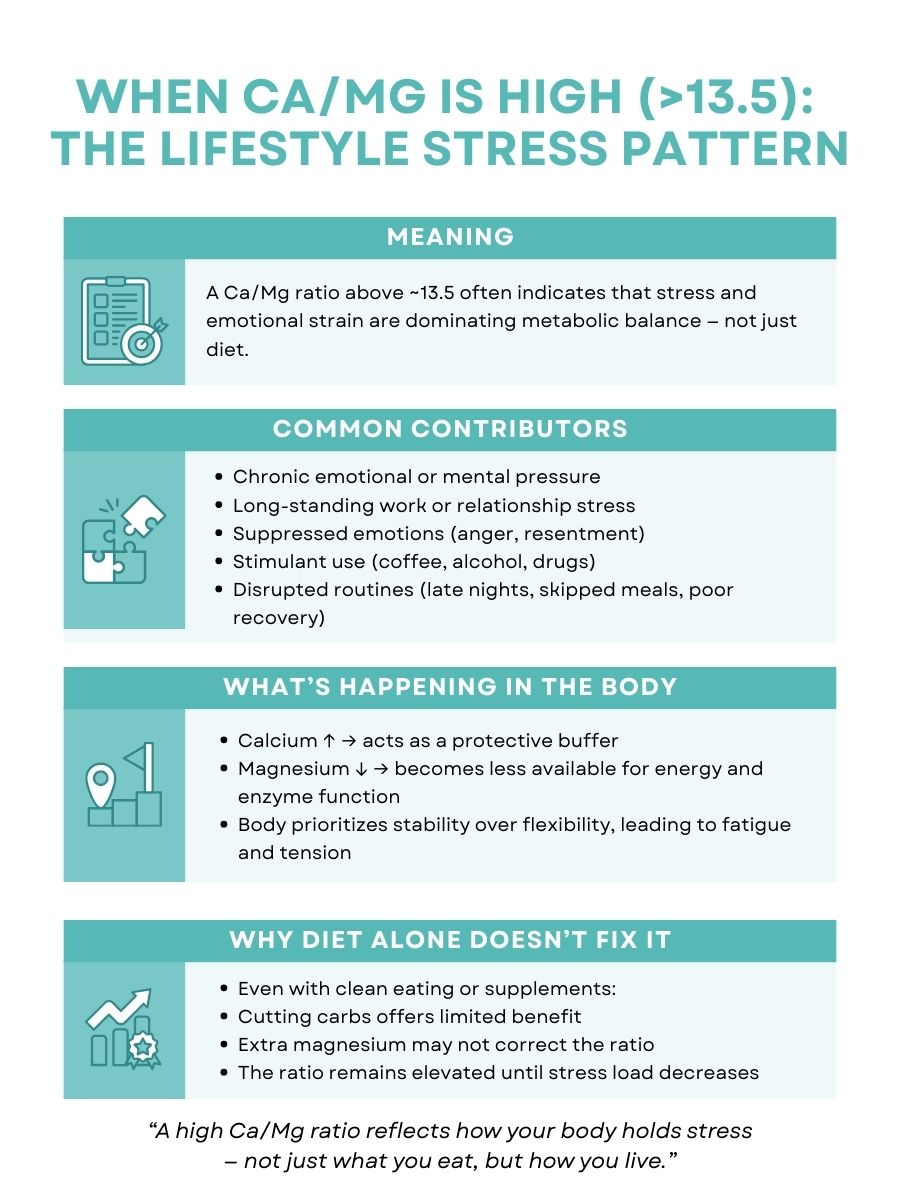
When Ca/Mg Is High (>13.5): Lifestyle Stress Pattern
A Ca/Mg ratio above ~13.5 is not just “very high.”
It often reflects lifestyle and emotional stress overriding metabolic regulation, rather than diet alone.
This pattern is commonly associated with:
- Chronic emotional or mental pressure
- Long-standing work or relationship stress
- Suppressed or unresolved emotions (especially anger or resentment)
- Stimulant use (caffeine, alcohol, recreational drugs)
- Disrupted routines (late nights, irregular meals, poor recovery)
In this state, calcium acts as a protective buffer, while magnesium becomes relatively unavailable. The body prioritizes stability over flexibility, often at the expense of energy.
Why Diet Alone Often Doesn’t Fix This
When Ca/Mg is above 13.5:
- Reducing carbohydrates may help only slightly
- Magnesium supplementation alone is often insufficient
- The ratio often stays elevated until stress load is reduced
This is why some people “do everything right” nutritionally and still see a stubbornly high ratio.
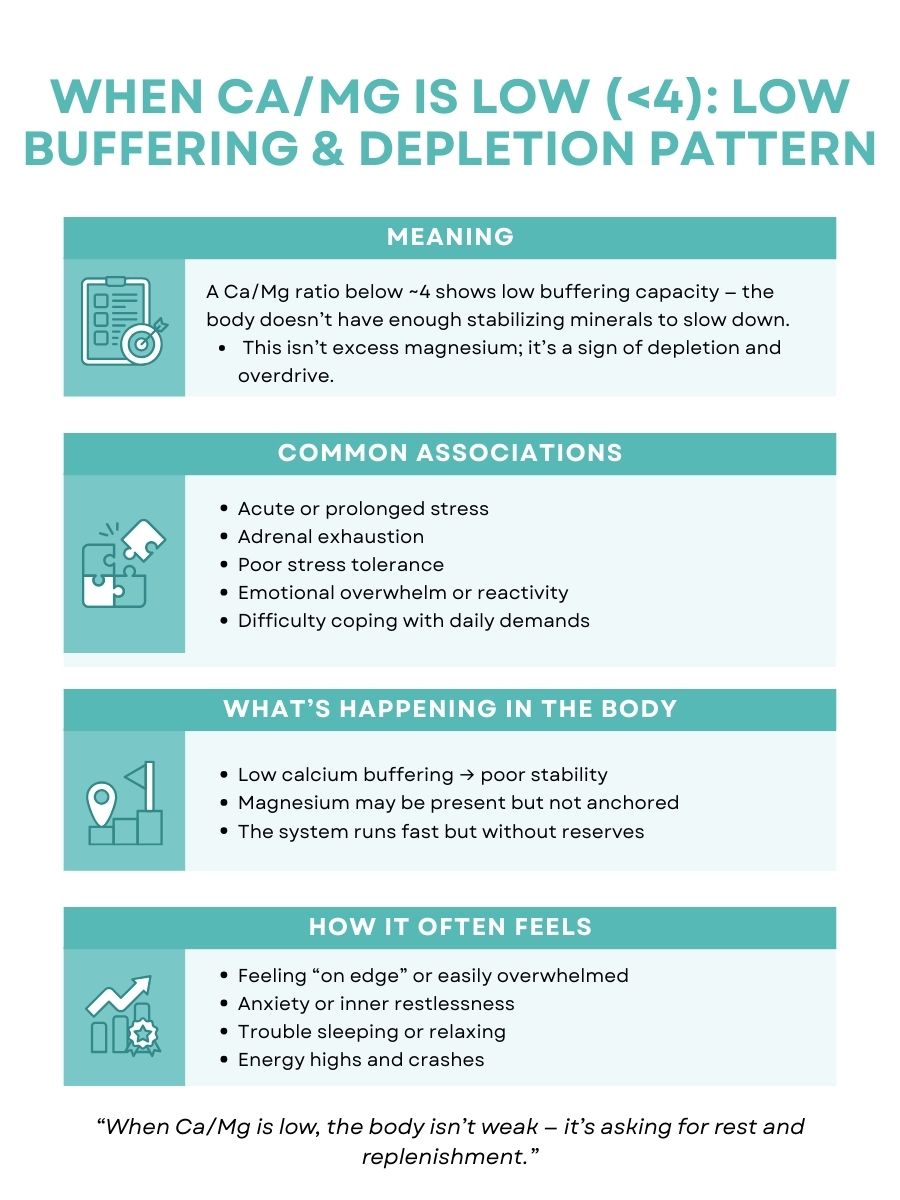
When Ca/Mg Is Low (<4): Low Buffering & Depletion Pattern
A Ca/Mg ratio below ~4 reflects low buffering capacity.
In simple terms, the body lacks enough stabilizing minerals to slow things down. This is a depletion pattern, not a sign of excess magnesium.
This pattern is often associated with:
- Acute or prolonged stress
- Adrenal exhaustion
- Poor stress tolerance
- Emotional overwhelm or reactivity
- Difficulty coping with daily demands
How This Often Feels
- Feeling “on edge” or easily overwhelmed
- Anxiety or inner agitation
- Poor sleep or difficulty relaxing
- Energy instability
Below ~4, aggressive detoxing, fasting, or restriction can worsen symptoms. Support must focus on rebuilding stability first.
Calcium Precipitation & Magnesium’s Role
When Ca/Mg is above ~10 or below ~3, calcium is more likely to fall out of solution.
This may contribute to tendencies toward:
- Joint stiffness or arthritic changes
- Kidney or gall stones
- Arterial or soft-tissue calcification
Magnesium keeps calcium soluble.
An imbalanced Ca/Mg ratio often reflects poor magnesium utilization, not simply low intake.
“But I Don’t Eat Carbs” — Common Reasons This Still Happens
Even when obvious sugars are reduced, Ca/Mg imbalance may be driven by:
- Hidden starches or sugars in packaged foods
- Overeating starchy vegetables or fruit
- Alcohol (wine, beer, mixed drinks)
- Eating beyond current metabolic capacity
Carbohydrate tolerance is individual and stress-dependent, not fixed.
How Ca/Mg Relates to Na/K & Oxidation Rate
Relationship to Na/K
- Calcium & sodium → mainly extracellular
- Magnesium & potassium → mainly intracellular
Key patterns:
- Both Ca/Mg and Na/K low → deep depletion, adrenal exhaustion
- Both Ca/Mg and Na/K high → acute stress and inflammation
Read more: Sodium-to-Potassium (Na/K) Ratio
Relationship to Oxidation Rate
As oxidation rate changes, carbohydrate needs change.
A diet that once worked may later become excessive.
Read more: Oxidation Rate on HTMA
Nutrients That Support Magnesium Balance
Magnesium requires:
- Zinc
- Vitamin B6
- Taurine (primarily from animal foods)
High-carbohydrate diets commonly deplete these, leading to magnesium loss or biounavailability, sometimes appearing as high magnesium in hair.

Toxic Metals & Detox Readiness
Heavy metals such as lead and cadmium can disrupt Ca/Mg by displacing calcium from bones or interfering with mineral regulation.
These metals may not appear on an initial HTMA.
They often show up on follow-up tests as mineral balance improves.
Read more: Detox Readiness & Heavy Metals on HTMA
What Changes on a Retest Mean
HTMA is about trends, not single results.
- Ratio moving toward ideal → improved stress tolerance and mineral regulation
- Ratio temporarily worsening → increased demands or elimination of biounavailable calcium or magnesium as regulation improves
- Ratio unchanged → the root driver (often stress or routine mismatch) has not yet shifted
It’s not uncommon for mineral ratios to look worse before they look better, especially early in a properly guided program.
Tracking the Ca/Mg ratio over time provides far deeper insight than any single test.
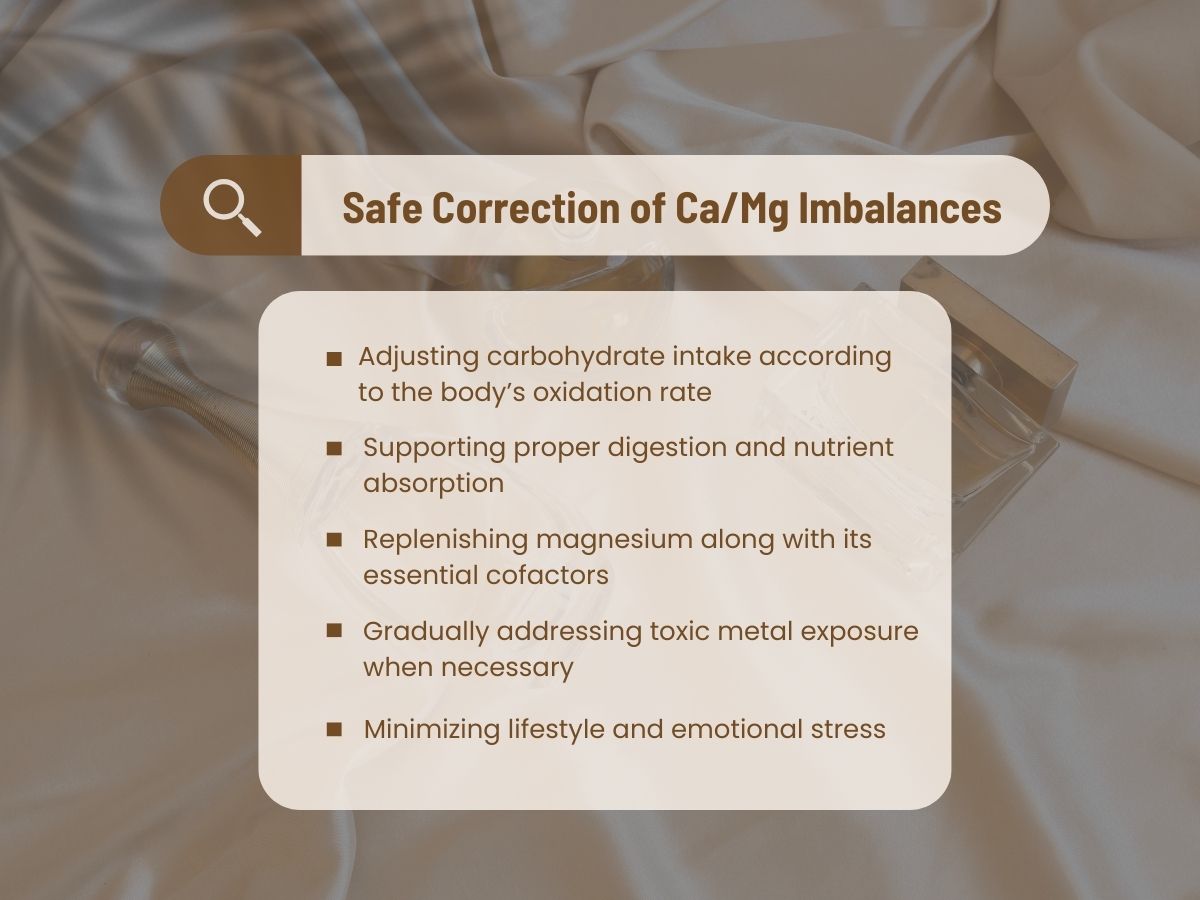
How Ca/Mg Is Corrected Safely
Correction focuses on:
- Adjusting carbohydrates based on oxidation rate
- Supporting digestion and absorption
- Rebuilding magnesium with its cofactors
- Reducing lifestyle and emotional stress
- Addressing toxic metals gradually, when appropriate
When Ca/Mg is severely imbalanced, stress support is foundational — supplements alone are rarely enough.
Final Takeaway
The calcium-to-magnesium ratio reflects how your body balances:
- Blood sugar
- Stress
- Energy
- Mineral regulation
When interpreted correctly, it is one of the most informative markers on an HTMA.
Want personalized guidance?
A Hair Tissue Mineral Analysis (HTMA) provides individualized insight into your mineral patterns and stress response — far beyond standard blood tests.
✔ Personalized interpretation
✔ Targeted dietary and supplement guidance
✔ Long-term, capacity-based healing
Reference
Analytical Research Labs