
Burnout isn’t just feeling tired.
It’s the kind of exhaustion that doesn’t go away with sleep, time off, or “taking it easy.”
You may still be functioning — working, caring for others, showing up — but everything feels heavier than it should.
If you’ve been told “your tests are normal” yet your body feels anything but normal, you’re not imagining it.
Burnout is real. And it’s increasingly common.
Article Contents
- What Is Burnout?
- Why Burnout Feels Different From “Normal” Fatigue
- The Role of Stress Hormones (And Why They Stop Working)
- Common Symptoms of Burnout
- Why Burnout Often Doesn’t Show Up on Blood Tests
- Causes of Burnout
- How Burnout Shows Up on Hair Tissue Mineral Analysis (HTMA)
- Burnout vs Chronic Fatigue
- Can Burnout Be Reversed?
- The Unexpected “Gift” of Burnout
- Curious If Burnout Is Driving Your Symptoms?
Burnout Is Not a Motivation Problem
Most people experiencing burnout are not lazy, weak, or undisciplined.
In fact, they’re often:
- conscientious
- responsible
- high-functioning
- used to pushing through discomfort
Burnout doesn’t happen because you stopped trying.
It happens because your body has been compensating for too long.
At a deeper level, burnout reflects nutritional depletion, nervous system exhaustion, and reduced energy production — not a character flaw.
Why Burnout Feels Different From “Normal” Fatigue
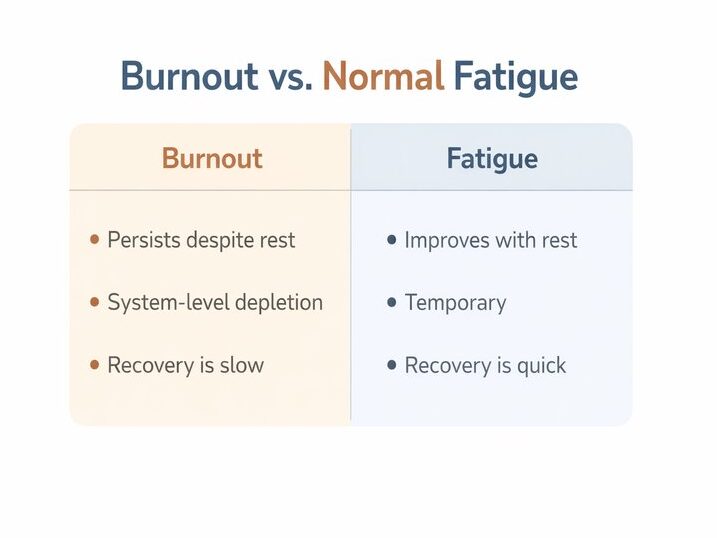
There’s an important distinction:
- Fatigue improves with rest
- Burnout does not
With burnout:
- You wake up tired
- Stress tolerance is low
- Recovery feels slow or absent
- Small demands feel overwhelming
This isn’t just a sleep issue.
It’s a system-level depletion.
The Role of Stress Hormones (And Why They Stop Working)
The body relies on stress hormones — such as adrenaline and cortisol — to meet challenges.
In the short term, they:
- raise blood sugar
- increase alertness
- mobilise energy
But when stress becomes chronic, this system becomes overused and exhausted.
Many people in burnout say:
“I can still push — but it costs me more every time.”
Eventually, the push stops working altogether.
Common Symptoms of Burnout
Burnout affects the entire body, not just energy levels.
Physical Symptoms
- Persistent fatigue
- Low blood pressure or dizziness
- Cold sensitivity
- Poor circulation
- Muscle weakness
- Joint or body aches
- Constipation or sluggish digestion
- Low appetite or bloating
- Frequent infections
Mental & Emotional Symptoms
Often the most distressing:
- Depression or emotional flatness
- Anxiety or irritability
- Brain fog
- Loss of motivation or pleasure
- Feeling overwhelmed by everyday life
- Low self-esteem due to reduced capacity
Some people unconsciously rely on urgency, anger, or constant stimulation just to function — because these temporarily activate stress hormones.
Why Burnout Often Doesn’t Show Up on Blood Tests
One of the most frustrating aspects of burnout is being told:
“Everything looks normal.”
Burnout develops gradually, at the tissue and cellular level.
Standard blood tests:
- reflect short-term circulation
- often appear normal until very late stages
This is why burnout is frequently dismissed as psychological, when it is actually biochemical exhaustion.
What Causes Burnout?
Burnout is rarely caused by a single factor.
1. Long-Term Stress Without Adequate Recovery
This includes:
- work pressure
- caregiving
- emotional strain
- chronic worry
- years of “holding it together”
Even without trauma, cumulative stress adds up.
2. Nutritional Depletion
Stress dramatically increases nutrient requirements.
Common contributors include:
- low protein intake
- high refined carbohydrate diets
- nutrient-poor foods
- eating on the run
- impaired digestion and absorption
Over time, the body simply runs out of what it needs to sustain energy.
3. Toxic Load the Body Can’t Clear Efficiently
As energy declines, detoxification capacity declines too.
This creates a loop:
lower energy → poorer detox → higher toxic load → deeper burnout
This is why aggressive detox or stimulation often makes burnout worse.
How Burnout Shows Up on Hair Tissue Mineral Analysis (HTMA)
Burnout is a broad term — but on Hair Tissue Mineral Analysis (HTMA), it shows up as specific, repeatable mineral patterns.
HTMA allows burnout to be defined more precisely by assessing long-term nutritional depletion and energy metabolism, rather than short-term hormone levels.
Common HTMA Patterns Associated With Burnout
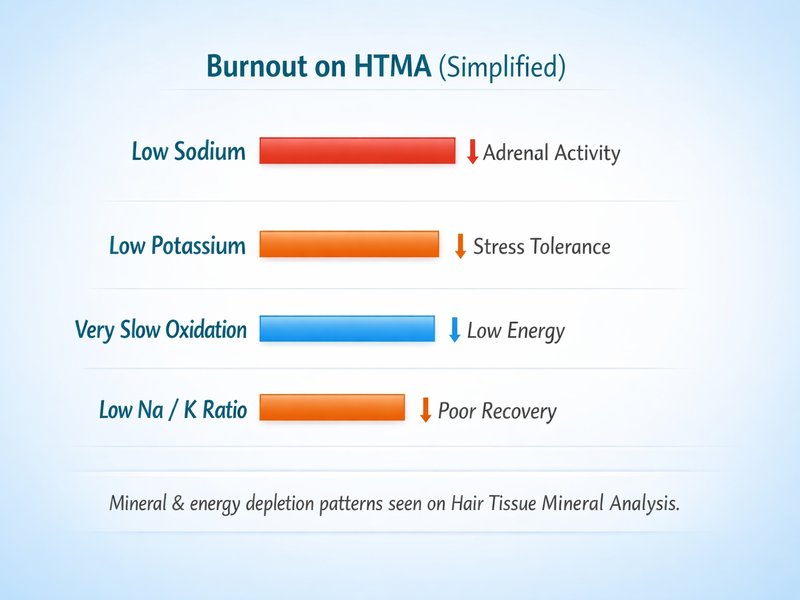
When hair is tested properly (and not washed at the laboratory), burnout is often associated with:
- Low sodium (often below ~8 mg%)
→ linked with reduced adrenal hormone activity - Low potassium (often below ~5 mg%)
→ reflects exhaustion and poor stress tolerance - Very slow oxidation rate
→ indicates the body is producing energy slowly after long-term stress (an exhaustion stage) - Low sodium/potassium ratio (often below ~2, especially below 1)
→ indicates reduced adrenal responsiveness - Four Lows or Three Lows patterns
→ severe depletion of energy-related minerals - Poor eliminator patterns
→ reduced ability to clear metabolic waste and toxins - Low phosphorus or sulfur
→ reduced energy production and detox capacity
When multiple indicators appear together, burnout is often more advanced.
Practitioners may refer to this as 2×, 3×, or higher burnout, depending on how many patterns are present.
Burnout Is Not the Same as Chronic Fatigue
Burnout and chronic fatigue overlap — but they are not identical.
- Burnout often begins with stress and compensation
- Chronic fatigue is what burnout can evolve into if unresolved
Burnout is often the earlier, more reversible phase — if addressed appropriately.
Can Burnout Be Reversed?
Yes — but not by forcing recovery.
Burnout improves when the body is:
- replenished
- stabilised
- supported — not stimulated
In nutritional balancing approaches, recovery focuses on:
- restoring mineral reserves
- calming the nervous system
- improving digestion and elimination
- gradually reducing toxic load
- rebuilding energy metabolism
This process takes time — but it addresses the root causes, not just symptoms.
The Unexpected “Gift” of Burnout
Burnout is uncomfortable, but it’s also informative.
It forces the body to stop compensating.
It exposes unsustainable patterns.
It demands a different relationship with stress, rest, and productivity.
Many people find that once burnout is addressed properly, they don’t just regain energy — they develop greater resilience and clarity than before.
Curious If Burnout Is Driving Your Symptoms?
If this article resonated, it’s likely because your body has been signalling for some time.
Hair Tissue Mineral Analysis (HTMA) can help reveal:
- burnout and exhaustion patterns
- nervous system stress chemistry
- adrenal insufficiency indicators
- mineral depletion
- hidden toxic metal stress
Most importantly, it helps clarify what your body needs right now —
not what worked years ago, and not what requires more pushing.
👉 Learn more about HTMA or explore testing options.
This content is for educational purposes only and is not intended to diagnose, treat, or cure disease.