Fast Oxidation (HTMA): When the Body Runs in Overdrive
Ever wonder why some people seem switched on all the time while others feel stuck in low gear? Hair Tissue Mineral Analysis (HTMA) helps explain this through your oxidation type and oxidation rate — how efficiently your body converts food into usable energy at the cellular level.
In Nutritional Balancing, there are four main oxidation-related patterns:
- Fast Oxidation: the metabolic engine is running hot and fast
- Slow Oxidation: the body applies the brakes to conserve energy
- Mixed Oxidation: shifting between fast and slow depending on stress and demand
- Four Lows Pattern: deep depletion, burnout, or a rebuilding phase
This page focuses specifically on fast oxidation — what it is, why it happens, how it shows up, and how it is typically supported.
All information here is educational only and is not intended for diagnosis, treatment, or medical advice.
Article Contents
- Energy: Your Body’s Electricity
- What Is Oxidation Rate, Really?
- What Fast Oxidation Means
- How Fast Oxidation Appears on an HTMA
- The Two Ratios That Define Fast Oxidation
- Degrees of Fast Oxidation
- Why Fast Oxidation Happens
- Acetates and Fats: Why Fast Oxidizers Need More Stability
- Why Diet Needs Differ by Oxidation Type
- How to Eat for Fast Oxidation
- Supplement Guidelines for Fast Oxidation
- Common Mistakes That Worsen Fast Oxidation
- Retests, Shifts, and Accuracy Notes
- The Takeaway: From Awareness to Balance
Energy: Your Body’s Electricity
Energy isn’t just about sleep, motivation, or mindset. At a biological level, it is chemical.
As Dr. Paul Eck explained, “It is the balance of the minerals within the body that controls the rate at which energy is produced and used.”
Minerals act like conductors in an electrical system. They regulate how quickly fuel is burned, how the nervous system responds to stress, how stable blood sugar feels, and how well the body recovers.
Your oxidation rate describes the pace at which this internal system runs. When the rate is too fast or too slow for too long, symptoms appear. HTMA offers a way to observe that pace through tissue mineral patterns rather than guesswork.
What Is Oxidation Rate, Really?
Oxidation rate refers to how efficiently the body converts food into energy inside the mitochondria.
It is influenced primarily by:
- adrenal gland activity
- thyroid cellular effect
- the balance between calcium, magnesium, sodium, and potassium
In Nutritional Balancing, oxidation type is categorized as fast or slow, while oxidation rate can be mild, moderate, or extreme within those types.
This page addresses fast oxidation specifically.
What Fast Oxidation Means
Fast oxidation is a metabolic pattern associated with a stronger adrenal and thyroid effect at the tissue level. The body tends to run warmer, more activated, and more responsive to stress.
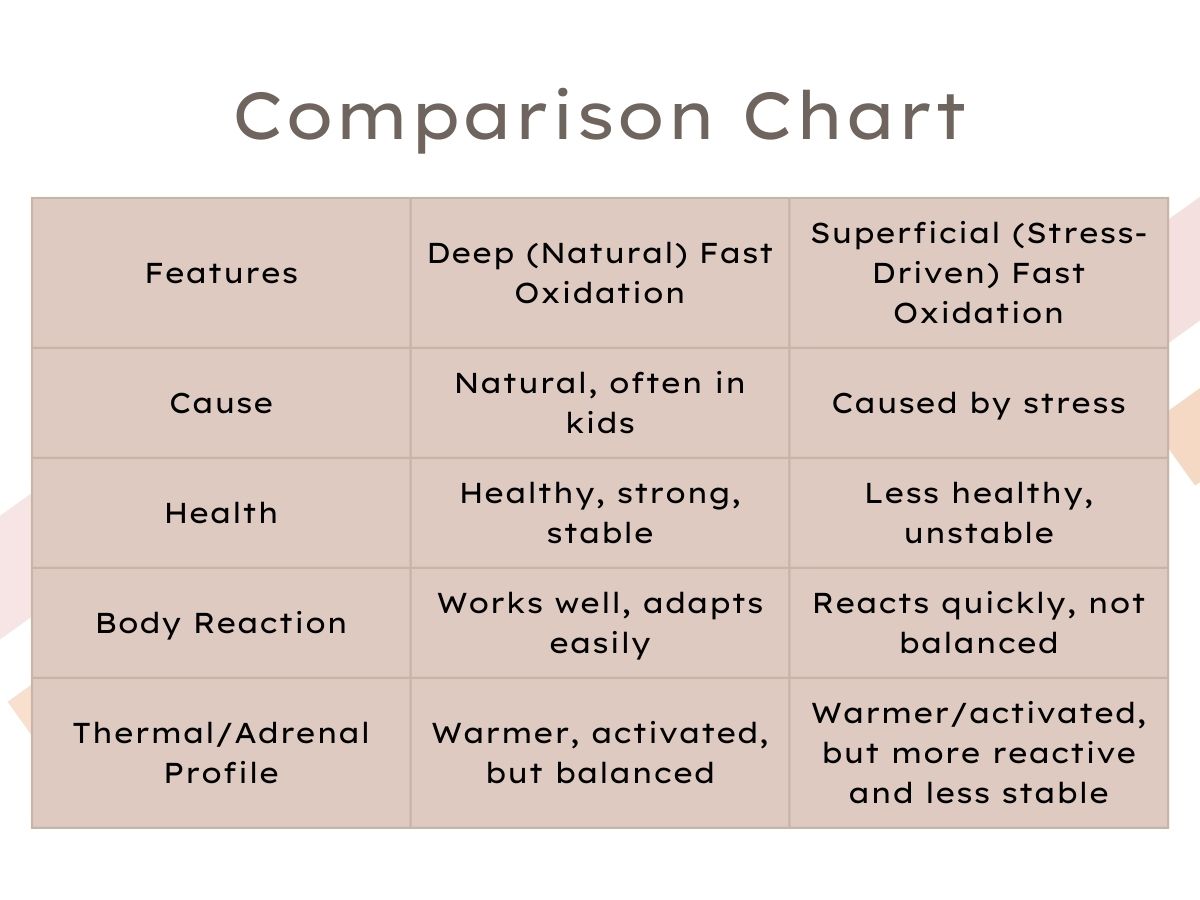
There are two broad presentations:
Deep (natural) fast oxidation
This is a healthier, more resilient state. It is common in babies and young children and rare in adults. Energy production is high but relatively well regulated.
Superficial (stress-driven) fast oxidation
This is far more common in adults. The body appears fast on an HTMA, but the speed is maintained by stressors rather than deep vitality. Energy output may be high, but stability is often poor.
This distinction matters. Fast oxidation does not automatically mean good energy or good health.
How Fast Oxidation Appears on an HTMA
Fast oxidation is usually identified when both of the following are present:
- Calcium / Potassium (Ca/K) ratio below 4
- Sodium / Magnesium (Na/Mg) ratio above 4.17
These two ratios work together to show how quickly the body is being driven and how much control exists over that speed.
On many charts, fast oxidation visually appears as:
- lower calcium and magnesium
- higher sodium and potassium
However, visual appearance alone is not always reliable. In some cases, ratios must be calculated to determine oxidation type accurately.
The Two Ratios That Define Fast Oxidation
Fast oxidation is defined by the interaction between adrenal drive and thyroid cellular effect. These are reflected by two key ratios.
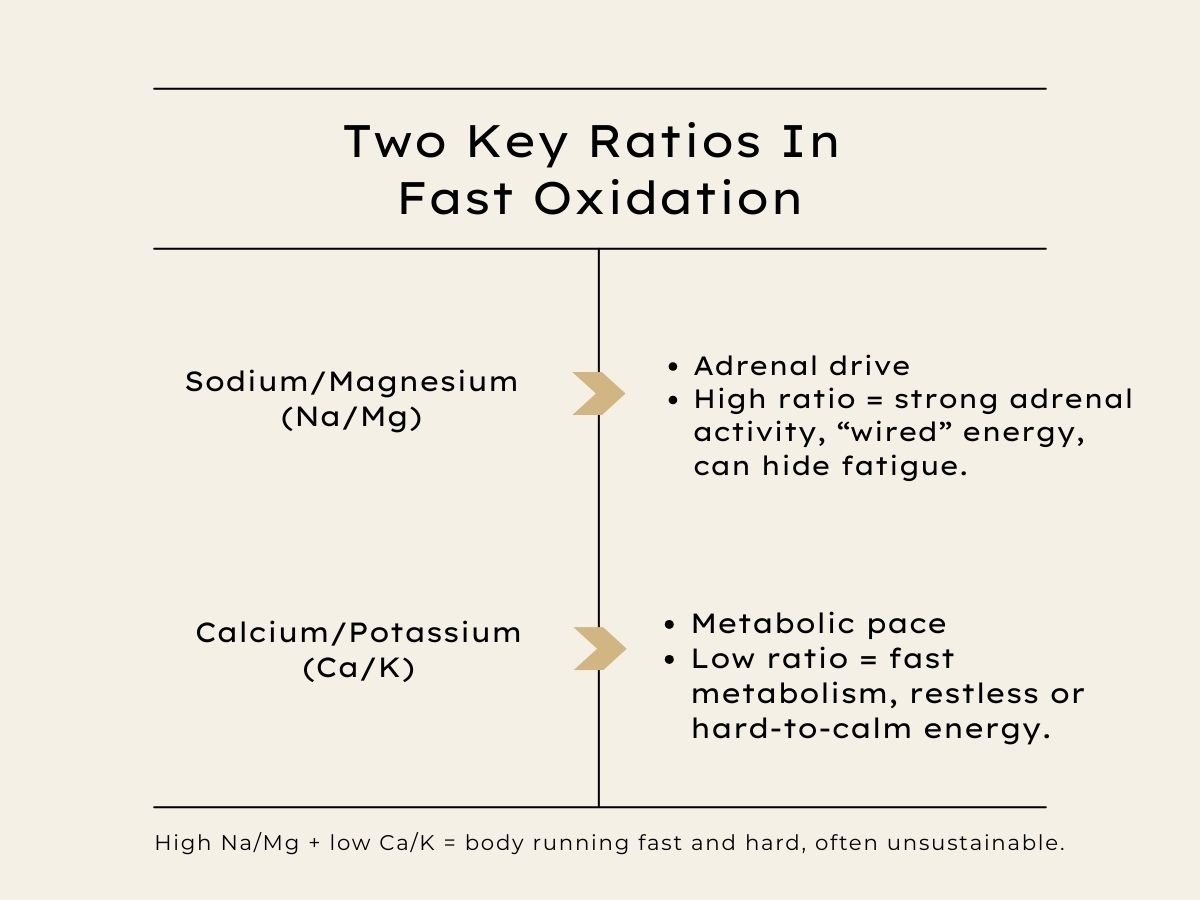
Sodium / Magnesium (Na/Mg): Adrenal Drive
The sodium–magnesium ratio reflects adrenal activity and energy output at the tissue level.
- Higher Na/Mg suggests stronger adrenal stimulation and a body running in high gear
- Energy may feel sharp, urgent, or reactive
- When prolonged, this often masks underlying fatigue
In stress-driven fast oxidation, this ratio explains why the body can feel “wired” even when reserves are low.
Calcium / Potassium (Ca/K): Metabolic Pace
The calcium–potassium ratio reflects thyroid cellular effect and metabolic speed.
- Lower Ca/K indicates a faster metabolic pace
- Energy burns quickly and can be difficult to slow down
- Restlessness, nervous energy, or difficulty relaxing are common experiences
Together, a high Na/Mg and low Ca/K describe a system that is being driven hard and fast — often beyond what is sustainable long-term.
Degrees of Fast Oxidation
Fast oxidation can be further described by degree using the Ca/K ratio:
- Mild fast oxidation: Ca/K above 1.5 (but still below 4)
- Moderate fast oxidation: Ca/K between 0.4 and 1.5
- Extreme fast oxidation: Ca/K below 0.4
Degree matters. Mild fast oxidation may feel manageable, while extreme fast oxidation often brings volatility, tension, and rapid depletion.
Why Fast Oxidation Happens
Fast oxidation can arise from different causes.
More resilient presentations
- infancy and early childhood
- rare cases of adults with genuinely restored higher energy systems
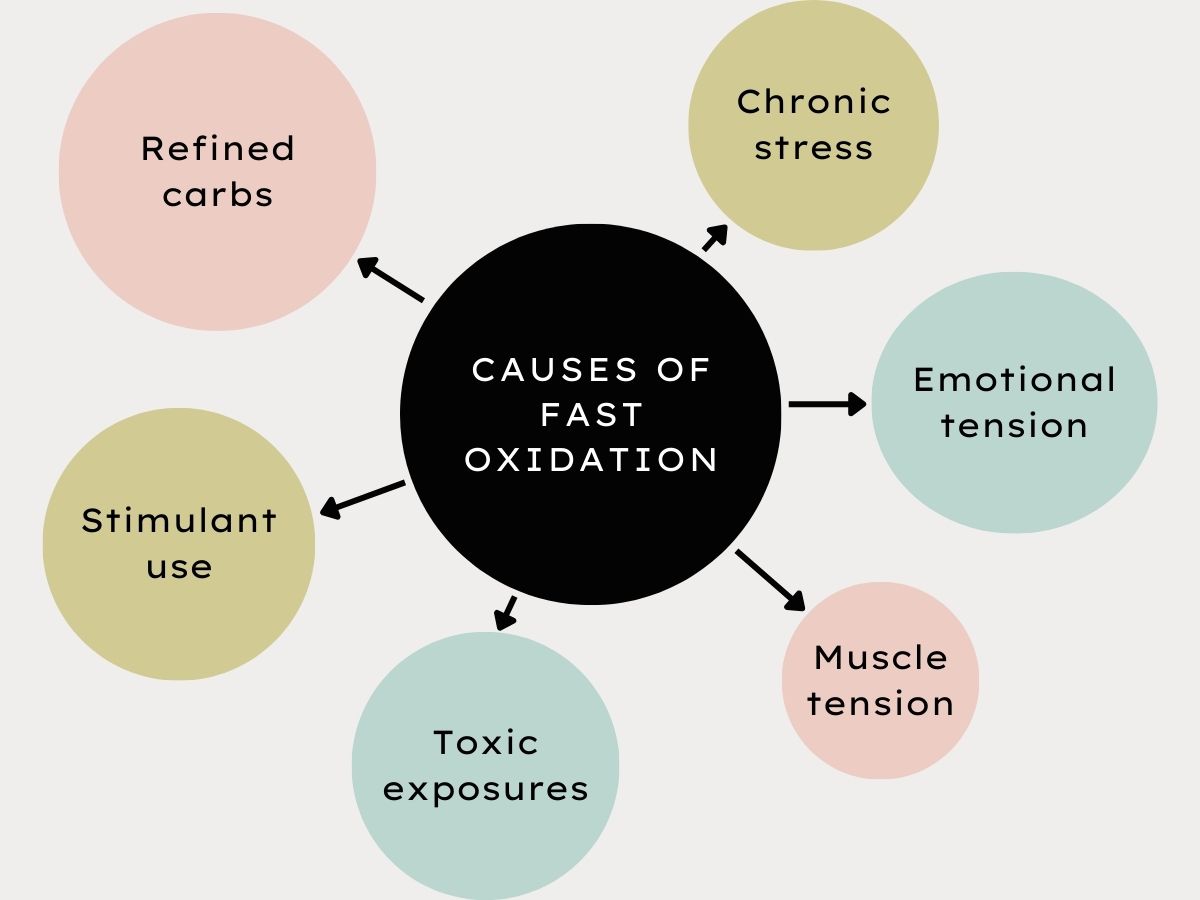
Stress-driven fast oxidation (most common in adults)
Common contributors include:
- diets high in sugar or refined carbohydrates and low in stabilizing fats
- stimulant use (caffeine, energy drinks)
- chronic stress, poor sleep, or overwork
- emotional pressure, fear, anger, or constant urgency
- toxic exposures that irritate adrenal or thyroid function
- structural stress, such as chronic neck or back tension
When the underlying stressor is removed, fast oxidation may quickly shift toward slow oxidation. This sudden shift is sometimes described as a “crash landing” and usually requires dietary and lifestyle adjustment rather than stimulation.
Acetates and Fats: Why Fast Oxidizers Need More Stability
One of the most important nutritional considerations for fast oxidation is the body’s higher demand for acetates.
Acetates are building blocks the body uses to:
- support steady energy production through the Krebs cycle (via acetyl-CoA)
- assist with biosynthesis, including hormones and enzymes
- support calming nervous-system activity through acetylcholine
Fast oxidizers tend to rely more heavily on energy pathways that require acetates. While the body can produce some internally, this production is often insufficient when metabolism is running fast.
This helps explain why many fast oxidizers:
- feel worse on low-fat diets
- feel more anxious, irritable, or unstable when meals lack fat
- experience energy spikes followed by crashes
Dietary fats provide a steady, food-based source of acetates. When enough fat is present, energy production becomes more efficient and less reactive, and the nervous system is easier to regulate.
In short: fats help slow and stabilize a fast metabolism, not by suppressing energy, but by making it more sustainable.
Why Diet Needs Differ by Oxidation Type
All food feeds into cellular energy production through the Krebs cycle, but it enters through different pathways.
- carbohydrates and protein supply pyruvate
- fats supply acetyl-CoA
Fast oxidizers tend to generate energy quickly. Without enough fat-derived acetates, energy becomes volatile rather than steady.
The goal is not to increase energy output, but to smooth and stabilize it.
How to Eat for Fast Oxidation
The guiding principle is stabilization.
Emphasize
- healthy fats at each meal (butter, ghee, eggs, olive oil, fatty meats, sardines)
- regular meals without long gaps
- cooked vegetables daily to rebuild mineral reserves
- moderate protein intake
Limit
- refined carbohydrates, sweets, fruit juices
- high-sugar or “low-fat” eating patterns
- relying on caffeine instead of food
A simple fast-oxidizer plate often looks like:
- protein + cooked vegetables + generous healthy fat
- optional small amount of starch if needed for stability

Supplement Guidelines for Fast Oxidation
Supplement support should be individualized and adjusted with retesting.
General themes often include:
- minerals that calm and stabilize the nervous system
- targeted trace mineral support based on ratios
- digestive support if absorption is weak
- omega-3 fats and vitamin D when appropriate
Equally important is avoidance of overstimulation. Many fast oxidizers react poorly to stimulating supplements, high-dose “energy” formulas, or glandular products.
Common Mistakes That Worsen Fast Oxidation
- trying to push energy higher instead of stabilizing it
- using stimulants to compensate for skipped meals or poor sleep
- extreme dietary swings
- overtraining without recovery
- assuming “fast” automatically means healthy
Retests, Shifts, and Accuracy Notes
Oxidation rate is not fixed.
- Retests can temporarily show faster or slower patterns during mineral shifts or detoxification.
- Hair preparation matters. Washing hair at the lab or showering with a water softener can distort sodium and potassium readings.
- Blood tests and symptom questionnaires are not reliable ways to determine oxidation rate. HTMA reflects tissue patterns, not short-term fluctuations.
The Takeaway: From Awareness to Balance
Fast oxidation does not mean your body is broken. It means your system is running at a higher pace — sometimes from vitality, more often from pressure.
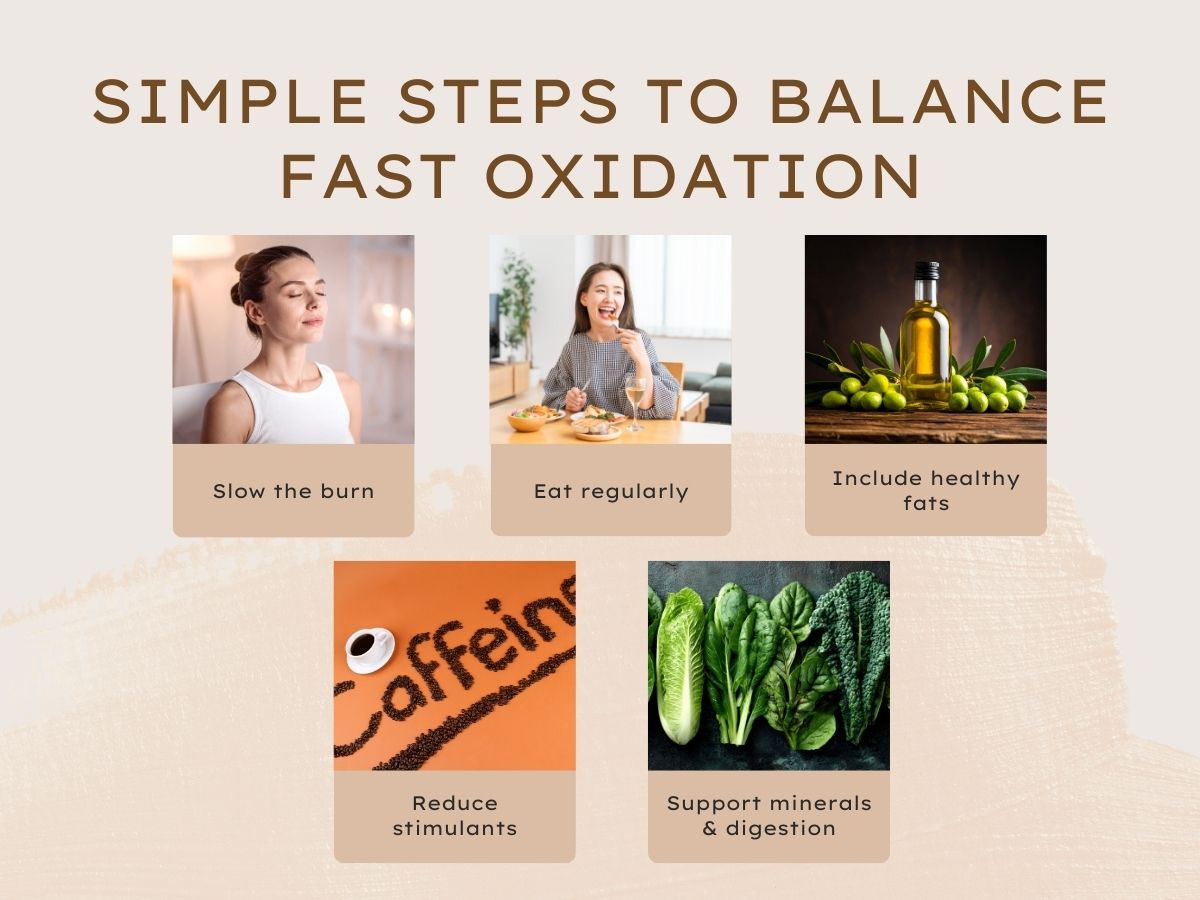
Balancing fast oxidation usually involves:
- slowing the burn rather than adding fuel
- prioritizing calm, regular nourishment
- restoring stability through adequate dietary fat
- reducing stimulation
- supporting minerals and digestion with precision
When energy becomes more efficient and less reactive, the body can shift from coping to repairing.