
When rest doesn't restore energy
Chronic Fatigue & Burnout
If you’re living with chronic fatigue, burnout, or long-term exhaustion that doesn’t improve with rest, you’re not alone — and you’re not broken.
Many people in this state are told they need better sleep, more motivation, or less stress. Others are reassured that their blood tests look “normal.” Yet their energy continues to decline, recovery feels impossible, and even gentle efforts can leave them wiped out.
Chronic fatigue and burnout are often better understood as states of depletion, where the body no longer has the internal resources it needs to adapt, repair, and restore energy. This page explains how that happens, why symptoms persist, and how Hair Tissue Mineral Analysis (HTMA) helps make sense of what’s going on beneath the surface.
Burnout and chronic fatigue — what’s the difference?
These terms are often used interchangeably, but they describe different parts of the same process.
Burnout refers to the long-term depletion that builds up when stress — physical, emotional, or metabolic — exceeds the body’s ability to recover.
Chronic fatigue describes how that depletion feels day to day: persistent exhaustion, poor resilience, and a reduced ability to cope.
In simple terms:
Burnout is the process.
Chronic fatigue is the signal.
Understanding this distinction helps explain why symptoms linger, and why common approaches often fall short.
Start here — explore what resonates most
Burnout Isn’t a Motivation Problem
For those who feel depleted, overwhelmed, or unable to bounce back from stress.
Read → Burnout: When Rest Doesn’t Fix the Exhaustion
Why Chronic Fatigue Doesn’t Improve With Rest
For exhaustion that persists despite sleeping more or slowing down.
Read → Chronic Fatigue: When Exhaustion Becomes Your Baseline (And Why “Normal Tests” Don’t Help)
Why Detox Makes Some Exhausted People Feel Worse
For those who react poorly to cleanses, supplements, or detox protocols.
Read → Why Detox Makes Some Exhausted People Feel Worse
Common signs of chronic fatigue and burnout
Chronic fatigue and burnout rarely appear overnight. More often, they develop quietly as stress accumulates over time.
You may recognise yourself in some of the following:
- Ongoing exhaustion, even after adequate sleep
- Feeling tired but wired, or unable to fully relax
- Brain fog, low motivation, or reduced mental clarity
- Crashes after exercise, caffeine, or busy days
- Increased anxiety, overwhelm, or emotional sensitivity
- Feeling worse with detox protocols or supplements
- Difficulty recovering from illness, stress, or travel
It’s very common for standard blood tests to appear “normal” despite these ongoing symptoms.
Why rest alone often isn’t enough
One of the most frustrating aspects of chronic fatigue is that rest doesn’t always lead to recovery.
That’s because energy isn’t just about sleep or willpower. It’s about biochemical capacity.
Over time, chronic stress affects mineral reserves, blood sugar regulation, adrenal signalling, and nervous system balance. When these systems are depleted, the body may remain stuck in a survival state — conserving energy rather than producing it.
This is why pushing harder, exercising more, or relying on stimulants often worsens fatigue instead of resolving it.
Why blood tests and general supplements often miss the problem
Many people with chronic fatigue are told their blood work looks fine, or they’re advised to take broad supplements “just in case.”
Blood tests are useful for identifying acute deficiencies or disease, but they don’t always reflect long-term tissue-level depletion. The body can keep blood levels stable by pulling minerals from deeper reserves, even when those reserves are running low.
Similarly, general supplements may not be well tolerated when the body is depleted. Without understanding which minerals are low, blocked, or imbalanced, supplementation can feel ineffective — or even make symptoms worse.
This is where a more targeted, pattern-based approach becomes important.
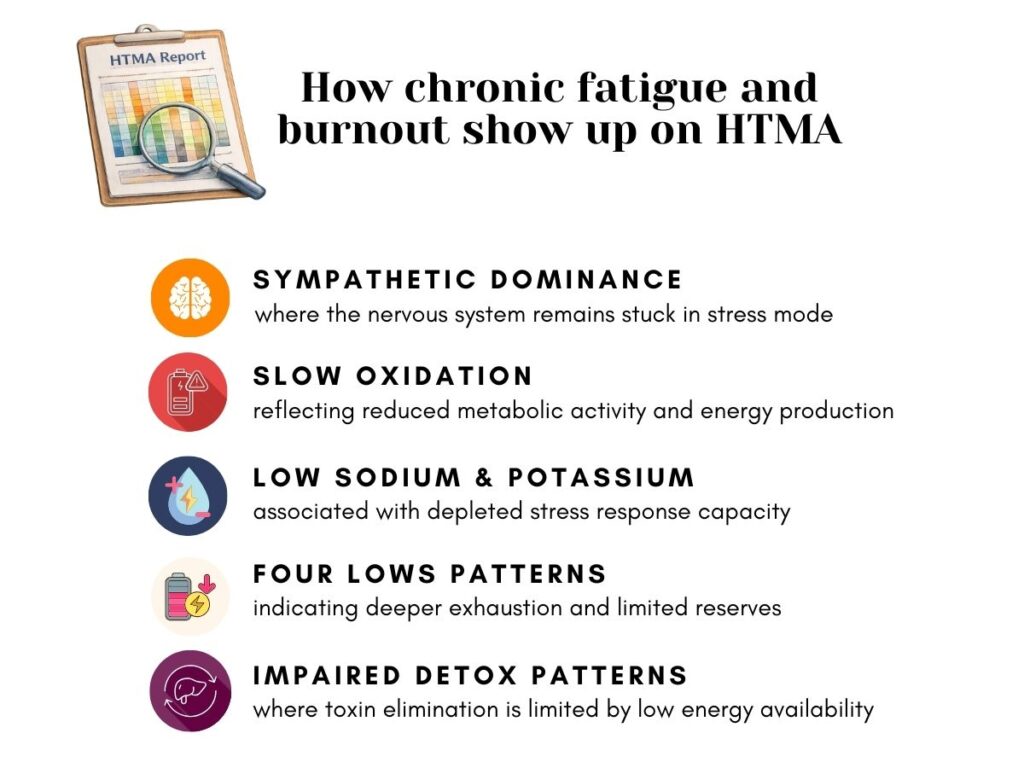
How chronic fatigue and burnout show up on HTMA
Hair Tissue Mineral Analysis (HTMA) looks at long-term mineral trends at the tissue level, offering insight into how the body has been responding to stress over time.
In people experiencing chronic fatigue and burnout, HTMA commonly reveals patterns such as:
- Sympathetic dominance, where the nervous system remains stuck in stress mode
- Slow oxidation, reflecting reduced metabolic activity and energy production
- Low sodium and potassium, associated with depleted stress response capacity
- Four Lows patterns, indicating deeper exhaustion and limited reserves
- Impaired detox patterns, where toxin elimination is limited by low energy availability
These patterns help explain why symptoms persist — and why the body may struggle with aggressive protocols.
Why detox often makes fatigue worse
Many people with chronic fatigue have already tried detoxes, cleanses, or “healing” protocols — only to feel worse.
This isn’t a failure. It’s information.
When energy production is low, the body may not have the capacity to safely mobilise and eliminate stored toxins. Supporting detox before rebuilding energy can increase symptoms such as fatigue, anxiety, brain fog, or insomnia.
In these cases, stabilisation usually needs to come before detoxification.
What recovery from burnout actually requires
Healing from chronic fatigue and burnout is rarely about doing more.
It’s about rebuilding — gradually and intentionally.
This often involves:
- Replenishing depleted minerals using a targeted, individualised approach
- Supporting steady blood sugar and nervous system signals, rather than stimulating them
- Using targeted supplementation based on mineral patterns, instead of broad or random products
- Reducing over-stimulation, including “healthy” stressors that the body can’t yet tolerate
- Allowing recovery at a pace the body can handle, without forcing progress
HTMA helps guide this process by showing where depletion exists, which systems need support first, and what the body can realistically manage at each stage of recovery.
Explore this topic in more depth
Burnout Isn’t a Motivation Problem
Read → Burnout: When Rest Doesn’t Fix the Exhaustion
Why Chronic Fatigue Doesn’t Improve With Rest
Read → Chronic Fatigue: When Exhaustion Becomes Your Baseline (And Why “Normal Tests” Don’t Help)
When Fatigue Is a Nervous System Issue
Read → Sympathetic Dominance: When You’re Stuck in Fight-or-Flight and Running on Empty
Why Detox Makes Some Exhausted People Feel Worse
Read → coming soon
Where to go next
If this page resonates, you may find it helpful to:
Learn how HTMA works and what it reveals
There’s no need to rush. Understanding comes first.
In practice, most people experiencing long-term fatigue aren’t lacking motivation or resilience. They’re depleted at a biochemical level. When the body is supported correctly — and given time — energy often returns gradually and sustainably.