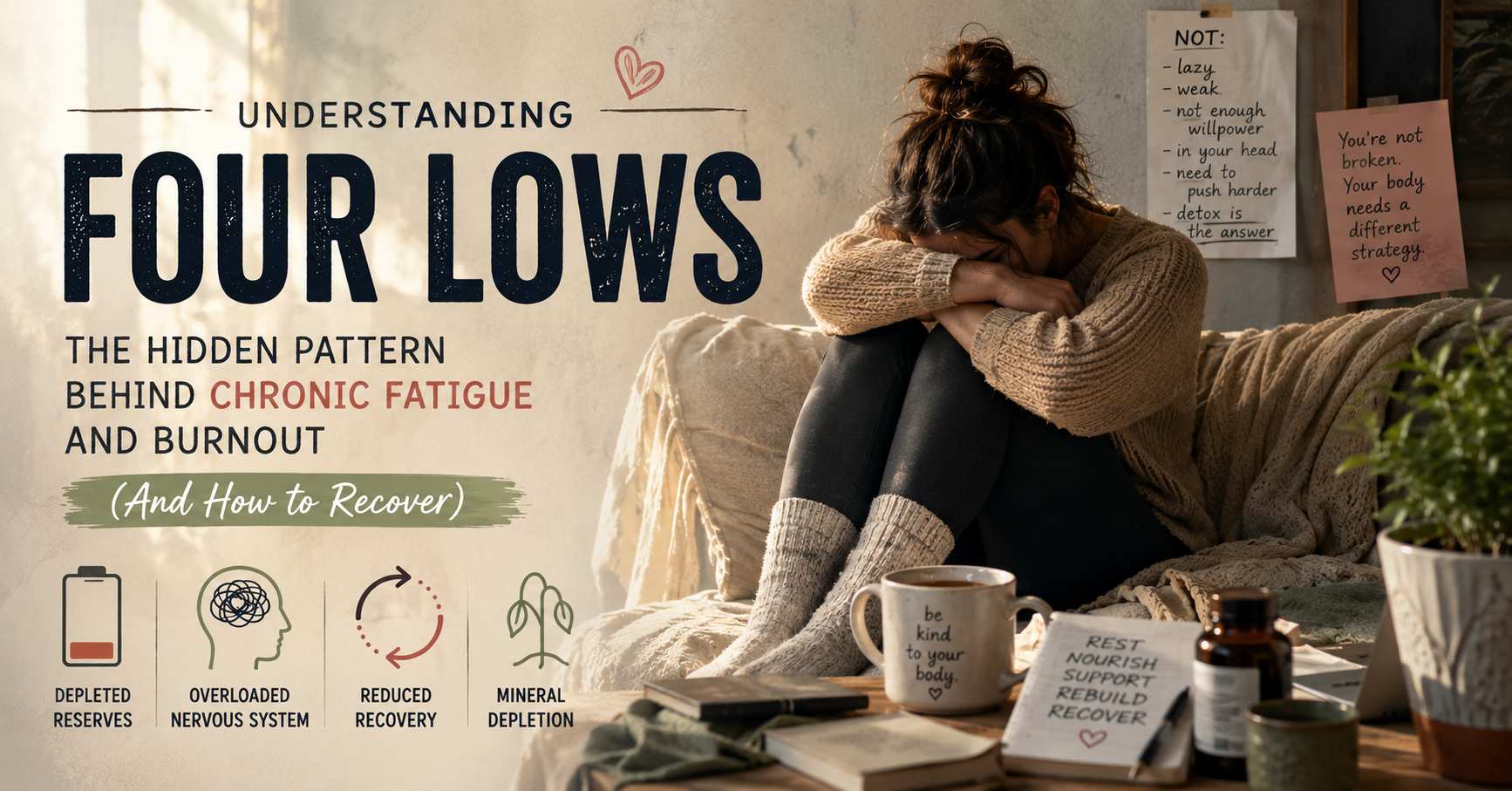
Written by Koay Yih Zi
Are You Stuck in Four Lows? The Hidden Mineral Pattern Behind Burnout, Fatigue & “I’m Not Crazy” Moments
You’ve done all the right things.
Thyroid test? “Normal.”
Bloodwork? “You’re fine.”
But you still feel like a melted version of yourself — anxious, exhausted, moody, craving sugar like it’s your job.
If that sounds familiar, I want you to meet one of the most misunderstood (and most important) patterns in hair tissue mineral analysis:
The Four Lows Pattern.
On This Page
What Is the Four Lows Pattern?
Why Blood Tests Can Look Normal
Symptoms of Four Lows
Why You Feel “Tired But Wired”
What Causes Four Lows?
What’s Happening Physiologically?
Practitioner Insight
Why Standard Health Advice Sometimes Backfires
How to Support Recovery from Four Lows
Who This Pattern Affects Most
What Four Lows Does Not Mean
Why HTMA Matters
Frequently Asked Questions
Quick Answer: What Is the Four Lows Pattern?
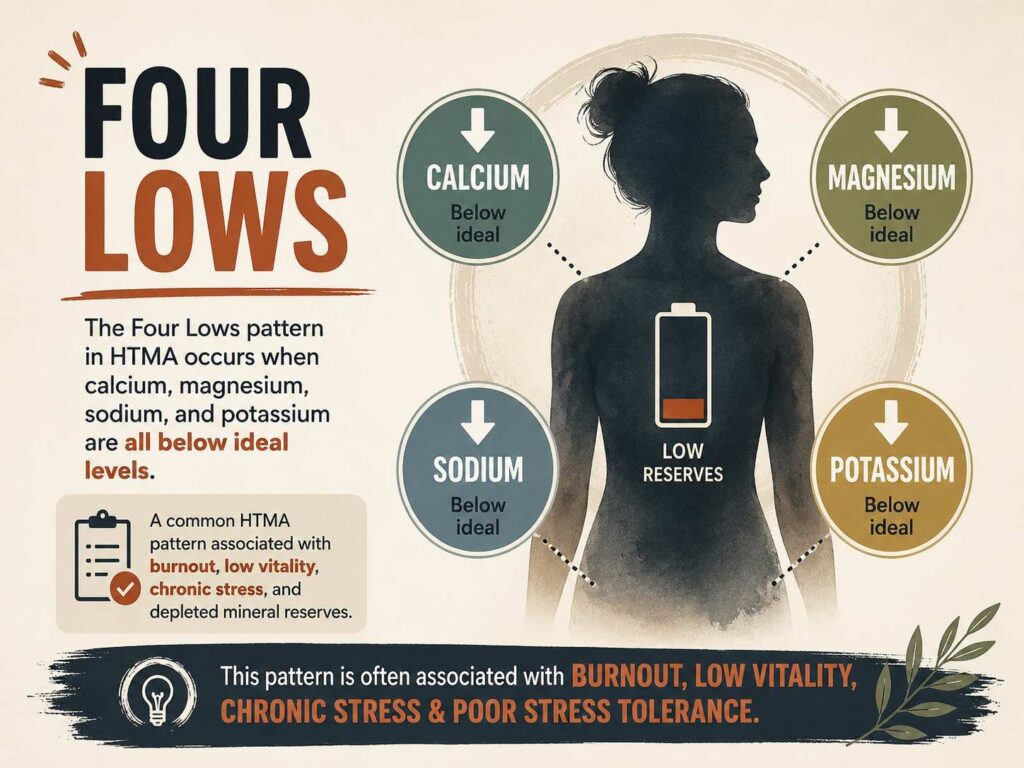
The Four Lows pattern in Hair Tissue Mineral Analysis (HTMA) occurs when calcium, magnesium, sodium, and potassium are all below ideal levels on a properly interpreted hair test.
According to nutritional balancing practitioners, this pattern is often associated with burnout, low vitality, chronic stress, poor stress tolerance, and depleted mineral reserves.
People in this pattern often describe feeling exhausted, anxious, overwhelmed, “tired but wired,” emotionally depleted, or unable to recover — even when standard lab work appears normal.
What Is the Four Lows Pattern?
In a nutshell: It’s when your body’s four major energy minerals — calcium, magnesium, sodium, and potassium — are all below optimal on a properly interpreted HTMA test.
And I don’t mean just mildly depleted. In many cases, these minerals appear significantly below optimal — suggesting the body may be struggling to maintain resilience and recovery.
This isn’t just a random coincidence. In HTMA, this pattern is often associated with deep depletion, chronic stress, reduced adaptability, and a body that may be struggling to recover from long-term overload.
Why Blood Tests Can Look Normal
Think of your blood like Instagram Stories: it only shows what’s happening right now.
Hair tissue, on the other hand, is more like your body’s private journal — it records what’s been going on for the last 3 months. That’s why bloodwork often misses long-term stress and burnout patterns like this.
In Four Lows, your body is so depleted that it’s not just running on empty… it’s practically turned off the engine and climbed into the back seat.
Blood tests are also tightly regulated because the body prioritises keeping blood chemistry stable for survival. That means tissue-level depletion and long-term stress patterns may not always appear clearly on standard labs — even when someone feels exhausted, overwhelmed, or chronically unwell. This is one reason HTMA and blood tests measure different things and can both have a place in understanding your health picture.
Symptoms of Four Lows
You might be in Four Lows if you’re experiencing:
- Fatigue that sleep doesn’t fix
- Brain fog, poor focus, or forgetfulness
- Anxiety, irritability, or “on edge” vibes
- Intense sugar cravings or emotional eating
- Muscle cramps, tightness, or twitching
- Poor digestion or food intolerances
- That weird “exhausted but wired” feeling
And if you’ve been to a million doctors, tried every supplement, and still feel off? Yup, Four Lows might be hiding underneath it all.
Why You Feel “Tired But Wired”
One of the most common things people with Four Lows describe is feeling exhausted physically… but unable to truly relax mentally.
You might feel:
– tired but restless
– drained but anxious
– exhausted but unable to sleep deeply
– calm on the outside but internally overstimulated
In HTMA, this pattern may reflect a combination of depletion and nervous system overload. The body has low reserves — yet may still be stuck in a chronic stress response after years of pushing, overworking, worrying, overstimulation, or relying on stress hormones to keep going.
This is one reason many people in Four Lows feel worse when they try to “push through” fatigue. You can read more in our article on why you feel tired but wired and what your minerals reveal.
If you’re constantly tired, overwhelmed, anxious, or running on empty despite normal lab work, our free guide explains why fatigue often persists and what you can do to support recovery.
What Causes Four Lows?
According to Dr. Paul Eck and Dr. Lawrence Wilson (HTMA pioneers), Four Lows is a deep stress pattern. It can be triggered by:
- Long-term emotional stress or trauma
- Perfectionism or being hard on yourself
- Overworking or chronic overachieving
- Years of poor diet or extreme restriction
- Burnout from stimulants, coffee, or supplements
- Copper toxicity (often hidden)
- And yes — just plain exhaustion
What’s Happening Physiologically?
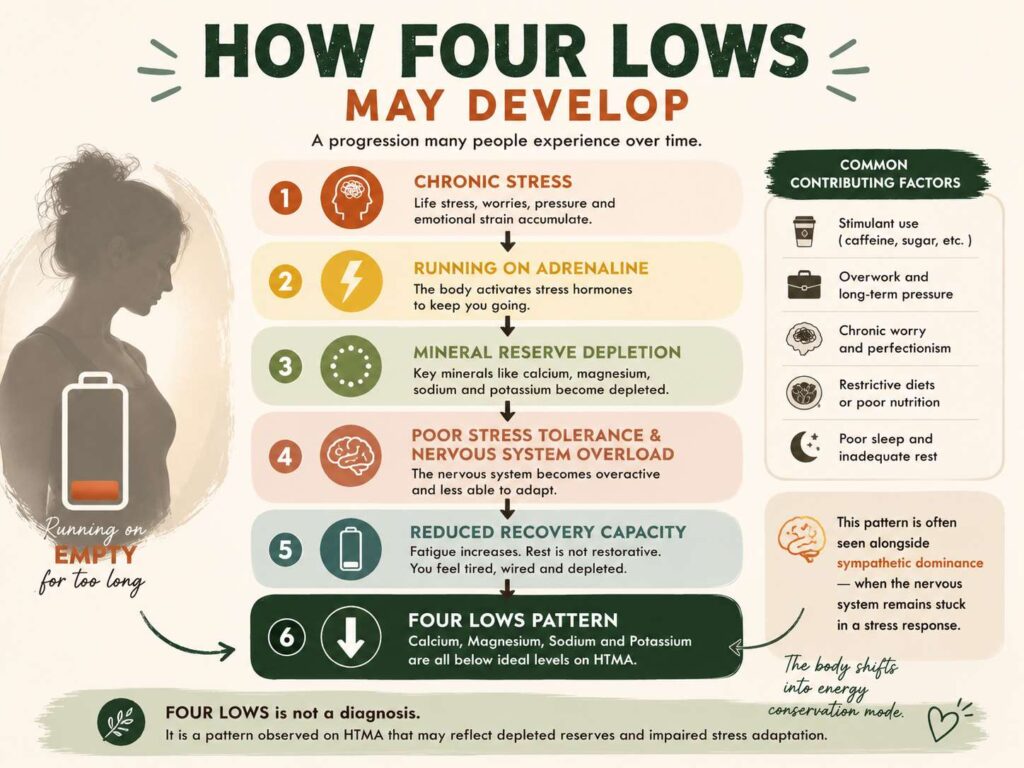
While Four Lows is not a medical diagnosis, nutritional balancing practitioners often view it as a state of reduced mineral reserves and impaired stress adaptation.
Over time, chronic stress may contribute to:
- depletion of sodium and potassium reserves
- poor stress tolerance
- nervous system overload
- impaired digestion and absorption
- increased sensitivity to stressors
- reduced recovery capacity
Many people in this pattern have spent years running on adrenaline, stimulants, overwork, perfectionism, chronic worry, restrictive diets, or simply “pushing through” exhaustion.
Eventually, the body may shift into a more protective, energy-conserving state. This is also reflected in patterns like sympathetic dominance
— a related HTMA pattern where the nervous system remains stuck in a stress response.
Practitioner Insight
One thing I often notice in clients with Four Lows is that they’ve usually been ignoring exhaustion signals for a very long time.
Many are high-functioning, driven, perfectionistic, or used to pushing through fatigue with caffeine, stress, supplements, or sheer willpower.
From the outside, they may seem productive and capable. Internally, though, their body often feels like it’s running on fumes.
It’s Like Your Body Hit the Brakes… Hard
Here’s how Dr. Wilson describes it:
“It’s like a car stuck in the mud, wheels spinning, engine racing — but getting nowhere.”
Your adrenals are worn out. Your thyroid isn’t responding. But instead of revving harder, your body has pulled the emergency brake. It’s trying to protect you from running yourself into the ground.
And unless you read the signs and pivot, you’ll stay stuck.
Why Standard Health Advice Sometimes Backfires
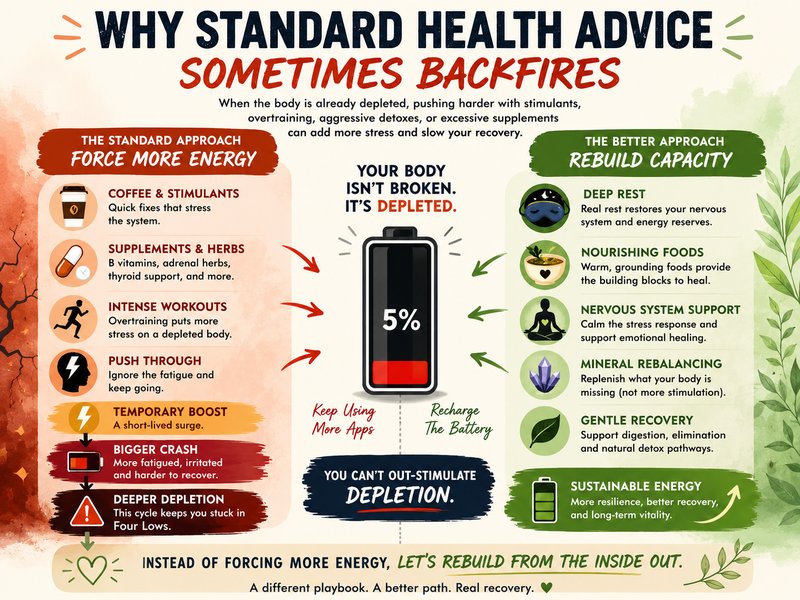
Most protocols aim to boost energy — think B vitamins, adrenal herbs, thyroid support, coffee (guilty), and intense workouts.
But in some individuals with Four Lows, aggressive stimulation may temporarily worsen symptoms or slow recovery.
When the body is already depleted, constantly trying to force more energy production through stimulants, overtraining, aggressive detoxes, or excessive supplementation may place even more stress on the system.
Instead, we need a different playbook — one that helps you rebuild from the inside out.
How to Support Recovery from Four Lows
With a properly individualised HTMA-based program, many people gradually improve this pattern over time and begin rebuilding energy, resilience, and recovery capacity. Here’s what that often includes:
- Specific supplements like calcium, magnesium, zinc, taurine, and TMG
- A calm, nourishing diet (think warm, grounding foods — no juice cleanses here)
- Deep rest. Like, real rest.
- Gentle support for drainage, digestion, and elimination
- Emotional healing (especially if perfectionism, fear, or past trauma are in the mix)
- NO adrenal/thyroid stimulants — they just keep the wheels spinning
- Reducing reliance on stimulants and “pushing through” fatigue
Who This Pattern Affects Most
- Women in their 30s–50s juggling everything
- Men who’ve burned the candle at both ends
- People who’ve been told “your labs are fine” but feel like garbage
- Overachievers with a secret (or not-so-secret) anxiety streak
- Sensitive types who “crash” easily
You don’t need to fit all those categories. But if the vibe is hitting? It’s worth testing for Four Lows.
What Four Lows Does Not Mean
Four Lows is not a medical diagnosis, and it does not mean your body is permanently damaged or incapable of healing.
It also doesn’t mean:
- you’re lazy
- your symptoms are “all in your head”
- you just need more willpower
- you should push harder
- aggressive detox is the answer
In many cases, the body may simply need a different strategy: rebuilding instead of forcing, supporting instead of stimulating, and slowing down enough for recovery to actually occur.
Why HTMA Matters
Hair Tissue Mineral Analysis is one of the few tools that can reveal this mineral pattern and provide insight into longer-term stress and mineral trends that may not appear clearly on standard bloodwork. It can also help identify related patterns — including other HTMA mineral patterns, oxidation rates, and calcium/magnesium balance — that give a more complete picture of how the body is coping with stress.
But HTMA gives you the full picture — not just what’s happening now, but what’s been building over time.
Final Thought
If you’ve spent years feeling exhausted, overwhelmed, sensitive, depleted, or dismissed by “normal” lab work, you are not imagining what you’re experiencing.
In HTMA, Four Lows is often associated with deep burnout, low resilience, chronic stress, and reduced recovery capacity — especially in people who have been pushing hard for a very long time.
The goal isn’t to chase symptoms endlessly.
The goal is to understand what your body may have been trying to communicate all along.
Hair Tissue Mineral Analysis can help uncover deeper mineral patterns and provide a more individualised roadmap for recovery.
If this article resonated with you, download our free guide to learn the most common hidden reasons behind persistent fatigue, burnout, brain fog, and low resilience.
Looking for personalised insight into your own mineral patterns?
Learn more about HTMA testing here.
Frequently Asked Questions